
| TL;DR |
|
Running a law firm means balancing client work with intake, scheduling, document management, billing, follow-up, and dozens of administrative tasks that keep cases moving.
That workload measurably affects attorney capacity. According to Clio’s latest lawyer statistics, lawyers bill an average of just 2.6 hours, or 33%, of an eight-hour workday. Administrative demands and other law firm inefficiencies can consume time that might otherwise go toward billable client work.
Hiring locally is one way to add capacity, but it is no longer the only one. Virtual legal assistant companies give firms access to remote professionals who can take recurring administrative and legal-support work off attorneys’ plates without requiring another desk in the office.
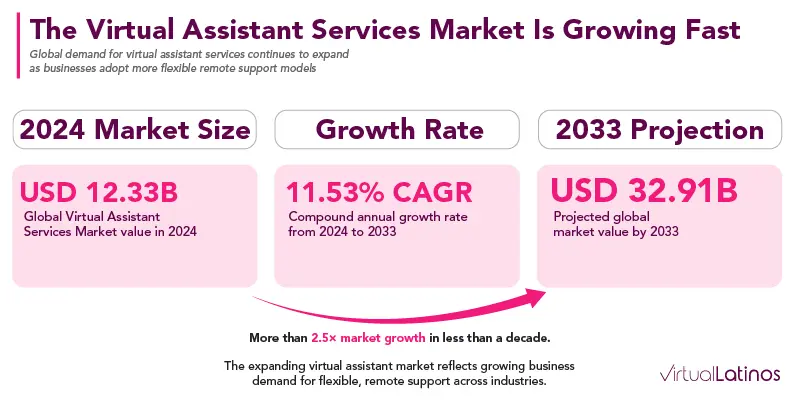
And the market behind that shift keeps growing. The global Virtual Assistant Services Market was valued at approximately USD 12.33 billion in 2024 and is projected to reach USD 32.91 billion by 2033, representing an 11.53% compound annual growth rate (CAGR).
For law firms, that growth means more providers, staffing models, and levels of specialization to choose from. The challenge is no longer simply finding remote support. It is determining which company offers the right combination of legal experience, bilingual capabilities, time-zone alignment, screening, management, and long-term support for your firm.
Let’s compare five virtual legal assistant companies U.S. law firms can consider: Virtual Latinos, LegalSoft, Wishup, Virtual Staffing, and Zirtual.
How to Choose the Right Virtual Legal Assistant Services Provider?
Identify Your Needs
Determine the specific tasks you need help with. Consider appointment setting, case management, and client service. Knowing your needs will help you find a company that offers tailored solutions.
Check for Legal Expertise
Make sure the company matches the role’s responsibilities with appropriate legal experience. Virtual paralegals and legal assistants should understand the terminology, procedures, deadlines, and workflows relevant to the work they will handle.
That distinction matters especially for solo practices, where operational mistakes can become professional-risk issues; malpractice exposure is a particular concern for solo attorneys. The more substantive or deadline-sensitive the work, the more important relevant experience, documented processes, and attorney supervision become.
Evaluate Communication Skills
Assess the communication skills of the virtual assistants. Regular communication is vital for maintaining a professional relationship and ensuring tasks are completed correctly. Opt for companies that facilitate seamless client communication through video calls and other channels.
Consider Cost Savings
Compare the cost of hiring a virtual assistant with that of an in-house employee. Virtual assistants can reduce overhead costs. Look for companies that offer cost-effective solutions without compromising on quality.
Review Flexibility and Availability
Choose a company that offers flexible and available virtual assistants. They should be able to work during your business hours, enhancing efficiency and allowing you to delegate tasks effectively.
Look for Cultural and Time Zone Compatibility
For US law firms, hiring virtual legal assistants from Latin America can be beneficial. Companies like Virtual Latinos offer assistants who are culturally compatible and work in similar time zones, ensuring seamless integration and regular communication.
Check for Tailored Solutions
Find a company that offers tailored solutions to meet your specific needs. Whether you need help with personal injury cases, client satisfaction, or streamlining operations, the right company should provide services that match your requirements.
Evaluate Professional Relationship
Establish a professional relationship through a thorough hiring process. Conduct interviews to assess the skills and fit of the virtual assistants. This step is crucial for a successful working relationship and ensuring a successful partnership.
Consider Independent Contractors
Hiring independent contractors as virtual assistants can provide flexibility and reduce legal liabilities. Ensure the company clearly outlines the terms of engagement and the remote professional’s responsibilities.
Assess Case Management Skills
Ensure the virtual assistants have strong case management skills. They should handle legal research, document preparation, and client interactions efficiently, helping you save time and improve efficiency.
Consider How AI and Human Support Work Together
Law firms increasingly use AI alongside remote legal support, so the question isn’t whether a provider uses technology, but how it divides work among automation, human support, and attorney oversight. AI can accelerate repetitive, lower-risk workflows, while people remain essential when work requires review, context, communication, or professional judgment.
For firms comparing virtual legal assistant companies, human-in-the-loop support should therefore be part of the evaluation. Look for a provider whose professionals can work alongside your legal technology, review and coordinate AI-assisted workflows, handle exceptions, and escalate work that requires attorney judgment.
The goal is not to choose between AI and people, but to build a support model where each handles the work it is best suited for.
Look for a Leading Provider
Choose a company with a proven track record in the legal field. A leading provider will have positive reviews and testimonials, indicating their ability to provide high-quality virtual paralegal services.
Consider Client Service Excellence
The perfect virtual assistant company should prioritize client service. They should focus on enhancing client satisfaction through efficient task management and regular updates. This ensures your clients receive the best possible service.

Top 5 Virtual Legal Assistant Companies for U.S. Law Firms
These companies approach virtual legal staffing differently. Rather than treating the ranking as a universal best-to-worst list, the more useful question is which model best matches your firm’s needs.
1. Virtual Latinos: Best for Bilingual, U.S.-Aligned Long-Term Support
Virtual Latinos connects U.S. businesses with pre-vetted professionals from Latin America, including Virtual Legal Assistants, intake specialists, case managers, and other professionals who can support law firm operations.
Its biggest differentiator for law firms is its geographic reach. Latin American professionals can work in U.S. time zones while bringing bilingual English-Spanish capabilities that are particularly useful for client-facing practices.
Virtual Latinos uses a human-guided recruiting process rather than asking firms to sort through an open marketplace. The recruitment team learns what the business needs, selects candidates, and typically presents a shortlist for the client to interview before making the final choice.
The model is built around long-term integration. Once hired, the Virtual Professional works directly with the firm, while Virtual Latinos handles the broader HR relationship, including recruitment, payment processing, and ongoing HR support.
Best for: Law firms looking for a long-term team member with bilingual capabilities, U.S.-time-zone alignment, and agency-backed recruiting and HR support.
Key considerations:
- Latin American talent with strong overlap with U.S. business hours
- English-Spanish bilingual professionals available
- Specialized legal support roles, including legal assistants and intake professionals
- Human-guided recruiting and candidate matching
- Client interviews candidates before selecting a professional
- Replacement support
- Ongoing HR and payment support through Virtual Latinos
Virtual Latinos’ published pricing currently starts around USD 1,800 per month, with rates increasing according to the professional’s experience and specialization.
For firms that want a professional who becomes part of the team rather than a temporary task resource, this model offers a balance between direct management and agency-backed support.
Looking for a virtual assistant for your law firm? Explore how Virtual Latinos matches legal teams with bilingual remote legal support.
2. LegalSoft: Best for Legal-Specific Managed Staffing
LegalSoft focuses specifically on staffing for law firms and offers roles including Virtual Legal Assistants, intake specialists, case managers, paralegals, bookkeepers, demand writers, and remote attorneys.
Its legal specialization is the clearest differentiator. LegalSoft states that its professionals are pre-vetted for law firm experience, and its staffing platform supports onboarding, time tracking, billing, and ongoing management.
LegalSoft also handles HR, payroll, and retention while the law firm manages the professional’s daily activities.
Best for: Firms that want a legal-focused provider with a managed staffing infrastructure.
Key considerations:
- Legal-specific staffing model
- Full-time Virtual Legal Assistants
- Pre-vetted legal professionals
- HR, payroll, and retention support
- Month-to-month structure
- Security and confidentiality protocols
- Pricing for a Legal Assistant currently starts at approximately USD 2,227 per month
LegalSoft can be particularly attractive when a firm wants multiple types of legal support through the same provider rather than hiring from a general VA platform.
3. Wishup: Best for Fast Placement and Pre-Trained Legal Support
Wishup provides virtual assistants across several industries but has developed a dedicated offering for U.S. attorneys and law firms.
Its legal professionals support areas such as client intake, case-file management, legal research, court-calendar management, billing, and document preparation. Wishup also emphasizes training in legal and business software such as Clio, Westlaw, MyCase, and QuickBooks.
Wishup states that its legal VAs complete more than 200 hours of legal-specific training, making its model particularly relevant for firms that want to reduce the amount of foundational training required after placement.
Best for: Firms prioritizing fast access to pre-trained legal support and software familiarity.
Key considerations:
- Legal-specific VA offering within a broader virtual staffing company
- Training in commonly used legal software
- Support for administrative and research-related legal workflows
- Dedicated account management
- Replacement support
- Plans for legal VAs currently start around USD 1,999 per month
Wishup may work well for firms that already have documented processes and want a professional who can begin working within established legal workflows quickly.
4. Virtual Staffing: Best for Dedicated Full-Time Legal Staffing
Virtual Staffing specializes in remote staffing for U.S. law firms and offers roles ranging from Legal Assistants and Paralegals to Remote Attorneys.
Its model emphasizes dedicated full-time placements. Legal Assistants can support calendar and email management, client scheduling, follow-up, and document organization, while more specialized roles expand into legal research, case preparation, document drafting, and compliance support.
Virtual Staffing sources professionals from both Latin America and the Philippines, giving firms access to a broader international talent pool.
Best for: Law firms looking specifically for dedicated, full-time remote legal staff.
Key considerations:
- Legal-industry focus
- Dedicated full-time professionals
- Legal Assistants, Paralegals, and Remote Attorneys available
- Latin American and Philippine talent
- English- and Spanish-speaking options
- No long-term contract advertised for its Legal Assistant offering
- Legal Assistant pricing currently starts at approximately USD 2,227 per month
The model is particularly relevant for firms that already know they need full-time capacity and want a provider focused heavily on the legal industry.
5. Zirtual: Best for Fractional U.S.-Based Legal Support
Zirtual takes a different approach from most providers on this list.
Rather than focusing primarily on offshore or nearshore full-time placements, Zirtual offers U.S.-based virtual assistants and fractional virtual paralegal support through a subscription model.
That distinction can matter for firms that do not need a full-time legal professional but still want access to experienced support for recurring work.
Zirtual positions its virtual paralegal service as flexible legal support for attorneys and law firms, allowing businesses to access legal talent fractionally instead of recruiting and retaining an additional employee.
Best for: Firms that prefer U.S.-based or fractional legal support instead of a dedicated full-time nearshore or offshore professional.
Key considerations:
- U.S.-based virtual support model
- Fractional virtual paralegal services
- Subscription-based structure
- Suitable for firms with lower or fluctuating support requirements
- Access to a broader bench rather than necessarily building around one full-time placement
For smaller firms with limited recurring workload, fractional support can provide flexibility that a full-time staffing model cannot.

Comparing the Top Virtual Legal Assistant Companies
Use this table to compare the top 5 virtual legal assistant companies for US law firms at a glance.
| Company | Best for | Staffing model | Time-zone alignment | Pricing signal |
| Virtual Latinos | Mid-size firms needing bilingual, pre-vetted legal talent with real-time collaboration | Dedicated | U.S. time zones (LATAM-based) | Transparent subscription |
| Legal Soft | Firms wanting legal-specific training and multiple role hires | Dedicated | U.S. time zones (LATAM-based) | Quote-based |
| Virtual Staffing | Cost-focused firms willing to train on legal workflows | Dedicated or shared | Requires scheduling (Philippines-based) | Lower hourly rates |
| Wishup | Firms needing flexible admin support with fast onboarding | Dedicated | Varies | Subscription tiers |
| Zirtual | Executive support for partners, less paralegal focus | Dedicated | U.S.-based | Premium |
Dedicated vs. Fractional: Which Model Does Your Firm Need?
One of the most important decisions is not actually which company to hire. It is what kind of support relationship you need.
Choose dedicated support when:
- Administrative work occurs every day
- Clients need consistent coverage
- The professional needs deep knowledge of your practice
- You want someone to become part of your long-term team
- You have enough recurring work to justify regular hours
Fractional support may make more sense when:
- Your workload fluctuates
- You only need a limited number of hours
- The work is project-based
- You need specialized help occasionally
- You are testing delegation before expanding the role
Getting this decision right can narrow the provider list considerably.
How Much Does a Virtual Legal Assistant Cost?
Pricing varies widely because these companies are not selling identical services.
A fractional U.S.-based paralegal, a full-time Latin American Legal Assistant, and a managed remote Case Manager may all be described as “virtual legal support,” but their pricing reflects very different levels of experience, hours, location, and provider involvement.
Instead of comparing only advertised rates, calculate the total staffing cost.
Consider:
- Monthly or hourly rate
- Recruitment or setup fees
- Payroll administration
- HR support
- Software licenses
- Training requirements
- Management time
- Replacement costs
- Contract commitments
The cheapest advertised option can become expensive if your firm spends months recruiting, training, replacing, or closely supervising the wrong person.
Likewise, a higher monthly rate may make financial sense when it includes recruitment, vetting, payroll, HR support, and replacement coverage.

Questions to Ask Before Choosing a Virtual Legal Assistant Company
Before signing with any provider, ask:
- What legal experience does the candidate already have?
- Will this person work exclusively with the firm or across multiple clients?
- Can the firm interview and select the candidate?
- What hours will the professional work?
- Can the provider source bilingual English-Spanish talent if needed?
- Which practice-management and legal software does the candidate know?
- What confidentiality and data-security requirements are in place?
- Who handles payroll and HR administration?
- What happens if the professional leaves or is not the right fit?
- What is included in the advertised price?
The answers will usually reveal more than a provider’s headline monthly rate.
Key Takeaways
- Start with the workload: Define whether the firm needs intake, administrative support, case management, legal assistance, or a combination before comparing providers.
- Look beyond monthly pricing: Recruitment, onboarding, HR support, management requirements, and replacement policies all affect the true cost of a placement.
- Match experience to responsibility: The more specialized the work, the more important relevant legal experience and attorney supervision become.
- Consider client communication: U.S.-time-zone alignment and bilingual English-Spanish support can be significant advantages for client-facing roles.
- Choose the staffing model before the brand: Knowing whether you need dedicated, fractional, nearshore, offshore, or managed support makes provider selection much easier.
Frequently Asked Questions
What is the best virtual legal assistant company for a U.S. law firm?
There is no single provider that is best for every law firm. Virtual Latinos is particularly well suited to firms seeking bilingual Latin American professionals working in U.S. time zones and integrated as long-term team members. LegalSoft and Virtual Staffing emphasize legal-specific staffing, Wishup emphasizes pre-trained and rapidly deployable legal support, and Zirtual offers a fractional U.S.-based model.
The best choice depends on the role, workload, budget, language requirements, and level of management support your firm needs.
How much does a Virtual Legal Assistant cost?
Pricing depends on location, experience, hours, specialization, and provider model. Current advertised starting prices among the companies compared in this guide range from roughly USD 1,800 per month at Virtual Latinos to USD 2,227 per month for full-time Legal Assistant offerings from LegalSoft and Virtual Staffing.
These figures should not be treated as equivalent packages. Always compare hours, experience, included services, contract terms, and HR support before evaluating price.
What should a law firm delegate to a Virtual Legal Assistant first?
High-volume, repeatable administrative work is usually the easiest place to start. Client intake, scheduling, routine follow-up, calendar management, file organization, CRM or case-management updates, and billing support can free attorneys from recurring non-billable work while establishing a clear delegation process.
More specialized legal work should be assigned according to the professional’s qualifications and under appropriate attorney supervision.
How do virtual legal assistant companies protect client confidentiality?
Reputable virtual legal assistant companies protect client data through signed confidentiality agreements plus layered security and supervision controls. Look for these safeguards:
- Signed NDAs and legal-specific confidentiality training before any file access.
- Role-based, least-privilege access to your case management system, with permissions revoked at offboarding.
- Encrypted communication and secure data handling protocols.
- A defined supervision structure, since under ABA Model Rule 5.3 you remain responsible for overseeing nonlawyer assistants.
Virtual Latinos includes NDAs in every engagement and provides guidance for secure onboarding.
Are Latin American Virtual Legal Assistants a good fit for U.S. law firms?
They can be particularly useful for firms that value U.S.-time-zone alignment and bilingual English-Spanish communication. Those advantages can be especially relevant for client intake, follow-up, scheduling, and practices serving Spanish-speaking communities.
The individual professional’s legal experience, communication skills, and fit with the firm’s workflows remain more important than geography alone.
Find the Right Virtual Legal Support for Your Firm
The best virtual legal assistant company is not simply the provider with the lowest rate or longest list of services. It is the one that can match your firm with the right professional, at the right level of experience, under a staffing model that works for your day-to-day operations.
For firms looking for bilingual professionals who work in U.S. time zones and can become long-term members of the team, Virtual Latinos offers a human-guided alternative to open marketplaces and transactional outsourcing.
Virtual Latinos handles the recruiting, vetting, matching, payroll, and ongoing HR support while your firm builds the day-to-day working relationship with the professional it selects.
Whether you need support with client intake, document preparation, billing, calendaring, or case management, Virtual Latinos can match your firm with pre-vetted Latin American professionals aligned with your workflows. Explore our virtual assistant services to see how legal support can fit into your firm.