Author: Jaime Nacach, founder and CEO of Virtual Latinos
In my early days as a leader, one of the most challenging things I faced was trusting someone I’d never seen face-to-face. We’ve all grown up in an environment where physical presence plays a key role in building trust. But the virtual world demands a new paradigm. As the founder of Virtual Latinos, a company that thrives in the digital realm, I’ve navigated these challenges firsthand. Join me on a behind-the-scenes tour of the strategies and wisdom I harness to lead a dynamic remote team of 100 professionals.

Redefine trust in the virtual world
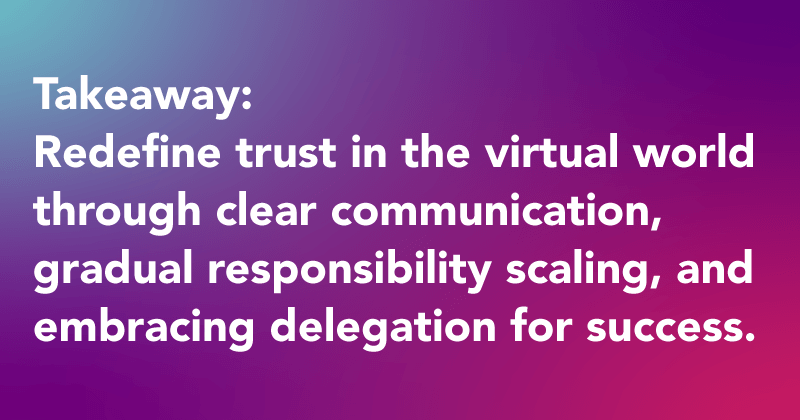
Gone are the days when a handshake sealed the deal. Today’s work environment, where a significant portion operates virtually, demands a redefinition of trust. Over the years, I’ve discovered that remote teams can be just as trustworthy, if not more so, as their in-person counterparts. However, the cornerstone of success lies in effective communication. Once you gain virtual trust, you will notice significant benefits for both parties.
Nowadays, the perk to work remotely is essential for employees. According to Buffer’s 2023 State of the Remote Work report, 98 percent of respondents marked this work model as positive.
Discover more: The Leader’s Guide To Managing Virtual Teams Effectively
Psychological barriers and strategies to delegation
Despite statistics, psychological barriers can decelerate remote working success as some still consider whether it is the best option for their businesses. I have personally encountered and overcome these challenges. Here are three psychological barriers you might encounter with virtual team delegation and how to overcome them.
1. The fear of relinquishing control
In large corporations, delegation can be systematic. But the fast-paced, ever-changing virtual environment can create fear.
How to overcome this fear: Before diving into delegation, honestly assess what you stand to gain and lose. The key to managing the fear of relinquishing control is setting clear outcomes and expectations upfront, which fosters autonomy and reduces the impulse to micromanage. Giving your team autonomy is essential, or else micromanaging will consume your precious time. It will help if you define clear outcomes and expectations from the beginning.
2. Lack of trust
Every team member brings a unique skill set. But trust isn’t just about skills—it’s about reliability.
How to build trust: Create a strategy to scale responsibility and task complexity levels. Start with minor responsibilities and then gradually escalate their complexity. Allowing your team to rise to increasingly challenging tasks will give both of you the confidence you seek in this remote working relationship. Include precise deadlines and leave space for optimizations. In the short term, you might notice how much you can trust. You should seek solid relationships with professional growth attached as a midterm plan.
3. Guilt and misunderstanding of delegation
If you truly enjoy participating in every aspect of the operation, you are probably capable of delegating, but misunderstand your true role. A sense of guilt might also manifest when overthinking the delegation process, when it involves tasks perceived as time-consuming or critical. To work well with your team, understand delegation and address your feelings about it.
How to correct delegation misunderstandings: Remember that the company needs your skills and knowledge for critical tasks. And that you require support from other professionals to help you achieve your goals. It is vital to communicate the benefits of accepting challenging tasks with a clear view of growth opportunities.
How delegation impacts virtual team success
The Owl Lab’s State of Remote Work 2022 report offers a generational lens:
- Gen Zs thrive in remote environments.
- Boomers often feel more productive in traditional setups.
However, 64 percent of all respondents feel more productive working remotely. The Future of Work report from Zapier in 2022 further highlighted a 38 percent increase in efficiency among remote workers. The data is precise: Remote teams can significantly boost productivity when managed and delegated tasks effectively.
So, if virtual teams reach higher productivity and efficiency percentages, why not trust remote delegation? And when should you do it? My advice: The sooner, the better.
Learn more: Maximize Productivity & Efficiency With A Top Virtual Administrative Assistant

Remote workplaces are the new standard for growing companies
The remote work model brings familiar feelings of fear, lack of trust, guilt, and uncertainty about delegation. But you know what? It is a good thing! You must turn on your Terminator scanner vision and prepare yourself with details to set the optimal conditions for effective delegation and business success.
Embracing remote work and delegation brings its own set of challenges, but the rewards are manifold. As I transitioned to working with virtual assistants worldwide, I identified a rich vein of talent in Latin America, leading to the birth of Virtual Latinos. Today, I’m proud to share that our venture stands at 80th in the prestigious 2023 Inc. 5000 list.
As business leaders, I invite you to embrace virtual trust by delegating to your remote team, as they represent today’s top-notch advantage. Elevate your delegation game and unlock unparalleled efficiency. Partner with Virtual Latinos today to integrate skilled virtual assistants from Latin America into your team. Trust the process, transform your business.
Read more about virtual teams:
- Challenges Of Managing Remote Employees
- How To Effectively Lead A Virtual Team Meeting
- The Psychology Of Delegation: Trusting Your Virtual Team
- Advantages Of Virtual Teams: Why Remote Work Wins
- The Leader’s Guide To Managing Virtual Teams Effectively
- The Ultimate Guide To Virtual Team Communication
- How Virtual Teams Are Reshaping The Workforce Landscape
- Challenges Of Virtual Teams: A Smart Guide
- 10 Game-Changing Types Of Collaboration Tools For Remote Teams