
If you run operations at a mid-size law firm, you already know the feeling. The caseload keeps climbing. Your paralegals are stretched thin. Filings slip a day, then two. Intake calls go unanswered for hours. The same task gets done three different ways across three practice groups, and partners are still handling administrative work that should never reach their desks. None of it is dramatic on its own.
Together, it is the reason the firm cannot quite breathe.
The answer is rarely to hire faster. The answer is to build the operational layer underneath the growth, one where capacity flexes with caseload, every workflow runs the same way every time, and a 30% surge in volume does not turn into a hiring scramble.
This is the playbook. We will walk through the bottlenecks that hold mid-size firms back, and a plan that you can start running on Monday. The broader landscape of legal virtual assistant services spans firms of all sizes. We see your reality: fifteen to seventy-five attorneys, multiple practice groups, an operations leader who owns the workflow, and a budget that has to defend itself with numbers.
Key Takeaways
- Mid-size firms hit a scaling wall around 15–25 attorneys when admin capacity can no longer keep up with the caseload.
- The structural fix has five pillars: flexible admin capacity, clean workflow design, centralized intake, surge support, and documented SOPs.
- A 12–25 attorney firm typically reclaims 1,200–2,500 paralegal hours a year by moving routine work to a virtual team.
- ABA Rule 5.3 supervision is fully achievable at scale, with written SOPs, named supervising attorneys, and a clear audit trail.
- Operations leaders who run a structured 90-day rollout see real workflow improvement inside the first quarter.
The Three Bottlenecks That Hold Mid-Size Firms Back
Almost every mid-size firm that stalls hits the same three walls, in the same order. Naming them is the first move. Designing around them is the work.
Bottleneck 1: Process inefficiencies
In a five-attorney firm, everyone knows how things get done because the partner said so. In a thirty-attorney firm, the same task gets done four different ways depending on who picked up the file. Intake forms shift by practice group. Document templates live on the desktops of whoever made them.
Onboarding a new paralegal takes six weeks because nothing is written down. Each piece feels small on its own. Together, they keep the firm running at about 70% of its potential.
Bottleneck 2: Your team is carrying too much
When administrative capacity does not keep pace with the caseload, your paralegals and coordinators absorb the gap. They stay late. They batch calls. They start letting go of the lower-priority items, usually client communication and follow-up, and the cracks begin to show. Turnover rises.
Every replacement takes three to six months to ramp, which only deepens the gap. The firm ends up paying more in overtime and recruiting than it would for a thoughtful capacity expansion, and the people you most want to keep are the ones most likely to leave.
Bottleneck 3: Growth arrives in waves; hiring does not
Caseload rarely climbs in a smooth line. It arrives as a 25% jump after a marketing campaign lands, a class-action filing, or a referral partner sending a wave of matters at once. Traditional hiring cannot match that rhythm; you need capacity in three weeks, but a paralegal hire takes three months. The firm either turns work away or pushes it onto people who are already at full tilt. Both add up.
The firms that solve this build a flexible layer of capacity that expands when caseloads climb and contracts when they ease.
What Scaling With Virtual Legal Assistants Actually Means
The phrase gets used loosely, so let us be specific. For an operations leader at a mid-size firm, scaling with virtual legal assistants means adding a layer of vetted, dedicated legal professionals who work remotely, follow your SOPs under attorney supervision, flex with caseload, and free your in-house team to focus on the work that truly needs to be done in the firm.
This is not about replacing paralegals. It is about giving them back the work they were hired for, substantive matter support, by handing the routine administrative volume to a team built for exactly that. Done well, paralegal satisfaction goes up, attorney billable hours go up, client response times come down, and your firm gains the ability to absorb 20–40% caseload growth without piling on fixed overhead.

The Five Pillars of a Firm That Scales Cleanly
A scalable admin operation rests on five connected pieces. Leave anyone out, and the program drifts. Put all five in place, and you build something the firm owns, a system that holds up through growth, turnover, and the busy quarters every firm eventually meets.
Pillar 1: Flexible admin capacity that moves with your caseload
The foundation is a dedicated virtual team, sized to handle routine document preparation, filing coordination, calendaring, billing support, and client communication across the firm. The economics of outsourcing legal administrative support at scale work because the work itself is highly procedural: the same filing steps, the same intake forms, the same follow-up cadence, and professionals trained on your SOPs can execute it with real consistency.
Capacity expands when caseload climbs and steps back when it eases, which is the piece that closes the scaling gap.
Pillar 2: Workflow design that removes the friction
Capacity alone is not enough. If new files still wait for attorney review, or filings sit in someone’s queue for two days because the handoff is unclear, adding more people just creates a longer line. The discipline of reducing workflow bottlenecks with virtual legal admin teams starts with mapping a matter end-to-end, identifying the three or four spots where work consistently stalls, and redesigning those handoffs so the virtual team can keep moving without waiting on internal approvals that never needed to exist in the first place.
Pillar 3: Centralized intake, the firm’s front door
Intake is the highest-leverage workflow in any firm. First-response time, the conflict check, the engagement letter, the kickoff call, each step either accelerates the matter or quietly loses it. Most mid-size firms run intake differently across practice groups, which makes the client experience uneven and allows good matters to slip through the cracks.
Centralizing client intake administration under one virtual team, one set of forms, one CRM workflow, one response-time standard, turns intake from a leaky bucket into a measured pipeline.
Pillar 4: Surge support for the busy quarters
Some firms have steady caseloads. Most do not. Litigation calendars cluster, class actions land in waves, and certain practice groups have predictable seasonal peaks. The traditional answer, over time, is the most expensive and least sustainable option on the table, and it costs you the people you most need to keep.
Building admin support during high-volume case periods into your operating model means having pre-arranged surge capacity ready to step in when volume climbs, so you take the work without breaking the people who run it.
Pillar 5: Documented SOPs, the system you actually own
None of the first four pillars holds up through turnover unless the work is written down. The discipline of creating SOPs for legal administrative tasks is what turns a virtual team from talented individuals doing tasks into a repeatable system your firm owns. Written SOPs capture the intake script, the filing checklist, the billing close-out, and the client communication cadence in a form that survives any single person moving on.
They also serve as the supervision record that ABA Rule 5.3 looks for, proof that the firm trained, supported, and reviewed the work of its nonlawyer team members.
A Sample Operating Model: Where the Work Sits
The clearest way to picture a mid-size operating model is a three-layer split: attorney work, in-house paralegal work, and virtual admin work. Each layer has a clean boundary, and each one is meant to do what it does best. The table below shows how a typical 20-attorney firm shares the daily work once the virtual team is in place.
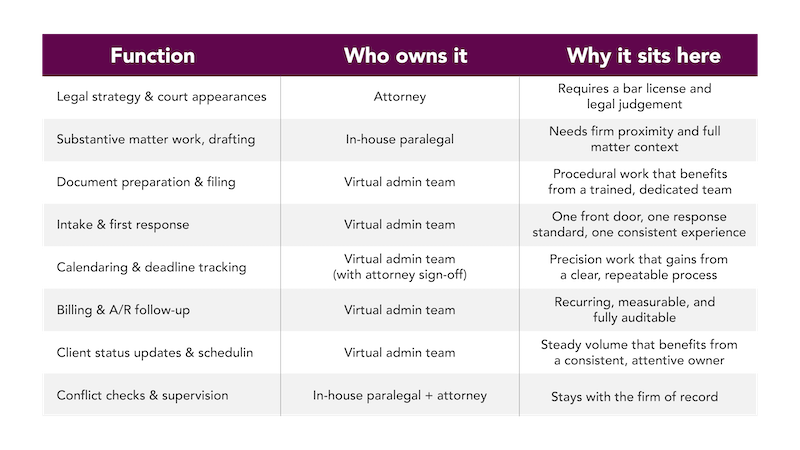
The Math: Hiring vs. Outsourcing for a 20-Attorney Firm
Every operations leader asks the same first question. Does the model actually pay for itself? The math is clear once the numbers are on the table.
A mid-size firm that adds two in-house paralegals carries roughly $130,000–$170,000 in fully loaded annual cost per hire, including salary, benefits, payroll taxes, software seats, and physical workspace. That is $260,000–$340,000 a year for two people, before a three- to six-month ramp-up period when they are not yet at full productivity.
The same admin capacity from a dedicated virtual team, two full-time professionals working your firm’s hours, typically runs $60,000–$90,000 a year combined, with no benefits load, no workspace costs, and a two- to three-week ramp-up because the professionals are already vetted and the roles are clearly defined.
The cost gap of $200,000+ a year across two roles is what makes the math work. The bigger argument, and often the more important one, is capacity. A virtual team can move from two professionals to four during a busy quarter without you taking on permanent payroll, and step back to two when the quarter ends. That flexibility is what closes the third bottleneck, for good.
ABA Compliance and Supervision That Holds Up at Scale
A mid-size firm cannot run an outsourced admin program informally, and you should not want to. ABA Model Rule 5.3 makes attorneys responsible for the conduct of every nonlawyer team member they supervise, remote or on-site, and state bars have grown more attentive to outsourcing arrangements over the last decade. The reassuring part: this is solvable. Done right, the compliance work scales as cleanly as the rest of the model.
Three controls do most of the work. Every virtual team member is paired with a named supervising attorney within the firm, usually the practice group lead. Every recurring task has a written SOP that defines what is inside scope, what is outside, and exactly when something escalates because it has crossed into legal judgment. And every month, a sample of completed work is reviewed to confirm the SOPs are being followed in practice. Together, those three controls leave a clear evidence trail that maps directly to your obligations under Rule 5.3.
Confidentiality, conflict screening, data security, and unauthorized practice of law are the four areas where a tighter framework usually pays for itself most, and the operational details of legal outsourcing compliance cover each of them: engagement-level conflict checks, encrypted document workflows, clear UPL boundaries, and the supervision documentation that holds up under a state-bar inquiry.

Your First 90 Days as the Operations Owner
A virtual admin rollout works best as a phased ninety-day plan. Trying to switch the whole firm at once is how programs stall in the first quarter. Start narrow, prove the model, then extend from there.
Days 0–30: Map and pilot
Pick one practice group with the cleanest, highest-volume admin work, usually the one with the most repeatable filings or the most predictable intake flow. Map the existing workflow end-to-end, identify the three or four tasks that consume the most paralegal time, and write the first version of the SOPs. Bring two virtual professionals onto that practice group, run them through a two-week onboarding, and start with a clear, contained scope.
Days 31–60: Measure and refine
Track three numbers weekly: hours of paralegal time freed, cycle time on the delegated tasks, and any quality flags raised by the supervising attorney. Update the SOPs as gaps surface. Hold a 30-minute weekly stand-up between the in-house team and the virtual team; that single ritual catches more workflow friction in the early weeks than any dashboard ever will.
Days 61–90: Extend
Once the pilot group has been stable for thirty days, bring in a second practice group. By day ninety, you should have a documented operating model, two practice groups on the new system, measurable hours back on the in-house side, and a foundation you can keep building on.
Five Common Mistakes and How to Avoid Them
Programs that stall in the first six months almost always stall for one of these five reasons. Each is preventable with a little upfront care.
- Skipping the SOPs: The team comes on before the work is documented, every question has to be answered live, and the ramp drags on twice as long as it should. Write the SOPs first.
- Letting every practice group customize from day one: If each group keeps its own intake forms and templates, you get the cost of outsourcing without the consistency that comes with it. Standardize first, then customize at the edges.
- Trying to delegate everything in week one: Spreading the scope too wide produces uneven quality across the board. Pick one or two task categories, get them right, then extend.
- Skipping the weekly stand-up: A 30-minute check-in for the first ninety days is non-negotiable. Programs that skip it usually discover the workflow problem in week eight, when the fix is far more expensive.
- Treating this as a cost-cutting move: The real win is workflow redesign and happier teams on both sides. Programs framed around outcomes compound. Programs framed around cuts plateau.
Frequently Asked Questions
How long until we see results?
Most firms see measurable cycle-time improvement within the first thirty days of the pilot practice group. Firm-wide impact, realization rate climbing, and overtime falling typically show up between months four and six, once the model has extended beyond the pilot.
Will this disrupt my in-house paralegal team?
Done well, it does the opposite. The point is to take the routine volume off their plates and give them back the substantive work they came to do. Paralegal satisfaction and retention usually improve within the first quarter. Disruption happens only when the rollout is positioned as a replacement, which is exactly what this is not.
How do we keep client information secure?
With the same controls you would use for any remote team member, applied with discipline: encrypted document sharing, access scoped to specific matters, signed confidentiality and data-handling agreements, conflict screening at engagement, and audit logs that show who accessed what. A reputable provider should already have these controls built into their standard operating model.
What size firm benefits most from this model?
Firms with ten to seventy-five attorneys get the strongest operational and financial return. Above seventy-five, firms tend to have dedicated operations infrastructure that already absorbs much of what this solves. The mid-size band is where the bottlenecks are sharpest, and the leverage is highest.
How do we handle a sudden caseload spike?
That is exactly what the surge pillar is built for. The team is structured so additional professionals can come on with a two-to-three-week ramp when caseload climbs, and step back when it eases. You pay for the capacity you use, without absorbing permanent payroll for a temporary jump in volume.
Build the Operations Layer Your Firm Has Been Missing
The mid-size firms that scale cleanly are not the ones that hire fastest. They are the ones that build the operational layer underneath the growth, the SOPs, the workflows, the supervision rhythm, and the flexible capacity that lets the firm meet a busy quarter without burning out the people running the work.
That layer is absolutely buildable. It does not take a year-long change initiative or a six-figure consulting engagement. It takes a clear scope, a written SOP, a dedicated virtual team, and a ninety-day commitment to running the rollout the right way.
When you are ready to build a virtual legal team shaped for the realities of a multi-practice-group firm, we help operations leaders scope, hire, and onboard pre-vetted bilingual legal professionals from Latin America, with the same time zones, dedicated firm hours, and an operating model built around ABA Rule 5.3 supervision. You can book a 20-minute discovery call to walk through your current workflow, name the bottleneck most worth fixing first, and act from there.