Why Stats on Virtual Teams Matter More Than Ever in 2026
Virtual teams represent more than operational efficiency; they’re about connecting talented professionals with meaningful opportunities and building partnerships that drive mutual success. The data confirms what forward-thinking business owners already know: when you hire with intention and cultural alignment, remote collaboration delivers exceptional results.
For business owners who’ve experienced the frustration of unreliable freelancers or misaligned outsourcing relationships, these statistics reveal an important truth: remote work succeeds when built on the right foundation, vetted talent, cultural compatibility, and clear communication structures. The companies seeing these results aren’t just hiring remotely; they’re hiring strategically.
From reducing overhead and boosting employee retention to expanding your access to global, bilingual talent, the data supports what the world’s most innovative companies already know: virtual work is smart business.
Here are 10 data-backed insights that demonstrate why virtual teams are reshaping how smart businesses hire, lead, and scale.
Key Takeaways: Virtual Team Statistics for 2026
- Massive Growth: Remote work has increased by 289% since 2019, with over 36 million Americans projected to be remote by 2026.
- Productivity Gains: Intentional remote environments boost productivity by 13% to 25% due to fewer distractions.
- Significant Cost Savings: Businesses save an average of $11,000 per year per remote employee on overhead and turnover.
- High Retention: 98% of remote professionals want to remain remote for the rest of their careers.
- Profitability & Diversity: Diverse remote teams are 36% more likely to outperform financially and make better decisions 87% of the time.
The full guide on hiring for administrative roles.
Hire the right talent faster.
1. Remote Work Has Grown 289% Since 2019—And It’s Still Rising
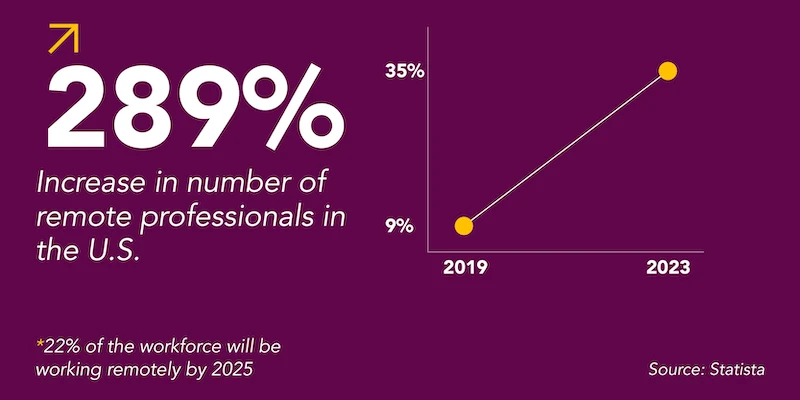
The number of remote professionals in the U.S. has exploded. According to Pew Research (2023), 35% of U.S. workers now work fully remotely, compared to just 9% in 2019, a staggering 289% increase.
According to Upwork’s Future Workforce Report (2021), an estimated 36.2 million Americans—22% of the workforce—will be working remotely by 2026.
Salesforce, one of the world’s top CRM platforms, adopted a “Success from Anywhere” model in 2021, prioritizing flexibility and performance over office hours. That move helped reduce attrition and expand talent pipelines.
The takeaway: Remote work has moved from a competitive advantage to a business standard. Companies that embrace it now position themselves to attract top talent and operate more efficiently.
2. Remote Teams Are 13–25% More Productive—When Designed Intentionally
Remote work delivers productivity gains not through location flexibility alone, but through the elimination of office distractions and commute time—allowing professionals to work during their peak focus hours.
Stanford University studied 16,000 employees at CTrip, a large travel agency, and found remote workers were 13% more productive, thanks to fewer distractions and no commuting.
McKinsey & Company later confirmed that asynchronous workflows and clear deliverables can push productivity gains to 25%.
Spotify introduced its permanent ‘Work From Anywhere’ policy in 2021, giving employees the freedom to choose remote, office, or hybrid work. This flexibility not only expanded Spotify’s access to global talent but also positioned the company as one of the first major tech players to make hybrid work a permanent feature of its culture.
3. Remote Work Saves Businesses USD 11,000+ Per Employee Each Year
According to Global Workplace Analytics, companies save an average of USD 11,000 per year per remote worker by reducing office overhead, turnover, and absenteeism. But the story doesn’t end with savings for the company; those dollars can be reinvested into employees through perks, stipends, and wellbeing programs.
For example, Moov Financial, a fully remote fintech company, offers home-office stipends and reimbursements so employees can create productive, personalized workspaces. Similarly, PickTrace, an agriculture software firm, provides team members with flexible schedules and a home office stipend to ensure their distributed teams thrive.
Other companies like AWeber take a different approach, running annual in-person retreats that bring fully remote teams together to maintain culture while saving on day-to-day office costs. These investments go a long way in balancing cost efficiency with employee engagement and retention.
Statista even estimates that widespread remote adoption could generate USD 700 billion in economic savings annually for the U.S. economy, showing just how transformative these models can be.
These cost savings create opportunities to reinvest in employee experience—through home office stipends, professional development, and wellness programs that strengthen retention and engagement.
4. Industries Driving the Demand for Virtual Teams
The surge in remote hiring is not uniform; some industries are embracing it far faster than others. According to Upwork’s Future Workforce Report and FlexJobs Remote Work Trends, five sectors dominate the demand for virtual teams in 2026:
- Customer Support: Bilingual chat agents, virtual call centers, and technical support staff remain top hires.
- Marketing & Creative: SEO experts, digital marketers, and content creators are increasingly remote-first roles, as highlighted by Forbes.
- IT & Software: Developers, DevOps services, and QA specialists are among the most recruited roles on remote platforms like Upwork.
- Healthcare Administration: Virtual assistants, billing coordinators, and intake staff, per Statista.
- Administrative Support: Executive assistants, project managers, and schedulers continue to be in strong demand as SMBs scale operations virtually.
FlexJobs also notes that remote job listings in these sectors attract two to three times more applicants than on-site roles, confirming worker preference is aligned with employer demand.
5. 98% of Remote Employees Want to Stay Remote
According to Buffer’s 2023 State of Remote Work, 98% of remote professionals want to continue working remotely for the rest of their careers. Flexibility isn’t just a perk; it’s become a primary retention driver.
A great example is GitLab, one of the world’s largest all-remote companies. With more than 2,000 employees in more than 60 countries, GitLab has never had a headquarters.
Instead, it runs on what it calls a “handbook-first” culture: every process, decision, and workflow is documented and accessible, making it easy for distributed teams to stay aligned. The company emphasizes asynchronous communication, clarity of expectations, and empowering employees to work where they’re most productive.
For business owners focused on retention, offering remote flexibility has become one of the most powerful tools available—directly addressing what 98% of remote workers say they want for their careers.
6. Diversity Means 36% Higher Profitability (And Remote Teams Help)

Diversity isn’’t just about representation; it’s about better business outcomes. McKinsey reports that companies in the top quartile for ethnic and cultural diversity are 36% more likely to outperform financially, while Harvard Business Review found that diverse teams make better decisions 87% of the time.
Zapier demonstrates this in action. With employees spread across multiple countries and time zones, Zapier has built a remote design culture where diverse perspectives are encouraged and systematically integrated into product development. Their design team notes that hiring globally has directly improved creativity, problem-solving, and product innovation.
For U.S.-based businesses, Latin American professionals offer a unique combination of advantages: bilingual capabilities, cultural alignment with American business practices, time zone compatibility, and a strong work ethic rooted in loyalty and initiative. This isn’t just about cost savings; it’s about accessing a talent pool that understands your market, communicates seamlessly with your clients, and brings fresh perspectives to your operations.
Virtual hiring removes geographic barriers to diversity, giving companies access to talent across cultures, perspectives, and skill sets—factors that McKinsey directly links to stronger financial performance and better decision-making.
7. Collaboration Tool Adoption Has Jumped 44%—Smart Use Wins
The rise of virtual work has dramatically accelerated the adoption of collaboration platforms. According to Statista, Microsoft Teams’ daily active users surged from just 20 million in 2019 to more than 300 million by 2023. This explosive growth highlights how central digital collaboration has become to the modern workplace, with many organizations standardizing on a team communication app from HubEngage or similar platforms to streamline conversations and reduce silos.
A great example of putting these tools to work is Automattic, the parent company of WordPress.com. As described on their official site, Automattic has 2,000+ employees working fully remotely across 95+ countries.
Instead of a central office, the company relies on digital tools and an async-first work culture to manage projects, share knowledge, and collaborate effectively. Their secret? Clear usage guidelines and structured workflows.
Success with collaboration tools isn’t about quantity—it’s about strategic selection and consistent implementation. Companies that focus on mastering a core set of platforms see better adoption, clearer communication, and stronger outcomes than those juggling multiple disconnected systems.
8. Async Work Cuts Delivery Times by 23%
At first glance, time zone differences might feel like a barrier for remote teams. But when companies adopt asynchronous workflows, those differences actually boost productivity, allowing work to continue almost around the clock.
Doist, the company behind Todoist and Twist, has been fully remote for over a decade, with team members spread across dozens of countries. Instead of relying on nonstop meetings, Doist uses async-friendly tools like Twist, GitHub, and Google Docs. This approach ensures that people can contribute when they’re most focused, not just when everyone else is online.
The benefits are clear:
- Team members aren’t constantly interrupted by notifications or calls.
- People can take time to write thoughtful responses instead of rushing to react.
- Everyone has the flexibility to review information later, even if they weren’t online at the same time.
As Doist explains, this leads to better focus, more autonomy, and less burnout. The Buffer 2023 State of Remote Work also confirms that async communication is one of the top practices teams use to stay productive and engaged long term.
When structured properly, time zone differences become an advantage rather than a barrier. Asynchronous workflows allow work to continue around the clock, with team members contributing during their most productive hours rather than being constrained by overlapping schedules.
9. Remote Leadership Needs Empathy and Structure
Managing remote teams isn’t about watching the clock—it’s about setting clear expectations and empowering people to deliver results.
Harvard Business Review emphasizes that successful remote leaders establish frequent communication, clarify goals, and provide emotional support rather than relying on surveillance or micromanagement.
GitLab, one of the world’s largest all-remote companies, runs on what it calls a “handbook-first” culture. Every process, from onboarding to performance management, is documented and transparent. Leaders communicate asynchronously, use clear OKRs (Objectives & Key Results), and avoid micromanaging by trusting employees to own their work.
Similarly, Basecamp promotes autonomy by replacing endless meetings with written updates and six-week project cycles. This structure gives teams ownership while ensuring progress is visible to leadership (Basecamp Shape Up).
Remote leadership isn’t hands-off—it’s structured, transparent, and rooted in trust. Clear goals and documented processes drive accountability without the need for constant oversight.
10. Remote Hiring Is a Core Strategy for 71% of Managers
This isn’t a short-term fix—it’s the future of work.
Upwork’s 2026 Workforce Report reveals:
- 71% of hiring managers will increase or maintain remote hiring
- 59% have made remote hiring a core part of their talent strategy
And with the freelance economy projected to hit USD 455 billion by 2026, according to Forbes, smart companies are moving fast to grab talent early.
With 71% of hiring managers planning to maintain or increase remote hiring, companies that build strong virtual teams now gain access to broader talent pools, faster hiring timelines, and more competitive positioning in the market.
FAQs for Business Owners
How do I keep my virtual team aligned across locations?
Pick one project-tracking platform (such as ClickUp or Asana) and make it your team’s single source of truth.
- Post weekly async check-ins so everyone can update progress in their own time
- Set OKRs and store them in a shared, searchable handbook
- Record short Loom videos for complex tasks to cut down on meetings
Teams that combine a clear goal system with one main tool report up to 25% higher productivity, according to McKinsey.
What if I need bilingual support staff aligned to U.S. time zones?
Platforms like Virtual Latinos offer pre-vetted bilingual professionals across Latin America, aligned to EST/PST, and familiar with U.S. business culture.
Is onboarding harder for remote teams?
Not if structured. Use onboarding templates, Loom videos, and assign a “buddy” to new hires. Companies like GitLab and Automattic credit structured remote onboarding for higher ramp-up speed and better retention.
How much can my business save by going remote?
Global Workplace Analytics calculates average savings of about USD 11,000 per remote employee each year, thanks to lower office rent, utilities, absenteeism, and turnover.
Are remote teams actually more productive?
Yes. A Stanford study of 16,000 workers found a 13% productivity boost, and McKinsey reports gains can reach 25% when you pair remote work with clear goals and async workflows.
Do employees want to keep working remotely?
Absolutely. Buffer’s 2023 State of Remote Work found that 98% of remote professionals hope to work remotely for the rest of their careers.
Final Thoughts on Why Remote Teams Are a Strategic Advantage
The data is clear: the latest Stats on Virtual Teams prove that remote and virtual collaboration isn’t just a response to global events, it’s the future of work.
Virtual teams consistently deliver higher productivity, lower costs, stronger retention, and broader access to global talent. For business owners, the question is no longer if you should embrace virtual teams, but how quickly.
If you’re ready to scale with bilingual, cost-effective professionals aligned to U.S. time zones, Book a free call today to discuss your hiring needs.
Or, if you’d like to see what’s possible right now, you can find the right talent and discover the vetted professionals who can help your business grow smarter in 2026, backed by the latest stats on virtual teams that prove their impact.