
| TL;DR |
|
The math you already know tells the story. According to Bloomberg Law’s 2024 Attorney Workload & Hours Survey, attorneys work an average of 48 hours per week but bill only 36 of those hours. That is a 12-hour gap, and roughly two of every eight working hours go to administrative duties such as time tracking and project management.
When overhead expenses are rising, as the Thomson Reuters Law Firm Financial Index Q4 2024 reported a 6.9% year-over-year increase, protecting margin starts with protecting attorney time, and legal outsourcing is how a growing number of firms do it.
Burnout compounds the problem. The same Bloomberg Law survey found attorneys feel burned out 42% of the time on average. The pressure is real, and the capacity to grow depends on how strategically you allocate both time and talent.
Legal outsourcing is not about finding the cheapest labor. It is about recovering the hours your attorneys lose to non-billable work, expanding capacity without proportional payroll growth, and building a support structure that makes your firm more profitable and more resilient.
For managing partners evaluating how to scale sustainably, legal outsourcing for law firms offers a strategic starting point. Let’s walk you through the business case, the cost model, ethical compliance under ABA rules, and how to choose a legal outsourcing partner who fits your firm’s long-term goals.
What Is Legal Outsourcing?
Legal outsourcing, often called legal process outsourcing or LPO, is the practice of delegating legal support tasks to professionals outside your firm. These professionals may work remotely, from another region, or through a specialized staffing partner, and they handle work that would otherwise consume your in-house team’s time.
LPO covers a wide spectrum of support functions. At one end, you have administrative tasks such as document management, scheduling, client intake, and billing support. At the other end, you have substantive legal work such as legal research, contract review, discovery support, and drafting.
The key distinction is that the outsourced professional handles execution while the supervising attorney retains responsibility for oversight, quality, and compliance. For managing partners, legal outsourcing is a lever for controlling costs, expanding capacity, and freeing attorneys to focus on higher-value, revenue-generating work.
The Business Case: Why Managing Partners Are Outsourcing Now
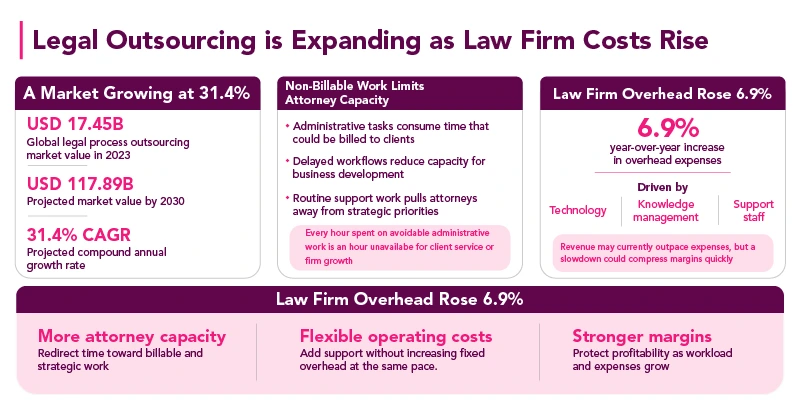
The legal outsourcing market is growing rapidly. According to Verified Market Reports, the global legal process outsourcing market was valued at USD 17.45 billion in 2023 and is projected to reach USD 117.89 billion by 2030, a 31.4% compound annual growth rate.
That growth reflects what you see inside your own firm. Attorneys lose significant time to non-billable tasks. Time that your firm could redirect to client work, business development, or strategic priorities.
On the other hand, operating costs continue to climb. The Thomson Reuters Law Firm Financial Index Q4 2024 showed overhead expenses rose 6.9% year-over-year, driven by technology, knowledge management, and support staff costs. Revenue growth may still outpace expense growth today, but any slowdown in revenue could squeeze margins quickly.
Legal outsourcing addresses both sides of this equation. You recover attorney capacity by moving administrative and routine legal tasks to trained professionals who cost less than in-house staff. You also avoid the fixed costs and long-term payroll commitments that make scaling expensive.
Reducing Law Firm Overhead Through Administrative Outsourcing
The clearest way to see the financial impact of legal outsourcing is to compare the cost of a Legal Virtual Assistant with the cost of hiring in-house.
A full-time in-house paralegal or legal assistant earns a median of about USD 61,000 per year, according to U.S. Bureau of Labor Statistics data, and runs roughly USD 75,000 to USD 110,000 per year once you add benefits, payroll taxes, office space, and equipment. By comparison, a full-time Legal Virtual Assistant lands in a range of roughly USD 1,800 to USD 3,500 per month.
Cost savings are only part of the return on investment. Many firms also use virtual legal admin teams to reduce workflow bottlenecks, improve attorney utilization, and expand administrative capacity without adding in-house headcount.
For managing partners who want to model the ROI for their firm, Virtual Latinos offers a free hiring guide that walks through the process of building a long-term legal support team with pre-vetted, bilingual professionals in US time zones.
What’s the Difference Between Legal Process Outsourcing and Offshoring?
Legal process outsourcing and offshoring are related but distinct concepts.
Legal process outsourcing refers to delegating legal support tasks to professionals outside your firm, regardless of where they are located. Your LPO partner could be across town, in another state, or in another country. The defining feature is not geography. It is that the work happens outside your firm under a service or staffing arrangement.
Offshoring specifically means working with a provider in another country, typically to access lower labor costs. Traditional offshore LPO often routes work to providers in South Asia, Eastern Europe, or the Philippines. While cost savings can be significant, offshoring introduces challenges around time zones, communication, and cultural alignment.
Near-shoring offers a middle ground. Working with professionals in Latin America, for example, gives you cost efficiency while maintaining overlap with US business hours, stronger English proficiency, and greater cultural proximity. This is the model Virtual Latinos follows: bilingual virtual professionals in US time zones who integrate into your daily operations and supervision structure.
What processes should law firms consider outsourcing?
The best candidates for outsourcing are tasks that are routine, time-intensive, and non-billable. These include administrative support such as calendar management, document organization, and client communication. They also include back-office functions such as billing, collections follow-up, and data entry.
You can also outsource substantive legal support, including legal research, contract review, document drafting, and discovery preparation. The deciding factor is whether the task can be standardized, documented, and supervised by an attorney without requiring real-time, in-person presence.
Legal Tasks You Can Outsource
Legal outsourcing covers a broad range of support functions. The goal is to move routine, repetitive tasks off your attorneys’ plates so they can focus on client work, business development, and strategic leadership.
Here are common legal tasks that firms outsource successfully:
- Legal research and case analysis
- Document drafting, formatting, and proofreading
- Contract review and redlining
- Discovery support and document management
- Client intake and new matter opening
- Calendar and deadline management
- Billing, invoicing, and collections follow-up
- Court filing preparation and e-filing support
- CRM and client relationship management
- Social media management and marketing support
- Transcription and document summarization
- General administrative support
Each of these tasks takes time away from billable work. When you move them to a trained Legal Virtual Assistant you supervise, you recapture that time for the work that drives revenue and client outcomes.
The Compliance Question: Outsourcing Within ABA Ethics Rules
Managing partners often ask whether outsourcing legal work is ethical. The answer is yes, as long as you maintain proper oversight and fulfill your supervisory obligations.
The ABA Model Rule 5.3 requires lawyers with direct supervisory authority over a nonlawyer assistant to make reasonable efforts to ensure the assistant’s conduct is compatible with the lawyer’s professional obligations. This means you remain responsible for the work product, confidentiality, and client interests, even when a virtual assistant executes the task.
ABA Formal Opinion 08-451 directly addresses outsourcing. It confirms that lawyers may outsource legal and nonlegal support services and may bill clients for outsourced work at a reasonable fee. The lawyer’s duty of competence under Rule 1.1 remains intact, and the lawyer must supervise the work appropriately.
More recently, ABA Formal Opinion 506 clarified that lawyers may train nonlawyer assistants to handle client intake, provided proper policies, training, and supervision are in place. The prospective client must always be offered an opportunity to discuss the fee agreement and scope of representation with the lawyer.
Unauthorized practice of law remains a boundary. Under Rule 5.5, a nonlawyer assistant cannot provide legal advice, represent clients in legal proceedings, or hold themselves out as an attorney. The supervising attorney must ensure that the virtual assistant handles only tasks appropriate for a nonlawyer.
Note that ABA Model Rules are not binding law on their own. They serve as a model that state bars adopt with variations. You should always check your state bar rules and any relevant ethics opinions before structuring an outsourcing arrangement.

How to Choose a Legal Outsourcing Partner
Not all outsourcing partners are built the same. As a managing partner, you need to evaluate potential providers against criteria that matter for long-term success, not just initial cost.
Here is a vendor-evaluation checklist:
- Direct supervision model: Will you work directly with your assigned professional, or does the provider route work through anonymous teams? Direct relationships support accountability and quality.
- Retention and long-term fit: What is the provider’s retention rate? High turnover means you lose institutional knowledge. Look for providers who invest in their professionals’ growth and support.
- US time-zone alignment: Can your virtual assistant work during your business hours? Real-time collaboration reduces friction and speeds turnaround.
- Vetting rigor: How does the provider screen candidates? Look for multi-stage vetting that covers language proficiency, role-specific skills, and cultural fit. Pre-vetted talent saves you time and reduces hiring risk.
- References and track record: Can the provider share success stories or references from firms similar to yours? A proven track record in legal support matters.
- Scalability: Can you add more professionals as your needs grow without starting the hiring process from scratch?
Virtual Latinos addresses each of these criteria. You can hire a Legal Virtual Assistant through a human-guided recruitment process that matches you with pre-vetted, bilingual professionals from Latin America who work in US time zones. The Replacement Guarantee provides protection if the first match is not the right fit, and the relationship model is built for long-term retention, not transactional staffing.
When Should You Consider Legal Outsourcing?
Legal outsourcing is not right for every situation, but there are clear signals that it is time to explore it:
- Your attorneys spend significant time on administrative or routine tasks that do not require a law degree
- You want to serve more clients without adding proportional headcount and payroll
- You have temporary or project-based needs, such as discovery for a large case, that do not justify a permanent hire
- You need specialized support, such as legal research or contract review, on a flexible basis
- You want to improve efficiency and capacity without the fixed costs and long-term liability of in-house hiring
- Your overhead is climbing faster than revenue, and you need to control costs without cutting capability
If any of these resonate, outsourcing is worth modeling. Start by identifying which tasks consume the most attorney time, then estimate the cost and productivity impact of shifting those tasks to a trained Legal Virtual Assistant.
7 Benefits of Legal Outsourcing for Your Firm
Cost-efficiency
Legal outsourcing delivers direct cost savings compared to in-house hiring. A full-time Legal Virtual Assistant runs roughly USD 1,800 to USD 3,500 per month. A full-time in-house paralegal earns a median of about USD 61,000 per year per BLS May 2024 data, and runs roughly USD 75,000 to USD 110,000 per year once benefits, payroll taxes, office space, and equipment are added.
Comparing those figures, that shift can cut the cost of the role by roughly 50% to 70% once you factor in total cost of employment. Those savings flow directly to your bottom line.
Specialized expertise
Outsourcing gives you access to professionals with specific skills when you need them. Whether you need legal research, contract review, or e-filing support, you can bring in trained support without a lengthy hiring process or permanent headcount commitment.
Focus on core work
When your attorneys spend less time on administrative tasks, they spend more time on client work, business development, and strategic leadership. Legal outsourcing lets you reallocate attorney time to the work that drives revenue and firm growth.
Flexibility and scalability
Your staffing needs change with caseload. Outsourcing lets you scale support up or down without the fixed cost and commitment of full-time hiring. You add capacity when you need it and avoid carrying overhead when you do not.
Risk mitigation
Working with a reputable outsourcing partner reduces the hiring risk that comes with direct employment. Pre-vetted professionals, replacement guarantees, and human-guided matching all reduce the chance of a bad hire. You also avoid the compliance complexity of managing benefits, payroll taxes, and employment law across jurisdictions.
Reduced administrative burden
Every hour your attorneys spend on scheduling, document management, or billing is an hour not spent on billable work. Outsourcing administrative tasks removes that burden and lets your team focus on what they do best.
Lower overhead
With overhead expenses climbing to a 6.9% year-over-year increase, controlling costs matters more than ever. Outsourcing lets you add capacity without adding to your fixed overhead. You pay for the support you use, not for benefits, office space, and equipment you may not need.

Key Takeaways
- Outsourcing recovers billable capacity: moving administrative work off your attorneys’ plates directly protects realization and margin
- You can add capacity without adding payroll or overhead, expanding how many clients your firm serves without a proportional cost increase
- Outsourcing converts high fixed staffing costs into flexible support you scale up or down, protecting margin even as industry overhead keeps rising
- Treat outsourcing as controlled delegation you stay accountable for, and confirm your state bar rules before you structure the arrangement
- Choose a partner offering direct supervision, rigorous vetting, and a replacement guarantee so a single bad match never stalls your firm
- The firms winning with outsourcing treat it as a growth strategy that improves capacity, profitability, and competitive position
Frequently Asked Questions
Is it legal and ethical for a law firm to outsource legal work?
Yes, outsourcing is both legal and ethical when done properly. The key requirements are proper supervision, maintaining confidentiality, avoiding conflicts, and ensuring the nonlawyer does not engage in unauthorized practice of law. Always check your state bar rules, as they govern your specific obligations.
How much can a law firm save by outsourcing legal work?
Cost savings depend on the scope of work and the alternative you are comparing. A full-time Legal Virtual Assistant runs roughly USD 1,800 to USD 3,500 per month according to independent 2026 industry analyses. A full-time in-house paralegal or legal assistant earns a median of about USD 61,000 per year, with total employer cost running higher once you add benefits, payroll taxes, office space, and equipment.
Comparing those figures, outsourcing can reduce the cost of the role by roughly 50% to 70%, consistent with industry analyses citing 60% to 72% savings.
When should a managing partner consider outsourcing instead of hiring in-house?
Consider outsourcing when your attorneys spend significant time on administrative or routine tasks, when you want to grow capacity without proportional payroll increases, when you have temporary or project-based needs, or when you need to control overhead without cutting capability. Outsourcing works best for tasks that are routine, time-intensive, and do not require real-time, in-person attorney presence.
How do I choose a reliable legal outsourcing partner?
Evaluate potential partners against criteria that matter for long-term success: data security and confidentiality policies, a direct supervision model, strong retention rates, US time-zone alignment, rigorous vetting processes, references from similar firms, and the ability to scale as your needs grow. Look for a partner who invests in their professionals and supports long-term working relationships rather than transactional staffing.
Turn Outsourcing Into a Growth Strategy
Legal outsourcing is not a cost-cutting tactic. It is a capacity-building strategy that protects your margin while positioning your firm for growth.
The firms that succeed with outsourcing treat it as a strategic decision. They identify the tasks that consume attorney time without generating revenue. They model the cost difference between in-house hiring and outsourced support. They structure their relationships under ABA ethics rules, with clear supervision and accountability. And they choose partners who deliver pre-vetted, reliable professionals built for long-term collaboration.
If you are ready to take the next step, Virtual Latinos connects you with bilingual, US time-zone-aligned Legal Virtual Assistants from Latin America, all pre-vetted through a human-guided recruitment process and backed by a Replacement Guarantee.
Build a legal support team you supervise directly, without the payroll overhead. Start hiring today.