
| TL;DR |
|
Your attorneys are spending more time on non-billable work than you realize. According to a 2025 Thomson Reuters report, law firms face mounting pressure to control overhead while maintaining service quality. At an average billable rate of USD 349/hr, every hour your team spends on administrative tasks instead of client matters costs your firm real revenue.
If your legal staffing strategy has not changed in the last three years, you are likely leaving hundreds of thousands of dollars on the table annually.
The legal industry is not standing still. The Bureau of Labor Statistics projects 5% employment growth for lawyers from 2024 to 2034, and legal hiring plans remain robust heading into H2 2026. Yet traditional hiring alone cannot keep pace with rising caseloads, overhead pressure, and the demand for remote legal staffing solutions that align with how modern firms operate.
Let’s dive into the strategic framework for building a scalable, cost-effective legal team. You will learn how to hire virtual legal professionals, compare pricing models, evaluate staffing alternatives, and structure contracts that protect your firm, so you can focus on what actually grows your practice: billable work, client relationships, and scalable law firm growth.
How to Hire a Legal Virtual Assistant
Finding qualified legal support is one of the most time-consuming challenges managing partners face. The traditional cycle of posting, screening, interviewing, and onboarding a single hire can consume four to eight weeks of your time or your operations team’s time.
Meanwhile, caseloads keep growing, and your attorneys keep absorbing tasks that pull them away from billable work.
A repeatable hiring process for virtual legal support eliminates that bottleneck. Here is how to approach it strategically so you can delegate with confidence and reclaim the revenue your firm is leaving on the table.
Defining the role and scope before you start hiring
The number one cause of failed virtual assistant engagements is mismatched expectations. Before you post a single job listing or contact a provider, document exactly what your law firm virtual assistant will handle.
Start by categorizing your firm’s current workload into three tiers:
- Billable work that requires bar admission (attorneys only).
- Skilled support that requires legal training but not bar admission (paralegals, legal assistants).
- Administrative work that requires neither (scheduling, document formatting, client intake, data entry).
Tiers two and three represent your delegation opportunity. Map the specific tasks in each tier, estimate the weekly hours each task consumes, and rank them by impact on attorney utilization.
This exercise gives you a concrete scope-of-work document that prevents scope creep and ambiguity that derail most staffing engagements.
Be specific. “Help with legal research” is too vague. “Conduct preliminary case law research on slip-and-fall precedents using Westlaw, summarize findings in a two-page memo, and flag conflicting rulings” is a task you can train, measure, and hold someone accountable for.
Where to source qualified legal virtual assistants
You have three primary sourcing channels, each with distinct trade-offs:
- Open marketplaces (Upwork, Fiverr): lowest cost, highest management burden, least consistency. You handle vetting, quality control, and replacement entirely on your own.
- Legal staffing agencies: higher cost, established candidate pools, but often focused on temporary placements and in-office roles. Traditional legal staffing agencies often focus on temporary placements and may not offer the long-term cultural fit that managing partners need for sustained growth.
- Dedicated virtual staffing providers: a middle path that combines pre-vetted talent with ongoing HR support. Providers that specialize in bilingual professionals from Latin America offer U.S. time zone alignment, cultural compatibility, and cost efficiency without the quality risks of open marketplaces.
Virtual Latinos falls into the third category, connecting law firms with pre-vetted Virtual Professionals through a human-guided recruitment process that includes a Replacement Guarantee if the initial match is not right.
The vetting and onboarding process for law firms
Legal work demands a higher standard of vetting than general administrative support. When evaluating candidates for remote legal staffing roles, your screening process should cover:
- Prior legal experience (law firm, corporate legal department, or legal process outsourcing background)
- English proficiency at a professional level (written and spoken)
- Familiarity with legal software (Clio, MyCase, PracticePanther, Westlaw, LexisNexis)
- Background checks and signed NDAs before any client data is shared
- Comfort with confidentiality protocols and data security practices
Structuring supervision without micromanagement
Effective delegation does not mean losing control. It means creating systems that allow your virtual legal support to operate independently within defined boundaries.
At USD 349/hr in average billable time, every hour your attorneys spend supervising tasks that could be managed through clear workflows represents a direct cost to your firm. The goal is structured autonomy: documented processes, regular check-ins (weekly, not daily), defined escalation paths, and clear quality benchmarks.
ABA Model Rule 5.3 requires lawyers to supervise nonlawyer assistants, including virtual staff. Meet that obligation by establishing communication channels, reviewing work product on a set cadence, and documenting your supervision protocols.
Firms that treat virtual professionals as integrated team members consistently report stronger compliance outcomes and higher productivity. Those outcomes often begin with a structured onboarding and supervision process, which is why many firms follow established frameworks for how to hire a legal virtual assistant.
Pricing Models and Cost Structures for Legal Staffing
Managing partners need predictable costs and clear ROI data to justify staffing decisions to their partners. Yet most firms evaluate staffing purely on salary, ignoring the loaded cost of benefits, overhead, and lost productivity that make traditional hiring far more expensive than it appears on paper.
Understanding the full cost picture is essential for building a legal staffing strategy that supports profitability, not just headcount.
Comparing cost models: hourly, monthly retainer, and full-time dedicated
Three pricing models dominate the virtual legal staffing market:
- Hourly: Best for project-based or intermittent needs. Typical range: USD 10 to USD 25/hr depending on experience and specialization. Flexible but less predictable for budgeting.
- Monthly retainer: A set number of hours per month at a discounted rate. Ideal for firms with consistent but not full-time support needs. Retainers typically range from USD 1,000 to USD 2,000/mo for part-time support.
- Full-time dedicated: A virtual professional works exclusively for your firm during business hours. This model costs between USD 1,800 and USD 3,500/mo and provides the deepest integration, strongest loyalty, and most consistent output.
The full-time dedicated model is the most popular among mid-size law firms because it mirrors an in-house hire without the overhead. Your dedicated professional learns your systems, builds relationships with your clients, and becomes a reliable extension of your team. This is the model that best supports legal process outsourcing at the firm level rather than at the project level.
Understanding current virtual assistant service rates can help firms evaluate how dedicated staffing compares to hourly or project-based alternatives.
The true cost of in-house legal staff vs. virtual alternatives
In-house legal support staff carry a high cost beyond their base salary. According to the BLS Employer Costs report, employee benefits add an average of 30 to 40% on top of base wages. But salary and benefits are only part of the story.
When you add employer-sponsored benefits, payroll taxes, office space, equipment, and training, the cost increases by 30 to 40%. That brings the fully loaded annual cost to approximately USD 79,000 to USD 85,000 per in-house paralegal.
The BLS Employer Costs for Employee Compensation report from March 2026 confirms that benefits average USD 15.60/hr on top of USD 33.72/hr in wages, totaling USD 49.32/hr in loaded cost.
Compare that to a dedicated virtual legal assistant at USD 1,800 to USD 3,500/mo, or USD 21,600 to USD 42,000/yr, with no benefits burden on your firm.
When you outsource legal work to qualified virtual professionals, you reduce your labor costs by 50 to 72% for comparable task execution on document preparation, client intake, legal research, and calendar management.
When combined with recovered billable hours and reduced overhead, the business case becomes even stronger, particularly for firms evaluating how much they can save with virtual legal assistants over the long term.
Calculating ROI: billable hours recovered per dollar spent
The real return on virtual legal staffing is not just cost avoidance. It is revenue recovery. Your attorneys spend a significant portion of each day on work that never appears on a client invoice.
Delegating even two to three hours of non-billable tasks to a virtual professional at USD 11 to USD 21/hr could recover substantial billable capacity. At USD 349/hr, recovering just 2.5 billable hours per day represents USD 872.50 in potential daily revenue per attorney, or approximately USD 218,000 in annual revenue recovery per attorney working 250 days per year.
Here is a simple ROI framework you can apply to your firm:
- Calculate your attorneys’ current utilization rate (billable hours divided by total hours worked)
- Identify how many non-billable hours could be delegated daily
- Multiply recovered hours by your average billable rate
- Subtract the annual cost of your virtual legal support
- The difference is your net revenue gain
Even conservative estimates show that firms investing USD 24,000/yr in a dedicated virtual legal assistant can recover USD 100,000 or more in billable revenue. That is the kind of ROI that justifies the staffing decision to any partner.
Legal Virtual Assistant vs. Alternatives
Managing partners often struggle to identify which staffing model fits their firm’s current size and growth trajectory. The right choice depends on your caseload volume, budget constraints, growth plans, and tolerance for management overhead.
Virtual legal assistant vs. in-house paralegal: a decision framework
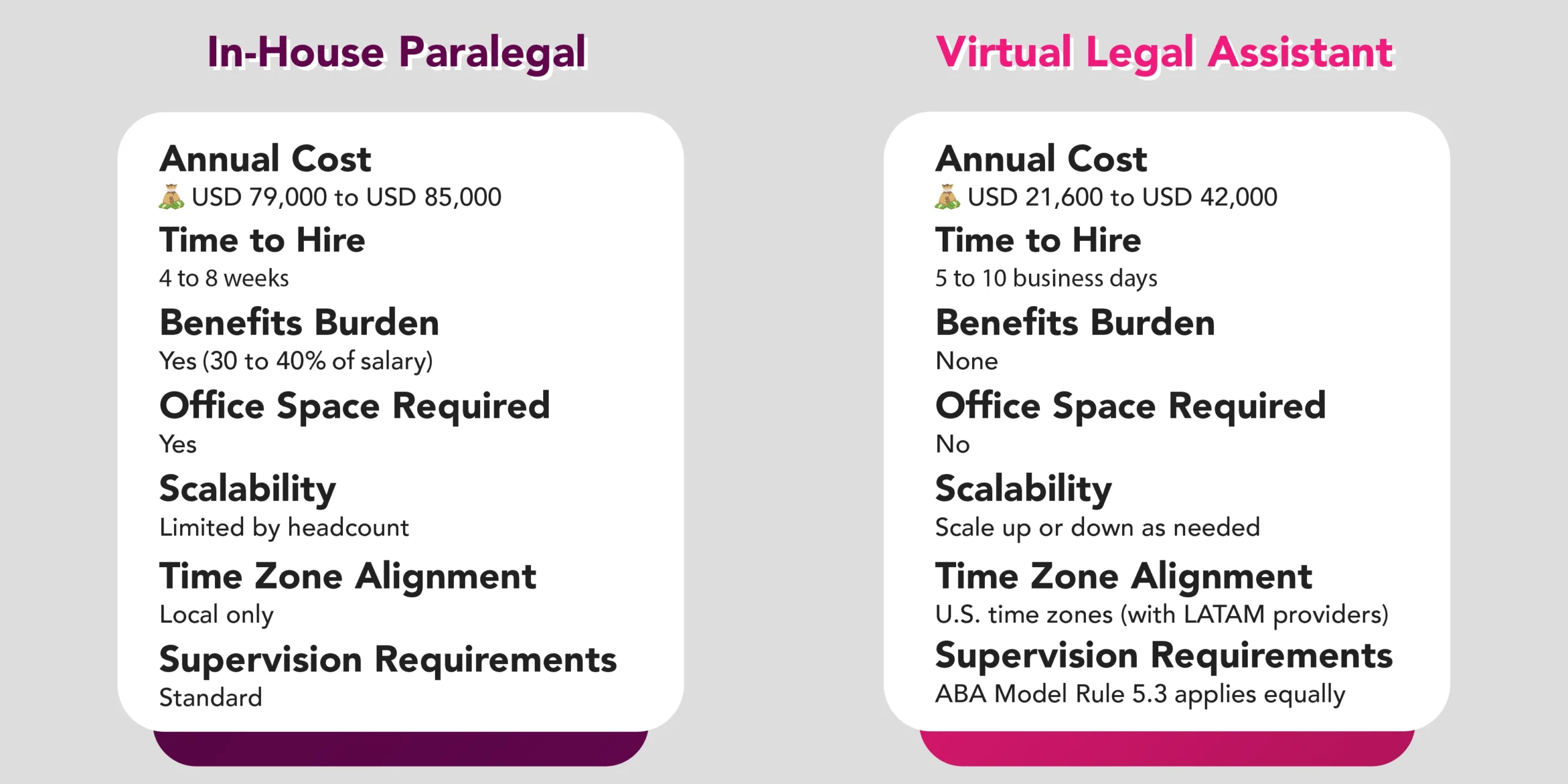
Both options deliver skilled legal support, but they differ significantly in cost, speed, and scalability. Virtual paralegal services offer a compelling alternative when your firm needs to expand capacity without expanding overhead. Here is how the most common law firm staffing models compare.
| Factor | In-House Paralegal | Virtual Legal Assistant |
| Annual cost | USD 79,000 to USD 85,000 (loaded) | USD 21,600 to USD 42,000 |
| Time to hire | 4 to 8 weeks | 5 to 10 business days |
| Benefits burden | Yes (30 to 40% of salary) | None |
| Office space required | Yes | No |
| Scalability | Limited by headcount | Scale up or down as needed |
| Time zone alignment | Local only | U.S. time zones (with LATAM providers) |
| Supervision requirements | Standard | ABA Model Rule 5.3 applies equally |
An in-house paralegal makes sense when your firm needs daily in-person presence for court filings, client meetings, or tasks that require physical access to documents. A virtual legal assistant is the better choice when your priority is cost efficiency, speed, and the ability to scale support up or down based on caseload.
The right choice often depends on how your firm defines support roles, particularly when weighing legal assistant vs. paralegal responsibilities and the advantages of a virtual legal assistant vs. paralegal staffing model.
Virtual staffing vs. legal staffing agencies: speed, cost, and control
Traditional legal staffing agencies have served the industry for decades, but they carry limitations that matter when you are evaluating long-term law firm staffing models.
A legal staffing agency typically charges a markup of 40 to 75% on the professional’s hourly rate and focuses on temporary or temp-to-perm placements. You get access to a local candidate pool, but the cost is significantly higher, and the engagement is often transactional.
Dedicated virtual staffing providers operate differently:
- Lower cost per hour with no placement fees
- Pre-vetted candidates matched to your firm’s needs
- Ongoing HR support and a Replacement Guarantee
- Long-term engagement orientation, not temp staffing
- Bilingual professionals working in your time zone
The trade-off is proximity. If your firm requires someone physically in your office, a local agency is the right fit. If your priority is cost, quality, and scalability, and you are comfortable with remote collaboration, a dedicated provider like Virtual Latinos delivers more value per dollar over time.
These considerations are central when evaluating virtual legal assistant companies, particularly for firms looking to balance flexibility, operational support, and long-term growth.
When to use a hybrid model: combining in-house and virtual teams
The most effective approach for mid-size firms scaling from 10 to 50 attorneys is not choosing one model exclusively. It is combining them.
The global legal process outsourcing market reached USD 27.8 billion in 2025 and is growing at approximately 21% CAGR. The U.S. LPO market alone is expected to grow at 28% CAGR from 2024 to 2030. That growth is driven primarily by firms adopting hybrid models that combine in-house expertise with virtual support.
A hybrid law firm growth strategy typically looks like this:
- In-house core: Senior paralegals, office managers, and staff who require daily physical presence
- Virtual dedicated team: Legal assistants, research support, document preparation, client intake, billing support
- Project-based virtual support: Overflow during case surges, discovery review, compliance research
This structure gives your firm fixed capacity for baseline operations and variable capacity for growth, without carrying the fixed overhead year-round. It is the staffing equivalent of building a firm that can breathe, expanding and contracting with demand while keeping your margins intact.
For many firms, this adaptability is a practical example of how remote legal assistants transform law firm operations, improving responsiveness while preserving profitability.
Contracts, Agreements and Service Terms for Virtual Legal Staff
Managing partners need airtight agreements that protect client confidentiality, define service boundaries, and ensure compliance with employment law. Without the right contract structure, even the best virtual staffing engagement can expose your firm to liability. Here is what you need to get right from day one.
Essential contract clauses for virtual legal assistant engagements
A strong legal virtual assistant contract should include these core elements:
- Scope of work: Define exactly which tasks are in-bounds and which are not. Ambiguity here is the most common source of engagement failure.
- Mutual NDA and confidentiality agreement: Cover all client data, case information, attorney-client privileged material, and firm-specific processes.
- Data handling and security protocols: Specify how files are stored, transmitted, encrypted, and destroyed. Require VPN access to firm systems and encrypted file sharing.
- Termination terms: Include notice periods for both parties (typically 14 to 30 days), conditions for immediate termination, and transition protocols.
- Performance metrics and SLAs: Define turnaround times, quality benchmarks, availability hours, and escalation procedures.
- Compliance obligations: Reference ABA Model Rules (particularly Rule 5.3 on nonlawyer assistant supervision) and state-specific ethical requirements.
If you engage your virtual legal assistant through a dedicated provider, confirm that the provider’s master service agreement covers these elements and that you have the right to audit compliance.
Contractor vs. employee classification: what law firms must know
Worker classification is not a technicality. It is a compliance requirement that carries real financial consequences if you get it wrong.
Under IRS guidelines, if you control when, where, and how your remote legal support performs their work, that relationship likely qualifies as employment, not independent contracting. The IRS applies a multi-factor test that evaluates behavioral control, financial control, and the type of relationship between the parties.
Misclassification penalties are significant: the IRS can assess USD 50 per misclassified W-2 plus 1.5% of all wages paid, in addition to back taxes and unpaid benefits liability. State-level penalties may apply as well, depending on your jurisdiction.
Most managing partners find that engaging virtual legal assistants through a dedicated staffing provider eliminates this risk entirely. The provider employs the professional directly, handles payroll and benefits in their home country, and assumes the classification liability. You get the operational control you need without taking on the employer classification exposure.
Setting SLAs and performance metrics for remote legal support
Scalable law firm growth depends on measurable performance, not just good intentions. When you define SLAs for your virtual legal staff, you create accountability structures that make remote work sustainable at scale.
Effective SLAs for legal virtual support typically include:
- Response time: Maximum time to acknowledge a new task or communication (e.g., 30 minutes during business hours)
- Turnaround time: Expected completion windows by task type (e.g., document preparation within four hours, research memos within 24 hours)
- Quality benchmarks: Error rates, revision frequency, and formatting compliance standards
- Availability: Defined working hours, expected overlap with your firm’s business hours, and protocols for time-off requests
- Reporting cadence: Weekly or biweekly status reports covering tasks completed, hours logged, and any blockers
Review these metrics monthly during the first 90 days, then quarterly once the engagement stabilizes. Adjust benchmarks as your virtual professional grows into the role and takes on more complex work. The goal is not rigidity; it is a shared framework that supports both accountability and professional development.
Key Takeaways
- Every non-billable hour has a price tag your P&L does not show. At an average billable rate of USD 349/hr, each hour your attorneys spend on admin work instead of client matters is revenue your firm never recovers. Strategic delegation is not about convenience; it is about margin protection.
- Virtual legal staffing cuts loaded labor costs by 60 to 70%. A full-time, in-house paralegal costs approximately USD 79,000 to USD 85,000/yr when you add benefits and overhead. A dedicated virtual legal assistant delivers comparable output for USD 21,600 to USD 42,000/yr with no benefits burden on your firm.
- The legal outsourcing market is growing at 21% CAGR for a reason. The global legal process outsourcing market reached USD 27.8 billion in 2025 and is projected to hit USD 33.46 billion in 2026. Managing partners who treat staffing as a strategic lever, not an expense line, are the ones driving that growth.
- Contractor classification is not optional. Misclassifying a virtual legal assistant as a contractor when the engagement functions as employment exposes your firm to back taxes, benefits liability, and IRS penalties. Getting the contract right from day one protects your margins and your reputation.
- Hybrid staffing models outperform all-or-nothing approaches. Firms that pair a lean in-house core with dedicated virtual professionals gain the flexibility to scale up during case surges and scale down during slow periods without carrying fixed overhead year-round.
- Onboarding speed is a competitive advantage, not a nice-to-have. While traditional legal hires take four to eight weeks to recruit and onboard, a pre-vetted virtual legal assistant from a dedicated provider can be operational within five to 10 business days, letting your firm capture revenue faster.
Frequently Asked Questions

What is the best legal virtual assistant service for law firms?
The best legal virtual assistant service depends on three factors: the complexity of work you need handled, confidentiality requirements, and whether you need someone in a compatible time zone. For U.S.-based law firms, providers that specialize in pre-vetted, bilingual professionals from Latin America offer a strong combination of cost efficiency, cultural alignment, and real-time availability.
Look for a service that includes a human-guided vetting process, an NDA, and confidentiality protocols built into the engagement, and a replacement guarantee if the fit is not right. Avoid platforms that operate as open marketplaces where you source and manage quality control yourself. The right provider acts as a staffing partner, not a job board.
Should law firms hire contractors or employees for remote legal support?
The answer depends on how much control you need over when, where, and how the work is performed. Under IRS guidelines, if you dictate the schedule, tools, and methods your remote legal support uses, that relationship likely qualifies as employment, not independent contracting.
Most managing partners find that engaging virtual legal assistants through a dedicated staffing provider eliminates this risk entirely because the provider employs the professional directly. You get the operational control you need without taking on the employer classification liability.
How much does a legal virtual assistant cost compared to in-house staff?
When you factor in salary, benefits, payroll taxes, office space, and equipment, the fully loaded cost of an in-house paralegal or legal assistant typically reaches USD 79,000 to USD 85,000/yr. A dedicated virtual legal assistant typically costs between USD 1,800 and USD 3,500/mo, or USD 21,600 to USD 42,000/yr, with no benefits or overhead.
That represents a 50 to 72% cost reduction for comparable task execution on document preparation, client intake, legal research, and calendar management.
What should be included in a virtual assistant contract for legal work?
A strong virtual legal assistant contract should include at minimum: a detailed scope of work defining which tasks are in-bounds and which are not; a mutual NDA covering all client data and case information; data handling and security protocols specifying how files are stored, transmitted, and destroyed; clear termination terms with notice periods for both parties; performance metrics and SLAs defining turnaround times and quality benchmarks; and intellectual property assignment clauses ensuring all work product belongs to your firm.
How do managing partners evaluate different legal staffing models?
Start by mapping your firm’s current workload into three categories: billable work that requires bar admission, skilled support work that requires legal training but not bar admission, and administrative work that requires neither. Then match each category to the most cost-effective staffing model. Attorneys handle category one. In-house paralegals or virtual legal assistants handle category two. Virtual assistants handle category three.
The evaluation criteria for each model are cost per hour, time to deploy, scalability during case surges, supervision requirements, and risk exposure. Most mid-size firms find that a hybrid model, with a lean in-house core plus dedicated virtual professionals for categories two and three, delivers the best ROI.
What is legal process outsourcing and how does it differ from virtual staffing?
Legal process outsourcing (LPO) refers to the practice of delegating legal support functions to an external provider, typically for high-volume, process-driven work like document review, contract management, or compliance research. The global LPO market reached USD 27.8 billion in 2025 and is growing at a roughly 21% CAGR.
Virtual legal staffing is a subset of this broader market, focused on embedding individual professionals into your team who work dedicated hours under your supervision. The key difference is integration: LPO providers typically deliver project-based output with limited visibility into how the work is done, whereas a virtual legal assistant serves as a member of your team, with daily communication, shared tools, and direct accountability to your firm.
How do law firms maintain confidentiality when using virtual legal assistants?
Confidentiality starts with the hiring process. Work with a provider that screens candidates for prior legal experience, conducts background checks, and requires signed NDAs before any client data is shared. Once onboarded, implement the same security protocols you would for any remote employee: encrypted file sharing, VPN access to firm systems, restricted permissions based on role, and regular audits of data access logs.
ABA Model Rule 5.3 requires lawyers to supervise nonlawyer assistants, which includes virtual staff. This means establishing clear communication channels, reviewing work product regularly, and documenting your supervision protocols. Firms that treat virtual assistants as part of their team, not as outside vendors, consistently report stronger compliance outcomes.
Final Thoughts
Building a profitable, scalable law firm requires more than hiring more attorneys. It requires a staffing strategy that aligns your costs with your capacity, protects your margins during slow periods, and gives you the flexibility to grow when opportunity arises.
The data is clear: virtual legal staffing reduces labor costs by 50 to 72%, recovers billable hours that are currently lost to administrative work, and gives your firm the operational leverage to compete with larger practices without carrying their overhead.
Virtual Latinos connects law firms with the top 1% of pre-vetted Virtual Professionals from Latin America who work in your time zone, understand legal workflows, and integrate into your team as long-term, dedicated members.
With over 900 active clients, a human-guided hiring process, and a Replacement Guarantee, your firm gets the support it needs without the risk. Through VL Academy, with 1,000+ participants and growing, and the VL Community of 10,000+ professionals, every Virtual Professional receives ongoing training and peer support to deliver consistent, high-quality work.
Ready to streamline your law firm and reclaim valuable billable hours? Hire a virtual assistant to grow your business.