
| TL;DR |
|
When you run a solo or small practice, lawyer burnout is not just a personal health issue. You are the practitioner and the business, so the exhaustion that drains you also drains the firm that depends on you. There is no partner to cover your caseload and no bench to absorb a missed deadline.
The data backs up what you already feel. In its 2025 survey covering 2024, Bloomberg Law found that attorneys felt burned out 42% of the time, a frequency that climbs higher for mid- and senior associates. Burnout is common enough that the World Health Organization now recognizes it as an occupational phenomenon tied to chronic workplace stress.
Let’s reframe burnout as a business risk you can manage. You will learn to spot the warning signs early, set boundaries that protect billable time, and use strategic delegation to add capacity. The goal: move from overwhelmed to optimized.
What Is Lawyer Burnout?
Burnout is not a medical condition. In its ICD-11 classification, the World Health Organization defines it as an occupational phenomenon: a syndrome resulting from chronic, unmanaged workplace stress. It shows up as exhaustion, cynicism about your work, and reduced professional effectiveness.
For a solo attorney, that definition carries extra weight. When you are the firm, burnout directly threatens the asset you depend on. Your judgment, responsiveness, and reputation are the product, and all three degrade when you are running on empty. Left unchecked, chronic stress can push you to cut corners, miss details, or let client demands erode the boundaries that keep your practice healthy.
Seen this way, burnout is not something to push through. It is a business risk to measure and design your operations around.
Why Does Lawyer Burnout Happen?
For solos, much of the pressure traces back to the billable hour. Your income rises and falls with the hours you can bill, yet the workday is full of tasks that do not bill at all.
The numbers make the drain concrete. Clio’s 2025 Legal Trends Report found that lawyers bill only 38% of an eight-hour day, roughly 3.0 billable hours. The rest disappears into administrative work. Bloomberg Law’s data points in the same direction: attorneys worked around 48 hours a week but billed only about 36, spending roughly two of every eight working hours on admin rather than legal work.
The picture is stark. Every hour swallowed by intake forms, scheduling, and document formatting is an hour you cannot bill and cannot get back. Sustained over months, that gap is exactly the overload that tips into burnout. It is also why how a virtual legal assistant improves profit stability for solo firms matters: reclaiming those non-billable hours protects both your energy and your revenue.
It helps to know the difference between healthy engagement and the early slide into burnout.
| Healthy engagement | Burnout warning signs |
| You feel energized by challenging cases | Even routine matters feel draining |
| You set limits and protect personal time | Work bleeds into evenings and weekends by default |
| You bounce back after a hard week | Exhaustion lingers no matter how much you rest |
| You feel connected to your clients’ outcomes | You feel detached, cynical, or numb about the work |
| You trust your judgment under pressure | You second-guess decisions and dread the inbox |
How Do You Recognize Lawyer Burnout Warning Signs?
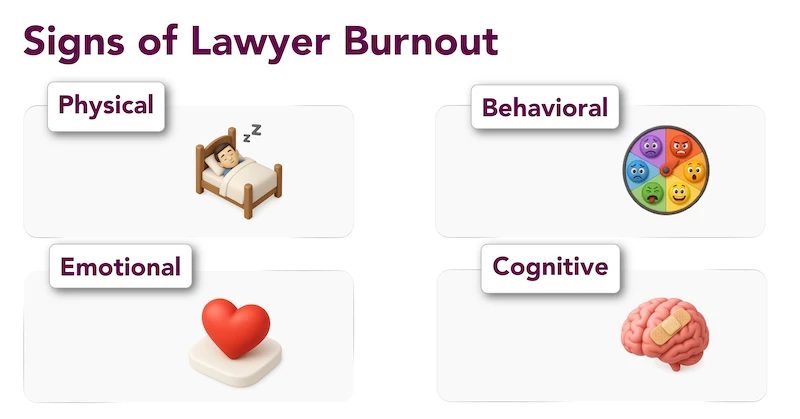
Burnout rarely announces itself. It builds quietly until it affects your work and your clients, and as a solo, there is no partner to catch what you miss. Watch for signs across four areas.
- Emotional: irritability, cynicism, dread before opening your inbox, or detachment from clients you used to care about
- Physical: constant fatigue, disrupted sleep, headaches, or getting sick more often than usual
- Cognitive: trouble concentrating, forgetfulness, indecision, or simple tasks taking twice as long
- Behavioral: procrastinating on filings, avoiding client calls, missing deadlines, or leaning on caffeine and late nights to keep up
When you are the whole firm, any one of these is more than a wellness concern. A missed deadline is your liability, and a lapse in judgment lands on your name. Catching these signals early gives you room to adjust before they become a real risk.
How Do You Prevent Burnout and Protect Your Practice?
Prevention is not about willpower or squeezing in more self-care after hours. It is about designing a practice that does not run you into the ground. Four levers do most of the work, and each pays off in billable time.
Set clear boundaries
Boundaries protect the hours that actually generate revenue. Decide when you are available, set response-time expectations in your engagement letters, and hold the line on scope creep. When you keep client demands from eroding your boundaries, you stop trading unpaid evenings for the illusion of great service.
Create sustainable work rhythms
Your capacity is finite, so plan around it. Block deep-focus time for the billable work only you can do, batch similar tasks together, and build real breaks into the day. Protect at least one slice of your week for strategy, not firefighting.
Use technology strategically
The right tools remove friction from the tasks that eat your day. Practice management software, automated intake, and calendar tools all cut the manual load. AI is part of this picture too. In a 2025 Rev survey, 54% of legal professionals using AI reported reduced stress. Used well, these tools handle repetitive work so you can focus on judgment.
Just treat technology as a complement to human help, not a replacement. Software can draft a template, but it cannot own a workflow the way a trained assistant can.
Build supportive professional relationships
Solo does not have to mean alone. Peer groups, bar association sections, and mentors give you a place to vent, sanity-check decisions, and remember you are not the only one under pressure. If you work with remote support, invest in the relationship the same way. Building a healthy remote team culture turns an assistant into a genuine partner rather than a task-taker.
Practical Steps to Recover from Existing Burnout
If you are already past the warning signs, prevention advice alone will not cut it. Recovery takes deliberate changes to how your practice runs, starting here.
Run a task-triage audit
For one week, write down every recurring task you touch. Then sort each into a delegate-automate-keep framework:
- Delegate: work a trained assistant can own, such as intake, scheduling, and document prep
- Automate: repetitive steps a tool can handle, such as appointment reminders and standard form generation
- Keep: high-judgment work that requires your license and expertise, such as strategy, advocacy, and legal advice
Most solos are surprised by how little truly belongs in the keep column. That is the first step toward a lighter week.
Seek appropriate support
Burnout can shade into anxiety or depression, and that is not something to white-knuckle alone. Every state has a Lawyer Assistance Program (LAP) offering confidential, often free support for attorneys under stress. Reaching out is a sign of professional responsibility, not weakness, and your state bar can point you to yours.
Restructure how your practice runs
Sometimes the fix is structural. If your caseload, practice areas, or pricing model guarantee overload, no amount of coping will solve it. Restructuring your practice model, whether that means narrowing your focus, raising rates, or changing how you staff the work, can pull you out of the cycle for good.
Build healthy daily habits
The basics still matter. Consistent sleep, movement, real meals, and time fully away from work restore the reserves that chronic stress depletes. You cannot out-hustle a body running on empty.

How Delegation Protects Your Practice and Prevents Burnout
Of every lever here, delegation gives a solo the most leverage. It attacks the root cause: the flood of non-billable work that fills your day and empties your tank. Hand that work to someone reliable and you buy back the hours that burnout steals.
The key is to delegate effectively by deciding what to hand off, setting clear expectations, and giving your support professional enough ownership to keep work moving without constant oversight.
Identify what to delegate first
Start with the non-billable admin that drains your day but rarely needs your license. The quick wins for most solos:
- Client intake and initial screening
- Scheduling and appointment coordination
- Document preparation and formatting
- Calendar and email management
These tasks pile up between billable work and quietly extend your day, so handing them off first delivers the fastest relief. From there, you can outsource your law firm’s administrative support more broadly as your systems mature.
Overcome the solo’s delegation barriers
If delegation is so effective, why do so few solos do it? The objections are real. The first is cost anxiety: the worry that you cannot afford help. The second is time: you feel too buried to hire and train anyone. The third is control: with your name on the door, letting go feels risky.
In a 2025 Rev survey, 41% of solo practitioners cited a lack of support and resources as a burnout driver, while only 2% of legal professionals outsource administrative work.
Reframe the cost, though, and the math shifts. Estimates from NALP, cited by Thomson Reuters, put the cost of replacing a departed associate at USD 200,000 to USD 500,000. A virtual assistant adds capacity without that overhead or a full-time salary.
To be clear, delegation is not a cure. It changes the conditions that produce burnout. The Bloomberg Law 2024 Attorney Well-Being Report found that attorneys reported burnout about half the time during the second half of 2023, a period when they averaged roughly 50 hours a week, with an unmanageable workload among the well-being challenges they cited most.
In professional workers generally, a 2025 study in Frontiers in Psychology found that job autonomy buffers how heavy workload demands translate into stress. Offloading admin pushes both dials the right way: your workload drops, and your control over your day goes up.
Find the right support
Not all help is equal, and the wrong hire can add stress instead of removing it. For a solo, the right fit shares a few traits: bilingual capability, alignment with your U.S. time zone, and pre-vetting so you are not gambling on an unknown. It helps to understand what a virtual legal assistant does for a solo law firm before you hire.
This is where Virtual Latinos fits. You get access to the top 1% of pre-vetted bilingual professionals from Latin America, matched through a human-guided hiring process rather than a cold marketplace. And our Replacement Guarantee means you won’t be stuck if the first match isn’t right.
Ready to reclaim your billable hours? Book a free strategy call and see what handing off the admin could do for your week.
Create effective delegation systems
Delegation works when it is built on a system, not a hope. Give clear written instructions the first time, set regular check-ins to review work, and build templates and checklists for recurring tasks. Use a shared task tool so nothing falls through the cracks. A little structure up front turns a new hire into a dependable extension of your practice.
Moving from Overwhelmed to Optimized
Step back, and the throughline is clear. Burnout is not a personal failing to push through. It is a business risk that threatens the asset your livelihood depends on: you. Protect your energy, and you protect your judgment, your client relationships, and your revenue.
The highest-leverage move is also the most practical. Every non-billable hour you reclaim is an hour you can bill, invest in growth, or get back for yourself. Boundaries, sustainable rhythms, smart technology, and above all strategic delegation turn an overwhelmed solo into an optimized practice that runs on systems, not sheer endurance.
Key Takeaways
- Treat your energy like your firm’s most valuable billable asset. Protecting it is a business decision, not self-care.
- Set and communicate clear boundaries so client demands stop eroding the hours that actually generate revenue.
- Offload non-billable admin such as intake, scheduling, and document prep first. It is the fastest way to reclaim billable capacity as a solo.
- Use a simple delegate-automate-keep audit to decide what only you should touch and what a trained assistant can own.
- A vetted, time-zone-aligned virtual legal assistant lets you add capacity without the cost, delay, or risk of a local full-time hire.
Frequently Asked Questions
What is the burnout rate for lawyers?
Burnout among lawyers is common, though studies measure it differently. Attorneys felt burned out 42% of the time, a frequency measure rather than a headcount. A separate 2025 Rev survey of 550 legal professionals found nearly 80% reported at least occasional burnout in the past year, a prevalence measure.
- The Bloomberg figure describes how often attorneys feel burned out, not how many
- The Rev figure describes how many felt it at least sometimes, and includes paralegals and legal staff
What are the most common signs of lawyer burnout?
The most common signs fall into four categories: emotional, physical, cognitive, and behavioral. Recognizing them early lets you act before they affect clients.
How can a solo attorney start delegating without losing control?
Start small and keep the high-judgment work. Offload tasks that do not require your license while you stay firmly in charge of legal strategy and advice.
Which tasks should a solo law firm delegate first?
Delegate the non-billable administrative work, client intake, initial screening, scheduling, and appointment coordination, document preparation and formatting, and calendar and email management. These are the fastest wins for reclaiming billable capacity.
Can a virtual legal assistant really help prevent burnout?
A virtual legal assistant does not cure burnout, but it changes the conditions that cause it. By taking non-billable admin off your plate, it lowers your workload and restores control over your day, the two factors most tied to burnout risk. It removes repetitive tasks, so you focus on high-value legal work and adds capacity without the cost of a full-time local hire.
Final Thoughts
You did not open your own practice to spend hours on paperwork or to feel burned out by the work you once loved. Protecting yourself from lawyer burnout is not indulgent. It is how you protect the business only you can run.
The path from overwhelmed to optimized runs through the choices you make now: set boundaries, build sustainable rhythms, and hand off the admin that is quietly draining your week. When you are ready to add capacity, you can hire a pre-vetted virtual legal assistant who works in your time zone and integrates from day one.
Your energy is your firm’s most valuable asset, so guard it accordingly. Book a free strategy call and start building a practice that supports you instead of consuming you.