| TL;DR |
|
You bill 2.5 hours on real legal work in the morning, and then the rest of the day disappears. Intake calls, formatting, e-filing, chasing an unpaid invoice, sorting an inbox that never empties. By 7 p.m. you are still at your desk, and the work that actually pays has barely moved.
You are not imagining the squeeze. Attorneys felt burned out 42% of the time, and spent two of every eight working hours on administrative duties.
If you are a true solo, this stings more, because there is no one to hand work to yet. You are the associate, the paralegal, the receptionist, and the bookkeeper at once. Learning how to delegate legal tasks is the first real lever you have, and it starts with a clear picture of what a virtual legal assistant for solo lawyers can actually take off your plate.
Why Most Solo Attorneys Lose 10+ Hours a Week to Non-Billable Work
The gap is not a discipline problem. It is a math problem. Clio found the average lawyer records only 2.9 billable hours in an 8-hour day, leaving 5.1 hours that never make it onto an invoice.
Zoom out to the week, and the picture gets sharper. The Bloomberg Law 2024 survey shows attorneys working about 48 hours but billing just 36, a 12-hour gap swallowed by work that pays nothing. Two of every eight working hours go to administrative duties alone.
For a solo, every one of those hours has your name on it. With no team to absorb the overflow, it becomes your evenings and weekends. Reclaiming even 10 of those hours is not a stretch goal. It is what happens when the admin stops landing on your desk.
The Mindset Shift From Perfectionism to Leverage
Most solos do not have a time problem. They have a control problem. The belief that no one can do it as well as you keeps every task on your plate, and it quietly caps how large your practice can ever get.
Here is the shift, laid side by side:
| Perfectionist mindset | Leveraged mindset |
| Only I can do this right | I can teach this once and review it |
| Delegation is a luxury for big firms | Delegation is how small firms become big firms |
| Handing off work feels like losing control | Handing off work is how I regain control of my calendar |
| My value is in doing everything | My value is in legal judgment and client relationships |
The firms that grow are not the ones with the busiest owners. They are the ones where the owner protects their judgment and lets a trusted team handle the rest. Building that trust takes a little structure, which is easier than it sounds when you focus on building trust in virtual teams from the start.
Quick Quiz: Are You Stuck in the Overwork Cycle?
Answer yes or no:
- You regularly work past 6 p.m. to finish work you could not touch during the day
- You are the only person who can move any task forward
- You have skipped or rushed billing because you ran out of time
- You answer your own phone and schedule your own calls
- You format your own documents and handle your own e-filing
- You feel guilty taking time off because the work simply stops
Three or more yeses means you are not overworked because you lack effort. You are overworked because you have no leverage yet.
How Much Time Can Delegation Really Save You?
Before you hire anyone, get honest about where your hours go. A quick audit turns a vague feeling of being buried into a concrete plan.
Calculate your current non-billable load
For one week, track every task in 30-minute blocks and tag each as billable or non-billable. Most solos are shocked to see 15 to 20 hours a week land in the non-billable column. That number is your opportunity.
Identify low-value recurring actions
Circle the tasks that repeat and require little legal judgment: intake scheduling, calendar management, document formatting, inbox sorting, invoice follow-ups. These are the first things a virtual legal assistant can take off your plate.
Set a weekly reclaim target
Pick a realistic number to start, such as 10 hours a week. That target gives you a clear brief for what to delegate and a clean way to measure whether delegation is working.
What Delegation Actually Costs, and What You Get Back
Let us be honest about the hesitation, because it is usually about cash flow, not belief. Adding a monthly cost when you are already stretched feels risky. So look at the actual math before you decide.
Virtual Latinos pricing runs in tiers: Starter is USD 1,800 to USD 2,100 per month, Professional is USD 2,300 to USD 3,000 per month, and Advanced is USD 3,200 to USD 3,500 per month, depending on the role and experience you need. Now weigh that against what you recover.
If your billing rate is USD 250 an hour and you reclaim just 10 hours a week, that is 40 hours a month of capacity you did not have. Rebilling even a handful of those recovered hours covers the cost, and the rest is margin, or the evenings you get back. The broader decision comes down to whether legal outsourcing makes more sense than adding that capacity in-house once you factor in cost, scalability, and compliance.
A virtual assistant also spares you the payroll, benefits, office space, and HR overhead of a local hire, so the payback often arrives faster than solos expect. Curious who could take these hours off your plate? You can hire a pre-vetted virtual legal assistant and see the talent available, with no pressure to commit.
A Step-by-Step System to Reclaim 10 Hours Through Delegation
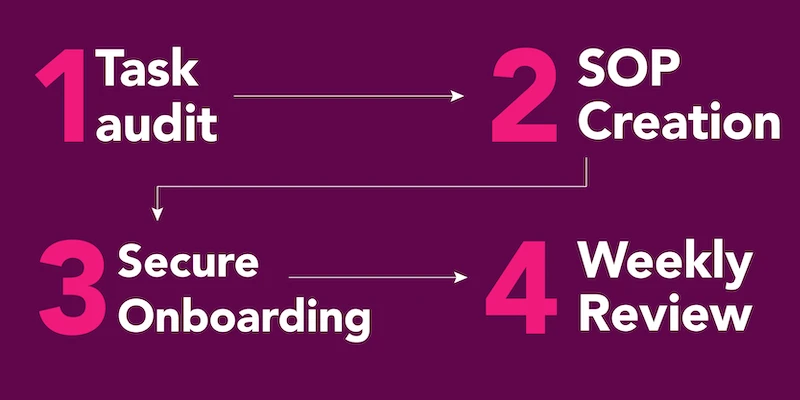
Good intentions do not reclaim hours. A repeatable system does. Here is the one that works for solos.
Step 1: Audit and categorize your workload
Take the week of tracking you did earlier and sort every task into three buckets. Categorizing before you delegate beats delegating reactively, because you hand off the right work in the right order instead of whatever is loudest that day.
| Keep | Delegate | Automate |
| Legal advice and strategy | Client intake and scheduling | Appointment reminders |
| Court appearances | Document formatting | Recurring invoices |
| Negotiation and settlement calls | Inbox triage | Calendar syncing |
| Signed pleadings and filings | Billing follow-ups | Intake form routing |
Step 2: Create simple standard operating procedures
For each task you delegate, record a two- to five-minute Loom video and write a one-page checklist. This is the difference between delegation that sticks and delegation that boomerangs back to you. Build a short library of SOPs for each delegated task so quality stays consistent no matter who does the work.
Step 3: Secure and onboard your virtual assistant
Hire a pre-vetted virtual legal assistant who works in your U.S. time zone and is bilingual, so client communication never skips a beat. Virtual Latinos Virtual Professionals are screened before they reach you, and a structured onboarding process gets them productive in your systems without weeks of guesswork.
Step 4: Automate tracking and feedback loops
Set a short weekly check-in for the first month to answer questions and refine SOPs. Measure your billable hours before and after so you can see the reclaimed time in your numbers, not just your gut feeling.
Delegate Safely: Ethics, Confidentiality, and ABA Model Rule 5.3
Delegation for a lawyer is not the same as delegation for any other business owner. The good news is the rules are clear, and following them is straightforward.
Under ABA Model Rule 5.3, you remain professionally responsible for the work of a nonlawyer or virtual assistant and must supervise it reasonably. Delegation does not transfer your duty. It extends your reach while you stay accountable.
That means some tasks never leave your hands:
- Giving legal advice to a client
- Court appearances and oral argument
- Signing pleadings and filings
- Settlement decisions that require legal judgment
- Conflicts analysis
Everything else, the admin and support layer, is fair game with the right guardrails. Protect confidentiality with a signed confidentiality agreement, limited-permission access to only the systems the task requires, and clear training on privilege.
A pre-vetted Virtual Latinos Legal Assistant is screened before onboarding, which helps you meet your supervision duty and protect attorney-client privilege from day one. When delegation involves prospective-client intake, ABA Formal Opinion 506 provides additional guidance on the role and supervision of nonlawyer assistants.
Tasks Solo Attorneys Should Delegate First to Protect Billable Hours
Start where the volume is highest, and the legal judgment is lowest. These four categories return the most time for the least risk. Map these day-to-day tasks from a virtual legal assistant to your own week.
Client intake and scheduling
New-client intake, calendar coordination, and reminders eat hours and rarely need you personally. A virtual assistant can screen, schedule, and prep the file so you walk into every meeting ready.
Document formatting and e-filing
Formatting pleadings, assembling exhibits, and handling e-filing logistics are repetitive and rule-bound, which makes them ideal to hand off. You still review and sign. Someone else does the assembly.
Inbox triage and phone screening
Let a trusted assistant sort your inbox, flag what is urgent, and screen calls so you protect deep-work blocks. You respond to what actually needs a lawyer, not to every message that lands.
Billing follow-ups and collections
Sending invoices, nudging late payers, and tracking receivables is work most solos avoid until cash gets tight. Hand it off and get paid faster. A consistent process for collecting past-due invoices turns payment follow-up into a routine workflow instead of something you only address when cash flow becomes a problem.
Lead Your Firm, Not Your Inbox

Every hour you spend formatting a document is an hour you are not practicing law, growing your book, or resting. Delegation is not about doing less. It is about doing the work only you can do, and letting a capable team handle the rest. That is the difference between owning a job and leading a firm.
Key Takeaways
- You can realistically reclaim 10 or more billable hours a week by handing off recurring admin work, not by working longer
- Start with the highest-frequency, lowest-judgment tasks first: intake, scheduling, inbox triage, document formatting, and billing follow-ups
- A one-page SOP or a short Loom video for each task is what makes delegation stick and protects your quality
- Delegation stays ethical when you keep legal advice, court appearances, and signed filings yourself and supervise the rest under ABA Model Rule 5.3
- A pre-vetted virtual legal assistant in your time zone usually pays for itself once you rebill even a few of the hours you recover
- Track your billable hours before and after, so the reclaimed time shows up in your numbers and not just your gut
Frequently Asked Questions About Delegating Legal Work
How do I delegate client communication without losing the personal touch?
You keep the relationship while your assistant handles the logistics. Draft a few approved templates for scheduling, follow-ups, and status updates so the voice stays consistent. Reserve substantive conversations for yourself, and let your assistant manage timing, reminders, and routing. A bilingual assistant in your time zone means clients still reach a real person fast.
Can a virtual assistant work inside my practice management software?
Yes, with a limited-permission user account rather than shared logins. Most platforms, including Clio, MyCase, and PracticePanther, let you grant role-based access so your assistant sees only what the task requires. Set permissions to match each duty, and review your state bar’s guidance on cloud access and confidentiality before you begin.
What tasks can a solo attorney ethically delegate to a virtual assistant?
You can delegate administrative and support work, but not the practice of law itself. Under ABA Model Rule 5.3, legal advice, court appearances, signed filings, and settlement judgment stay with you. Intake, scheduling, formatting, e-filing logistics, inbox triage, and billing follow-ups are all delegable when you supervise reasonably and use clear SOPs.
Is a virtual legal assistant worth it for a solo practice versus hiring locally?
For most solos, yes, because the return shows up in recovered billable hours without the overhead. You skip payroll taxes, benefits, office space, and HR administration that come with a local hire. A pre-vetted virtual legal assistant is built for a long-term relationship, not a temporary gig, so you train once and keep the value for years.
How quickly can I expect to see the 10-hour savings?
Most solos see measurable time back within 30 days and a full reclaim within 60 to 90 days. Start with high-frequency, low-judgment tasks so the wins come early. Keep a short SOP and a quick review step for each task to reduce errors and let you hand off more with confidence as trust builds.
Take Back Your Week and Lead Your Firm Forward
You did not open your practice to spend your evenings formatting documents and chasing invoices. The path out is not working harder. It is handing off the recurring work, keeping the legal judgment that only you can provide, and watching your billable hours climb back to where they should be.
The math is on your side, the ethics are clear, and the talent is ready. When you are ready to make the move, hire a pre-vetted virtual legal assistant and start reclaiming your week.