
| TL;DR |
|
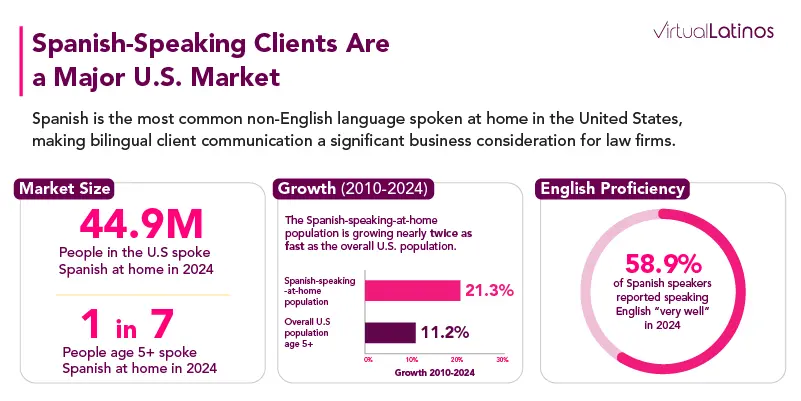
If you run a solo practice or a small firm, the choice between translation tools vs bilingual legal virtual assistants shows up the moment a Spanish-speaking caller reaches your intake line. You are practicing law and running the business at the same time, and whether that caller stays with you or moves on to the next firm often comes down to one thing: can your office speak their language? The market is real: about 44.9 million U.S. residents age five and older speak Spanish at home, roughly one in seven people.
Free software looks like the fast, cheap fix. The harder question is what happens when a mistranslated term ends up in something you sign, file, or send to a client.
Translation Tools vs Bilingual Legal Virtual Assistants at a Glance
Before you weigh features, look at the two options side by side. Software wins on raw speed and price for low-stakes text. A trained human wins everywhere accuracy, trust, and confidentiality carry real consequences for your practice.
| Factor | Translation tools | Bilingual legal virtual assistant |
| Accuracy | Fast and often fluent, but no accountability for legal meaning | Reviews context, catches misused terms, and can flag what needs a certified translator |
| Confidentiality | Free consumer tools may use your input outside your firm’s controls | Works inside your policies, systems, and confidentiality expectations |
| Scope of work | Converts text only | Handles intake, follow-up, scheduling, documents, and client rapport |
| Cost | Low or free upfront, with hidden risk cost | Predictable, far below a full-time local hire |
| Client trust | Impersonal, no relationship | A consistent human voice clients recognize and trust |
| Best use | Quick gisting and internal triage | Anything client-facing, signed, or filed |
Use software when speed matters more than nuance. Bring in a human the moment a mistake would cost you a client, a case, or your standing with the bar.
What Translation Tools Do Well (and Where They Stop)
Translation software earns its place in your workflow. When a Spanish-language email lands in your inbox, a quick machine translation tells you what it is about and how urgently it needs a response. That is real value for a busy solo who cannot afford to sit on a hot lead.
Tools are genuinely useful for a few jobs:
- Gisting incoming messages so you can triage and prioritize your day
- Getting the rough sense of a low-stakes document before you decide what to do with it
- Internal review, where nothing leaves your desk, and no one relies on the output
- Quick, disposable text that will never be signed, filed, or sent to a client
Where they stop is just as important. A translation tool has no duty to your client and no stake in the outcome. It will produce a confident answer whether or not that answer is correct, and it cannot tell you when it is wrong.
For triage, that is fine. For a contract clause, an intake summary you rely on, or a message that shapes a client’s decision, “confident” is not the same as “correct.” That gap is exactly where risk lives.
Where Machine Translation Fails in Legal Work
The problem is not that machine translation is always wrong. The problem is that it is wrong in ways you cannot see unless you already speak the language and know the law. Here are the three failure modes that matter most for a small firm.
Ambiguous legal terms and no jurisdictional equivalent
Legal language is precise on purpose, and everyday translation flattens that precision. Words like “sanction,” “consideration,” and “indemnify” carry specific meanings that shift with context, and many concepts have no clean equivalent in another legal system.
This is a documented risk, not hypothetical. A 2013 evaluation funded by the Legal Services Corporation found that machine-only translation “results in significant translation errors that may be critical in the context of the provision of legal services.”
When that same evaluation tested legal Spanish text about spousal support, the software produced errors that “completely changed” the meaning. Today’s AI is more fluent, but fluency is not accuracy, and that older finding still proves the core point: legal translation needs human review.
Formatting that changes meaning
Small formatting differences quietly rewrite the substance of a document. Dates, decimals, and number conventions vary across countries, so a machine can flip a figure or a deadline without any warning.
The stakes get higher when two language versions of the same document disagree. In Juarez v. Wash Depot Holdings (Cal. Ct. App. 2018), conflicting English and Spanish versions of an arbitration clause made the entire agreement unenforceable. A discrepancy you never noticed can undo the protection you drafted for.
Confidentiality and privilege risk of free AI tools
When you paste client facts into a free consumer AI tool, that information can travel outside your firm’s confidentiality and privilege controls. ABA Formal Opinion 512 (July 2024) makes clear that lawyers must understand how AI tools use client data and put adequate safeguards in place under Model Rule 1.6, and that boilerplate consent in an engagement letter is not enough before you feed client confidences into these tools.
This is not a ban on AI. It is a reminder that convenience does not excuse you from your duty to protect what clients tell you.
What a Bilingual Legal Virtual Assistant Does That Software Cannot
Software converts text. A bilingual legal virtual assistant works the relationship. That difference moves the needle for a small firm serving Spanish-speaking clients.
A trained bilingual professional supports the whole client journey, not one isolated task:
- Live, warm intake so a Spanish-speaking caller feels understood on the first call
- Follow-up and scheduling that keep leads from going cold
- Document collection and organization, with the judgment to flag anything that needs a certified translator
- Cultural rapport that turns a nervous first-time caller into a signed, loyal client

There is also a language point that software misses entirely. Legal Spanish, the register used in contracts and courtrooms, is not the same as the conversational Spanish most people speak at home. A trained bilingual professional bridges that gap, matching the right register to the moment so your client understands what they are agreeing to and your documents say what you mean.
That language support can sit within the broader responsibilities of a virtual legal assistant for solo lawyers, connecting bilingual client communication with the intake, follow-up, and administrative work that keeps a small practice moving.
The Real Cost Comparison for a Small Firm
Cost is where most solos get the comparison backward. A free tool looks like it costs nothing, but the price shows up later: a lost client, a mistranslated clause, or a confidentiality slip that no software company will answer for. That is unmanaged risk sitting on your books.
Line the three options up honestly:
- Free or low-cost software: little upfront spend, but the hidden cost of errors and confidentiality exposure lands on you and your license.
- A full-time local bilingual hire: reliable, but a heavy salary, benefits, and payroll commitment that a solo or small firm often cannot justify for a workload that ebbs and flows.
- A bilingual legal virtual assistant: a predictable, part-time-friendly cost, well below a full-time local hire, with a real human accountable for the work.
Framed this way, the decision is not software versus salary. It is whether you carry unmanaged risk or hire an affordable, pre-vetted human who covers the work software cannot.
How to Decide: A Simple Framework for Your Firm
You do not have to choose one tool for everything. Use a triage-versus-execution rule and the decision gets easy.
Reach for a translation tool for triage: understanding an incoming message, sorting your inbox, or getting the gist of low-stakes internal text. Bring in a bilingual legal virtual assistant for execution: anything client-facing, signed, filed, or relied upon. The stakes tell you which side of the line you are on.
The need is only growing. Among working-age Spanish speakers ages 18 to 64 in the U.S., more than 40% report speaking English less than “very well”, according to U.S. Census Bureau data. Many of them will need real, human communication to move through your process with confidence, not a machine-translated form.
One more line to keep in mind: for official filings, a certified translator is still required. Federal rules for immigration filings, for example, require that any foreign-language document submitted to USCIS come with a certified English translation attesting that the translation is complete and accurate.
A bilingual legal virtual assistant helps you spot those moments early and route the document correctly, so nothing critical slips through on autopilot.
Why Virtual Latinos Is the Ideal Partner for Bilingual Legal Support
Once you accept that some work needs a human, the next question is where to find one you can trust without a long, risky hiring slog. That is what Virtual Latinos was built for.
You get access to the top 1% of pre-vetted bilingual Virtual Professionals from Latin America, screened for English fluency, role-specific skills, and cultural fit before they ever reach you. They work in U.S. time zones, so a Spanish-speaking client who calls first thing in the morning gets a live, warm response instead of a next-day callback.
Our human-guided hiring process pairs you with the right person instead of handing you a list of profiles to sort alone. And our Replacement Guarantee means you are not stuck if the first match is not the right fit.
Hire a virtual assistant to grow your business.
Key Takeaways
- Use tools for triage and speed, and a trained human for anything client-facing, signed, or filed, so you capture Spanish-speaking leads without adding malpractice exposure.
- Treat language access as a growth lever, because it often decides whether a caller retains you or dials the next firm.
- A pre-vetted bilingual professional in U.S. time zones costs far less than a full-time local bilingual hire while covering intake through follow-up.
- “Fluent” output is not the same as “accurate” output; natural-sounding machine text can still misstate the law.
- Choosing the right mix protects your license, your clients, and your calendar.
- The practical answer for most solos is both tools and a human, each doing the job it is actually good at.
Frequently Asked Questions
Can a bilingual virtual assistant translate legal documents, or do I still need a certified translator?
Yes, a bilingual legal virtual assistant can translate routine client communication and draft materials, but court filings and other official records still require a certified translator. Use each for what it does best:
- A bilingual legal virtual assistant handles everyday emails, intake notes, client updates, and document review, and flags anything sensitive.
- A certified translator provides the formal certification of accuracy that official filings require; for instance, foreign-language documents submitted to USCIS must include a certified English translation.
- A good assistant helps you tell the two apart so nothing critical is filed without the right sign-off.
Is Google Translate or ChatGPT safe to use for client communication in my law firm?
Generally no, not for substantive client communication, because free consumer tools can move your input outside your firm’s confidentiality and privilege controls.
How much does a bilingual legal virtual assistant cost compared with translation software?
Software is cheaper upfront, but it carries hidden risk costs when errors or confidentiality slips land on you. A bilingual legal virtual assistant is a predictable expense, well below a full-time local bilingual hire, and it comes with a real person accountable for the work.
What can a bilingual legal virtual assistant do besides translate?
Quite a lot. A bilingual legal virtual assistant runs live intake, follow-up, scheduling, and document collection, and builds the kind of rapport that turns a first call into a signed client. It supports the whole relationship, not one isolated task.
Can a bilingual legal virtual assistant work during U.S. business hours?
Yes. Virtual Latinos professionals work in U.S. time zones, so your Spanish-speaking clients reach a live person during your business hours instead of waiting for a callback the next day.
How is a bilingual legal virtual assistant different from an answering service or a court interpreter?
An answering service takes messages, and a court interpreter serves a specific proceeding. A bilingual legal virtual assistant works inside your practice day-to-day, handling client-facing tasks across the journey while knowing when to route work to a certified translator or interpreter.
Serve Every Client With Confidence
The choice was never really software or nothing. Translation tools are great for triage and speed, and they belong in your workflow. But for anything a client signs, relies on, or hears from your firm, you need a human who is accountable for accuracy, protects confidentiality, and builds trust. That is how you serve a growing Spanish-speaking client base without adding risk you cannot carry.
At Virtual Latinos, we make that human affordable and low-risk: pre-vetted top 1% bilingual talent in U.S. time zones, a human-guided hiring process, and a Replacement Guarantee. Give your Spanish-speaking clients the real, human service that wins their trust, and give yourself your time back.