
Forget the outdated myth that outsourcing is reserved only for enterprise giants. Today’s lean, fast-moving companies are thriving with managed services—delegating complex IT management to seasoned experts while keeping their internal focus firmly on growth and innovation.
This shift is not just a trend; it’s reshaping the very foundation of business success in a hyperconnected world.
From cybersecurity to network performance optimization, managed services provide the technical backbone that empowers organizations to operate more efficiently, securely, and competitively.
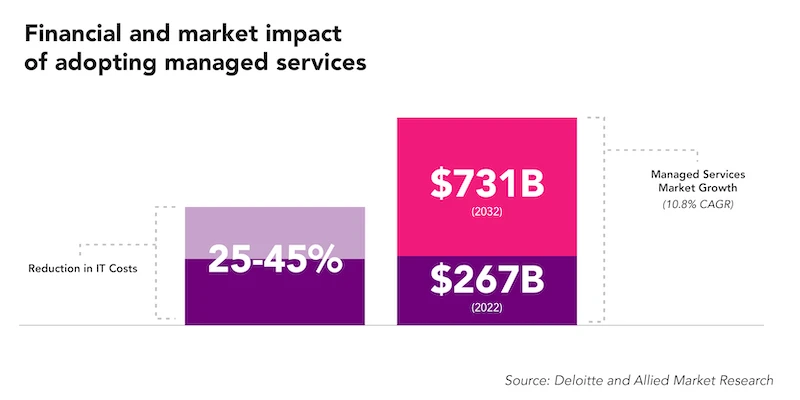
The impact is tangible: organizations that adopt managed services report an average 25–45% reduction in IT costs, thanks to predictable pricing models and increased operational efficiency.
Financial predictability frees up valuable resources that can be reinvested into core business initiatives, fueling sustained growth.
It’s no surprise, then, that the global managed services market is on a steep upward trajectory—valued at $267.3 billion in 2022 and projected to soar to $731.1 billion by 2032, with a 10.8% CAGR.
Forward-thinking enterprises recognize that managed services are not just about outsourcing tasks; they are about building strategic partnerships that drive resilience and scalability.
Let’s explore in depth the advantages of adopting a managed services model, uncover how it can elevate your business performance, and explain why it’s a smart, future-proof strategy for today’s most ambitious and innovative organizations.
What is a Managed Services Model?
According to SAP’s definition of an MSP, an MSP is a third-party company that manages and delivers a defined set of services to another company—their customer—usually in the areas of contingent labor or IT services.
Typical responsibilities managed by MSPs span across several core business areas, including:
- Information technology (IT): Ensuring network connectivity, managing infrastructure, and handling data backup and disaster recovery processes.
- Marketing: Developing strategic plans, creating marketing campaigns, and producing written content to support brand communication.
- Human resources: Overseeing processes like employee onboarding and offboarding, as well as managing payroll and benefits administration.
- Contingent workforce management: Coordinating the hiring, assignment, and monitoring of temporary or contract workers.
- Supply chain operations: Managing activities related to sourcing suppliers, purchasing goods, overseeing logistics, and handling product distribution.
Rather than managing operations internally—often at great expense and with limited specialization—companies entrust these functions to specialized providers who deliver ongoing support, monitoring, and proactive management.
In the IT context, partnering with a managed IT service provider (MSP) offers access to seasoned professionals without the burden of recruiting, training, and maintaining a full-time, in-house IT team.
This collaboration ensures critical systems, networks, and cybersecurity defenses are not only maintained but continuously optimized—allowing internal teams to redirect their focus toward innovation, customer experience, and business growth.
Importantly, the managed services model is not just reactive (fixing problems after they occur); it is proactive. MSPs monitor infrastructure, anticipate vulnerabilities, and implement preventive measures to minimize downtime and mitigate risks.
As SAP outlines, MSPs often leverage sophisticated technology and analytics to continuously improve service delivery and ensure compliance.
According to a report by CompTIA, 46% of organizations using managed services have rreduced their annual IT costs by 25% or more. By outsourcing IT functions, businesses can reduce the need for additional in-house IT staff, thereby cutting down on salaries, benefits, and training expenses.
Moreover, scalability is a key advantage: as businesses grow, their needs become more complex. MSPs can adapt services dynamically, offering flexible support that scales up—or down—based on evolving business demands.
In short, partnering with a managed service provider is like having a trusted technology ally: one that ensures your IT backbone remains resilient, secure, and aligned with your long-term goals—empowering your business to innovate, scale, and lead in a digital-first world.

Why Managed Services Are a Smart Choice
Managed services offer a streamlined, cost-effective approach to managing IT infrastructure, enabling organizations to stay competitive, secure, and efficient.
This model not only benefits enterprises but also contributes to community development and the global expansion of remote talent—particularly across Latin America.
Empowering businesses to trive
Managed services empower organizations by delivering expert-level IT support, proactive maintenance, cloud optimization, and cybersecurity—all on a scalable, subscription-based model.
This approach allows companies to reduce operational risks, lower internal IT costs, and enhance performance through 24/7 support and the latest technological tools.
According to Research and Markets report, businesses that outsource IT to managed service providers (MSPs) can reduce operational costs by 20–25% while boosting productivity and resilience.
By offloading complex IT management, companies can focus on their core mission: delivering value to customers, innovating new products, and growing in competitive markets.
Building stronger, more connected communities
Beyond the private sector, managed services also support community development by enabling local organizations, non-profits, and municipalities to implement and sustain technology-driven initiatives.
These services facilitate centralized systems, secure data sharing, and improved communication among stakeholders.
For instance, cloud-based platforms provided by MSPs allow community leaders to coordinate efforts across sectors—such as health, education, and housing—with greater efficiency and transparency.
This democratization of technology infrastructure ensures that all communities, regardless of size or budget, can benefit from digital transformation.
Attracting talent and unlocking global opportunities
For remote professionals, especially in Latin America, managed services create new gateways to the global economy. As MSPs often operate across borders, they require a diverse, distributed workforce skilled in IT support, cybersecurity, and development. This opens doors for Latin American talent to work on international projects without relocating.
Talent platforms such as Virtual Latinos connect these professionals with companies seeking high-quality remote expertise. This shift has created a boom in remote hiring. A Statista (2024) report found a 30% year-over-year increase in IT-related remote jobs in Latin America, much of it driven by the global adoption of managed services.
Remote professionals benefit by accessing stable income, upskilling opportunities, and exposure to international work standards—without the barriers of geographic limitation.
Managed services are more than an operational shortcut—they’re a strategic enabler for business growth, community resilience, and talent mobility.
By aligning with experienced providers, companies can optimize performance, foster inclusive digital ecosystems, and engage skilled professionals worldwide. It’s a smart, sustainable choice for a connected future.

Advantages of Managed Services
Adopting a managed services model is more than a tactical decision—it’s a strategic investment in long-term growth, resilience, and agility. Below, we explore the core advantages that make managed services a smart choice for forward-thinking organizations.
Cost-efficiency: A financially savvy choice
One of the most compelling benefits of managed services is their ability to stabilize IT costs. Instead of dealing with unpredictable expenses due to system failures or emergency upgrades, businesses benefit from fixed, monthly pricing models.
This cost predictability simplifies budgeting and frees capital for strategic growth initiatives.
Access to expertise: Leveraging top talent
Partnering with a Managed Service Provider (MSP) gives businesses access to a diverse and skilled team of IT professionals—without the overhead of hiring, training, and retaining full-time staff.
From cybersecurity and cloud computing to data analytics and network management, these experts stay current with industry trends and regulatory compliance.
In a time when IT talent shortages are growing, especially in specialized fields, MSPs fill a critical gap. Korn Ferry projects that by 2030, there will be a global talent shortage of over 85 million skilled workers, costing businesses up to $8.5 trillion in lost revenue annually.
Enhanced focus on core objectives
Delegating IT operations to an MSP allows internal teams to focus on core business goals instead of being bogged down by technical issues or infrastructure management. This shift boosts productivity, enables innovation, and accelerates the development of new services or products.
Scalability and flexibility: Adapting to change
One of the key advantages of managed services is their built-in scalability. As your business evolves—expanding to new markets, increasing user demands, or introducing new digital services—your IT support can evolve with you.
MSPs offer flexible service plans that can scale up or down depending on business needs, seasonality, or budget changes.
This agility is especially vital in today’s volatile economic and technological landscape. According to Allied Market Research, the managed services market is expected to grow from $267.3 billion in 2022 to $731.1 billion by 2032, a testament to its increasing relevance in adaptive business models.
By embracing managed services, businesses unlock a model designed for cost control, technical excellence, strategic focus, and future-proof flexibility—exactly what’s needed to thrive in a rapidly evolving digital world.
Ready to Scale Smarter? Supercharge Your Business with Managed Services
Managed services offer a proven approach to streamline operations, reduce overhead, and enhance focus on strategic goals—without compromising quality or control.
This is a smarter, leaner way to work. Whether you’re expanding globally, navigating remote operations, or simply craving more time to focus on your core mission, managed services give you the power to do more with less.
From cutting costs to unlocking elite IT expertise and empowering global talent, the managed services model is designed for businesses that are ready to lead—not just keep up.
Say goodbye to operational stress and hello to scalable success—discover how managed services can power your next chapter. Contact us today.