
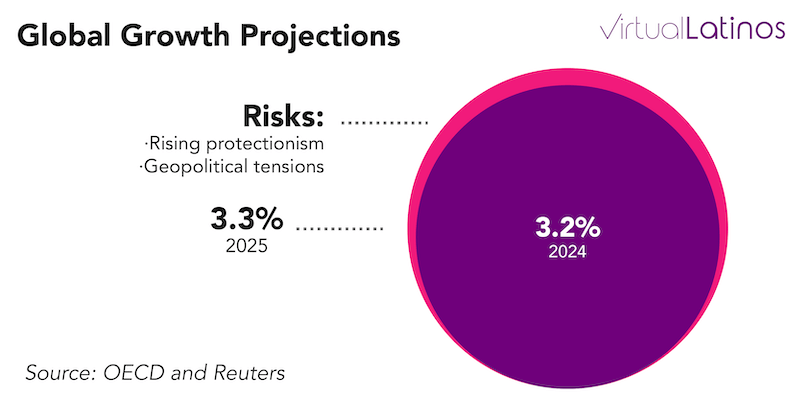
Offshore outsourcing is shaking up how businesses deal with the challenges of today’s global economy. On one hand, global growth is projected to hit 3.3% in 2025, just a bit higher than the 3.2% expected for 2024.
But on the flip side, this moderate growth comes with risks like rising protectionism and geopolitical tensions, which could destabilize economies.
In the U.S., potential protectionist policies tied to political changes might lead to higher tariffs, impacting inflation and global trade.
Meanwhile, Europe has its own hurdles, with expected interest rate cuts influenced by political uncertainties in key countries like Germany and France.
Despite these risks, experts are predicting a “soft landing” for the global economy in 2025—avoiding a full-blown recession but still navigating cautious waters.
In this context, offshore outsourcing stands out as a solid strategy for businesses aiming for resilience and scalability.
By tapping into global talent and cost efficiency, companies can adapt to market uncertainties, drive innovation, and stay competitive.
Next, we’ll dive into the world of offshore outsourcing—what it’s all about, its benefits, challenges, and best practices—to help decision-makers unlock its full potential and build future-ready businesses.
Key Insights of Offshore Outsourcing
Offshore outsourcing is a business strategy where companies hire external firms in other countries to handle specific tasks or business functions. These can range from customer service and IT support to software development and manufacturing.
By delegating non-core activities, businesses outsource operations to achieve cost savings, access specialized skills, and focus on core competencies.
Offshore outsourcing is primarily driven by three key benefits:
- Cost efficiency
- Specialized expertise
- Global reach
However, offshore outsourcing isn’t without its challenges. Communication barriers due to time zone differences, cultural misunderstandings, and language gaps can sometimes hinder collaboration.
Additionally, managing quality control and ensuring data security across borders require careful planning and robust systems.
Despite these challenges, offshore outsourcing remains a powerful tool for businesses seeking resilience and scalability in an unpredictable global economy.
Types of Offshore Outsourcing
Offshore outsourcing companies offer a range of services that help businesses streamline operations and focus on growth.
From managing routine business processes to handling complex, knowledge-intensive tasks, these solutions provide the flexibility and expertise companies need to stay competitive in a global market.
Business Process Outsourcing (BPO)
Business process outsourcing (BPO) involves delegating non-core business operations to a third-party provider. Common BPO services include:
- Customer support
- Administrative tasks
- Human resources
- Finance and accounting services
- Data entry
BPO is particularly valuable for businesses looking to improve efficiency in repetitive tasks, allowing internal teams to concentrate on core business activities and strategic goals.
Information Technology Outsourcing (ITO)
ITO refers to outsourcing IT-related services to specialized firms. These services may include:
- Software development services and maintenance
- IT infrastructure management
- Network security
- Data analytics
As companies undergo digital transformation, ITO has become indispensable for organizations seeking advanced technological solutions such as software development services and web development.
To ensure these outsourced projects stay on track and align with business objectives, many teams rely on product management templates, which provide structured workflows, task tracking, and clear documentation for seamless collaboration between internal staff and external vendors.
Knowledge Process Outsourcing (KPO)
KPO involves outsourcing high-value processes that require specialized knowledge. These services include market research, legal processes, and financial analysis. KPO enables businesses to access expert insights and drive competitive advantage.
By leveraging offshore outsourcing companies, businesses can effectively manage a variety of business processes and knowledge-intensive tasks.
This approach not only enhances operational efficiency but also positions organizations to navigate evolving market demands with confidence.

Challenges of Offshore Outsourcing
While offshore outsourcing offers significant advantages, it also comes with its share of challenges.
Recognizing and addressing these hurdles proactively can help businesses maximize the benefits of outsourcing while minimizing potential risks.
Security risks
Sharing sensitive company information with offshore vendors poses potential security risks. Protecting intellectual property and customer data requires robust security measures, such as:
- Encryption protocols
- Regular security audits
- Comprehensive data privacy agreements
Additionally, companies should conduct thorough due diligence when selecting an offshore outsourcing provider, ensuring they comply with international data protection standards like GDPR or HIPAA.
Building trust through transparency and continuous monitoring is key to safeguarding business-critical information.
Lesser control
Outsourcing tasks to external teams may reduce the hiring organization’s control over processes. Challenges such as communication delays, cultural differences, or misunderstandings about project requirements can hinder progress.
To overcome this, businesses should establish:
- Clear communication channels, such as regular video meetings or collaborative tools.
- Measurable performance metrics to track progress and ensure accountability.
Investing in a project manager or liaison who bridges the gap between the in-house team and the offshore vendor can further streamline operations.
Time zone and cultural differences
Offshore outsourcing often involves working across different time zones and cultures, which can complicate collaboration. Misaligned schedules might delay responses, while cultural misunderstandings could affect teamwork or project outcomes.
To address this, businesses can:
- Create overlapping work hours for real-time communication.
- Provide cultural sensitivity training to both in-house and outsourced teams.
- Leverage collaborative tools that enable asynchronous updates, like Slack or Trello.
Quality assurance
Maintaining consistent quality standards across borders can be challenging. Variations in work methodologies or technical expertise may lead to discrepancies in deliverables.
Mitigating this involves:
- Defining clear quality benchmarks from the outset.
- Conducting regular performance reviews.
- Partnering with outsourcing companies that have proven track records in the required domain.
While challenges like security risks, reduced control, and cultural differences are inherent to offshore outsourcing, they are not insurmountable. By adopting strategic measures and fostering strong relationships with outsourcing partners, businesses can navigate these obstacles effectively. Offshore outsourcing, when managed well, remains a powerful tool for achieving global scalability and innovation.
Top Offshore Outsourcing Destinations
Choosing the right offshore outsourcing destination is crucial for businesses seeking cost efficiency, expertise, and seamless collaboration. Each region offers unique advantages tailored to different business needs.
The Philippines
The Philippines is a leading offshore outsourcing destination due to:
- Cost-effective labor
- English-proficient workforce
- Favorable business environment
India
India remains a dominant player in the outsourcing industry, offering:
- Advanced technical expertise
- Competitive pricing
- A robust IT infrastructure
Latin America
Countries like Mexico and Colombia are gaining popularity among U.S. businesses for nearshore outsourcing, thanks to:
- Geographic proximity
- Cultural and linguistic similarities
- High-quality talent pool
These countries provide a strategic advantage for businesses seeking faster communication and collaboration due to overlapping time zones.

Benefits of Offshore Outsourcing
Offshore outsourcing has many benefits and has become a game-changer for businesses seeking to enhance efficiency and reduce costs.
Cost savings
One of the most compelling reasons to embrace offshore outsourcing is cost efficiency. Companies can save up to 70% on labor costs, reduce operational expenses, and eliminate the need for significant infrastructure investments. Offshore outsourcing services help businesses redirect resources to core business activities.
For instance, a U.S.-based company hiring a virtual assistant from Latin America can significantly cut costs while maintaining high-quality service.
Improved business processes
By outsourcing non-core tasks, businesses can streamline operations and focus on strategic initiatives. This leads to improved customer satisfaction, faster turnaround times, and enhanced productivity.
Additionally, outsourcing enables companies to explore new markets and diversify revenue streams.
Access to skilled professionals
Offshore outsourcing provides access to a global talent pool of skilled professionals. Countries like the Philippines and India boast workforces proficient in advanced analytical and technical skills. For example:
- IT professionals from Ukraine excel in software development and data engineering.
- Virtual assistants from Latin America offer multilingual support and administrative expertise.
Leveraging these skills can drive innovation, efficiency, and competitiveness across business operations.
Building strategic partnerships
Partnering with the right offshore outsourcing service provider is critical for maximizing the benefits of this business model. A reliable offshore outsourcing partner can help businesses save money while ensuring high-quality output.
Offshore outsourcing is a pathway to innovation and growth. Embracing this model, businesses can optimize their processes, access world-class talent, and build partnerships that drive long-term success in a globalized economy.
Unlocking Growth and Resilience with Offshore Outsourcing
Offshore outsourcing is a practical solution for businesses seeking to stay competitive in a fast-changing global economy. By tapping into international talent and expertise, companies can streamline operations, reduce costs, and focus on innovation.
Take the next step toward growth and innovation. Partner with Virtual Latinos now and unlock the full potential of offshore outsourcing for your business success.