
| TL;DR |
|
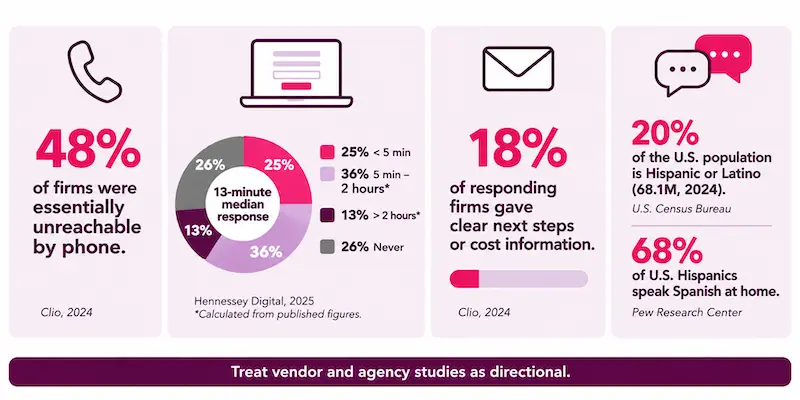
Reducing intake bottlenecks with bilingual VAs starts with an honest look at where your inquiries stall. Clio’s 2024 Legal Trends secret-shopper study of 500 U.S. law firms found only 40% answered the phone, down from 56% in 2019. In total, 48% were essentially unreachable by phone.
Email replies had their own gap. Among firms that responded by email, only 18% gave clear next steps or cost information. Clio’s 2024 research also found 67% of consumers still want the option to speak with a human.
Language adds pressure. The U.S. Census Bureau reports the Hispanic or Latino population reached 68.1 million in 2024, or 20% of the country. That makes language a capacity variable worth measuring in your intake audit.
Let’s break down how to map where intake stalls, what a bilingual virtual assistant can own, and how to report results partners will trust. It’s one piece of a broader plan to scale your law firm with virtual legal assistants.
Why Intake Becomes Your Firm’s Biggest Bottleneck
In many growing firms, intake has no single owner. Paralegals, receptionists, and attorneys share it between billable tasks, so it gets whatever time is left.
Attorney time is already scarce. Clio’s 2025 Legal Trends Report puts lawyer utilization at about 38%, meaning five hours of an eight-hour day go unbilled. Intake doesn’t explain that whole gap, but every intake task on an attorney’s desk competes for those hours.
What the response data shows
Web leads follow the same pattern as phone calls. Hennessey Digital’s 2025 lead response study tested web lead forms at 1,333 firms. The law firm marketing agency found a median response time of 13 minutes.
Only 25% of those firms responded in under five minutes, and 26% never responded. In all, 39% took more than two hours or never replied. The firms tested span personal injury, criminal defense, and other practice areas, and a marketing agency ran the study, so treat it as directional.
Responsiveness isn’t the only factor clients weigh. In Clio’s 2025 consumer survey, consumers ranked experience, reputation, reviews, free consultations, and clear information above responsiveness. Still, a firm nobody can reach never gets judged on any of those.
Why language turns delays into lost cases
Pew Research Center reports that 68% of U.S. Hispanics spoke Spanish at home in 2024. It also found that 71% of Latinos ages five and older spoke English proficiently. Many callers are bilingual, and some will be more comfortable handling a legal matter in Spanish.
Census data adds context. In the American Community Survey covering 2017 through 2021, 22% of people age five and older spoke a language other than English at home. About 61% of them spoke Spanish.
The operational risk is routing. When every Spanish inquiry goes to one bilingual paralegal, a hidden queue forms behind that person’s billable work. When that person takes leave or resigns, the queue has no backup at all.
Mapping Where Your Intake Stalls Before Adding Bilingual VAs
Before you hire, find the stage of your law firm intake process that’s stuck. Intake is a chain of handoffs, and delays tend to show up in specific links you can measure.
The five intake stages to audit
Pull one month of inquiries and trace each through these stages:
- First contact, where calls, voicemails, web forms, and chats get a human reply
- Qualification, where someone confirms practice area, jurisdiction, and urgency
- Conflict check, where party names go to whoever clears conflicts
- Data entry and handoff, where details land in your CRM or practice management system
- Consult booking and follow-up, where the prospect gets a time, a reminder, and next steps
For each stage, note the owner, the elapsed time, and anything that gets re-entered. Where practice groups use different scripts or fields, look for duplicate data entry and slower conflict checks.
Signs the bottleneck is language-driven
Language problems hide inside general intake metrics. Watch for these patterns:
- Spanish web-form leads sit unassigned longer than English ones
- Spanish voicemails get returned later than English ones
- Each practice group improvises its own Spanish script, or has none
- Staff switch between formal usted and informal tú with no firm standard
- Notes for Spanish callers are thinner or need translation before attorney review
If two or more of these show up, the bottleneck is partly a staffing design issue. Adding English-only capacity won’t clear it.
How Bilingual VAs Reduce Intake Bottlenecks
A dedicated bilingual virtual assistant works as your legal intake specialist and gives intake a clear owner. From Virtual Latinos’ perspective, four mechanisms do the work.
Dedicated first-contact coverage in U.S. time zones
A Virtual Legal Assistant working in U.S. time zones answers calls and web forms during your business hours, in Spanish or English. Because intake is their main job, first contact stops competing with billable deadlines.
Set shifts around the peak inquiry windows your audit measured, such as Monday mornings or the days after a Spanish-language campaign launches. Coverage then follows demand.
Consistent qualification scripts in Spanish and English
A fast reply only helps if it moves the prospect forward. Your assistant runs the same approved script in both languages, captures the same fields, and closes with clear next steps.
Scripts also standardize tone. A fluent Spanish speaker applies the formality your firm chooses, so callers get the same experience in every practice group.
Clean data entry and faster handoffs to attorneys
Your assistant enters complete intake data into your CRM, submits names for conflict checks, and writes an English summary for the attorney. The attorney walks into the consult with a finished file instead of a voicemail and a phone number.

Follow-up that doesn’t fall through the cracks
Unbooked leads can stall between first contact and consult. Your assistant works the follow-up cadence your SOP defines, including callbacks, reminders, and document requests in the prospect’s chosen language.
Every touch gets logged, so you can see which leads stalled and why. If intake capacity is your constraint this quarter, the most practical first step is to hire a virtual assistant to grow your business and give Spanish and English inquiries one dedicated owner.
Bilingual VA vs Call Center vs AI Answering: Which Fits Your Firm?
Each option solves a different problem. This table compares them on the factors that matter most to intake operations.
| Factor | Dedicated bilingual VA | Legal call center | AI answering |
| Continuity | Same person every shift | Rotating agents | Same system, no working relationship |
| Context retention | Learns your cases, staff, and practice groups | Limited to call notes | Limited to configured data |
| SOP and CRM integration | Works inside your CRM under your SOPs | Often uses its own platform | Depends on vendor integrations |
| Spanish nuance | Fluent speaker applies your script and formality | Depends on which agent answers | Varies by product and setup |
| After-hours coverage | Covers agreed shifts | Often offers overnight and weekend plans | Can run around the clock |
| Cost structure | Rate for one dedicated person’s hours | Varies by vendor, often per call, minute, or plan | Varies by vendor, often subscription or usage-based |
| Best fit | Daily intake ownership and follow-up | Overflow and after-hours live answering | After-hours triage and simple routing |
AI and call centers have real strengths. Many offer night and weekend coverage, and AI can handle simple routing. Given that most consumers in Clio’s 2024 research still wanted a human option, keep a human handoff behind any automation.
For the partner business case, start with a U.S. benchmark. The U.S. Bureau of Labor Statistics reports a median annual wage of USD 62,890 for paralegals and legal assistants in May 2025, before benefits and overhead.
Use that figure to model the cost of a virtual legal assistant against your own intake volume.
Implementing Bilingual Intake Support Without Disrupting Workflows
Rollout goes smoothest when you keep your workflows and change who owns each step.
Define ownership and escalation rules
Write a one-page, RACI-style ownership matrix for every intake step. For each one, name who does the work, who approves it, who gets consulted, and who stays informed.
Cover the edge cases. Your assistant flags a possible statute-of-limitations deadline, and the responsible attorney confirms the urgency. Your assistant drafts a referral-out for a declined matter, and an attorney approves it before it’s sent.
Under ABA Model Rule 5.3, lawyers must make reasonable efforts to ensure nonlawyer assistants act consistently with the lawyers’ professional obligations.
Set escalation triggers, such as urgent deadlines, existing-client issues, or any request for legal advice. Placing the role inside your structured legal support team keeps reporting lines clear.
Build bilingual SOPs and scripts
Start from your best-performing English script and adapt it into Spanish with attorney review. Skip word-for-word translation, since legal terms and tone don’t always carry over.
Standardize one field set across practice groups, including language preference. Keep scripts, common questions, and escalation rules in one shared SOP your assistant updates as new questions come in.
Protect confidentiality and access
Give your assistant role-based permissions in your CRM and practice management system, limited to the intake records they handle. Pair that access with a signed NDA and documented supervision.
A governance framework for outsourced legal teams helps you show partners how oversight works day to day.
Measure what matters
Baseline these five KPIs for one month before launch, then report them monthly:
- Speed to first response, by channel
- Contact rate, the share of inquiries that reach a live conversation
- Consult-booked rate
- Intake completeness, the share of files with every required field before attorney review
- Cost per signed case
These numbers give managing partners a before-and-after view built on your firm’s data. They also feed your long-term legal staffing strategy when case surges hit.
Why Virtual Latinos Is the Right Partner for Bilingual Legal Intake
You need bilingual legal intake support you can train, trust, and keep. Virtual Latinos connects your firm with bilingual Virtual Legal Assistants from Latin America who work in U.S. time zones.
Top 1% pre-vetted bilingual talent
Only the top 1% of applicants join the Virtual Latinos community. Every candidate is pre-vetted for:
- English fluency
- Role-specific skills
- Problem-solving and initiative
- Communication style and cultural fit
The candidates you interview are already screened for the skills intake work demands.
A human-guided hiring process
Our human-guided hiring process starts with your intake workflow, practice groups, and goals. We build a hiring plan, shortlist candidates, facilitate interviews, and support onboarding.
You keep the final decision. That makes it simple to bring a managing partner into the last interview round.
Replacement Guarantee and long-term fit
A wrong hire costs you training time. The Replacement Guarantee gives you support if your first match isn’t the right fit.
Virtual Latinos focuses on long-term placements. Over time, your assistant becomes a team member who knows your SOPs, your attorneys, and your clients.
Key Takeaways
- Trace one month of inquiries through all five intake stages. Record the owner, elapsed time, and any re-entered data to find the one or two handoffs that stall.
- Add a language-preference field to every intake form. It shows how much Spanish-language demand you actually have before you staff for it.
- Write a one-page ownership matrix with escalation triggers. Send urgent deadlines, existing-client issues, and any request for legal advice straight to an attorney.
- Adapt your best English script into Spanish with attorney review. Avoid word-for-word translation, and set one firm standard for usted or tú.
- Baseline five KPIs for a month before launch. Report speed to first response, contact rate, consult-booked rate, intake completeness, and cost per signed case to partners every month.
Frequently Asked Questions
What tasks can a bilingual virtual legal assistant handle in intake?
A bilingual virtual legal assistant can handle intake administration in Spanish and English while attorneys make all legal judgments. Common tasks include:
- Confirming consults and sending directions or video links
- Gathering IDs, notices, or reports before the meeting
- Tagging lead source and status in your CRM
- Routing out-of-scope inquiries to your referral list
- Maintaining Spanish and English versions of intake FAQs
The same list works at lower volume for a bilingual legal virtual assistant for smaller practices.
Can a remote assistant handle confidential intake information?
Yes, with the right controls. Limit and monitor access with these four safeguards:
- Firm-managed accounts instead of personal logins
- Multi-factor authentication on every system
- Activity logs you review on a set schedule
- Same-day access revocation when an engagement ends
Before launch, check your state bar’s ethics opinions on remote nonlawyer staff and have your firm’s counsel review the setup.
How long does it take to onboard a bilingual intake assistant?
It depends on how mature your SOPs are, since written scripts and a single field set shorten every phase. A three-phase ramp keeps risk low:
- Shadow live intake calls and study your scripts and escalation rules
- Handle inquiries while a supervisor reviews each file before handoff
- Work independently and escalate according to your ownership matrix
Move to the next phase only when file quality holds steady.
Do we still need bilingual intake if most of our Spanish-speaking clients also speak English?
Yes, because bilingual intake lets every caller choose their language, whatever their English level. The first caller may be a parent or spouse who is more comfortable in Spanish, even when the client speaks English. Conversational English and comfort explaining a legal problem can also differ, so a language choice removes friction at first contact.
What intake KPIs should an operations manager track monthly?
Track a second layer of metrics beyond your core response and booking numbers, because it catches problems those miss:
- Language and channel segmentation for every metric
- Abandoned-call rate
- Time to conflict clearance
- Consult no-show rate
Report each one as a three-month trend so partners see a direction instead of a single month’s noise.
Turn Intake Into a Growth Engine
Intake bottlenecks are operations problems, and they respond to operations fixes: clear ownership, consistent scripts, and measured results. A dedicated bilingual Virtual Legal Assistant gives Spanish and English inquiries the same reliable path to an attorney.
Start with your audit, set your baseline, and bring partners a plan built on your own numbers. When you’re ready to add intake capacity, Virtual Latinos will help you find the right long-term fit.