
| TL;DR |
|
You know the feeling. A potential client calls during a hearing, a deposition, or a rare lunch break, and no one is there to answer. By the time you call back, they have already hired the firm that picked up first. For solo attorneys and small firm owners, a missed call is not a minor inconvenience. It is a lost consultation, and often a lost case.
The numbers back up what you already sense. Research from Legal Navigator found that about 35% of calls to small and mid-size law firms go unanswered, a gap that costs the industry roughly USD 109 billion a year. Worse, 80% of callers who hit voicemail hang up without leaving a message.
Now add a language barrier to that same call. A Spanish-speaking prospect who reaches voicemail, or an intake process built only in English, rarely calls a second time. A bilingual legal virtual assistant closes that gap, and we’ll show you how.
Why Solo Firms Lose Consultations Before They Ever Begin
Most solo attorneys do not lose clients in the courtroom. They lose them at the very first touchpoint, before a consultation is ever booked. When you are in session or with a client, the phone still rings, and the caller on the other end is deciding quickly.
The legal field is especially exposed here. CallRail data compiled by Legal Soft shows a 28% missed-call rate for the industry, one of the highest of any sector. People with a legal problem feel urgency, and they call the next firm on the list when no one answers.
Speed matters more than most owners realize. Data compiled by Aira shows the first business to respond wins the client about 78% of the time, and responding within five minutes dramatically improves your odds of connecting. A callback the next morning is often a callback to someone who already signed elsewhere.
Now layer language on top of speed. If a caller is more comfortable in Spanish and reaches an English-only voicemail, the friction doubles. You are not just slow to respond. You are hard to talk to, and that prospect quietly disappears.
The Growing Spanish-Speaking Client Base You May Be Turning Away
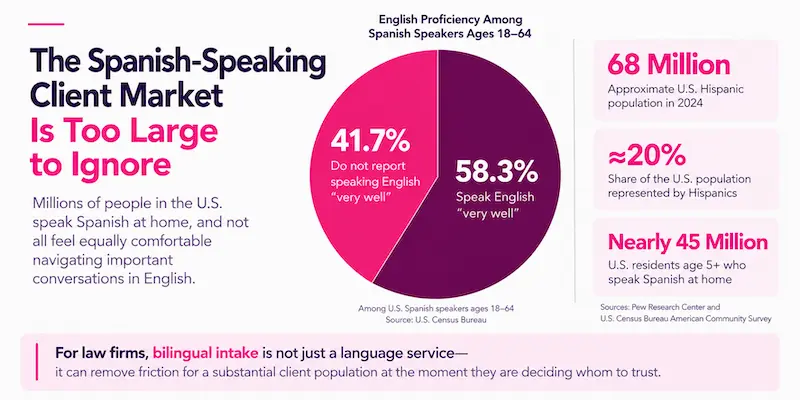
The market you are missing is large and growing. The Pew Research Center reports the U.S. Hispanic population reached about 68 million in 2024, roughly 20% of the country. That is one in five potential clients in most metro areas you serve.
Language preference is the part that hits intake directly. According to U.S. Census Bureau American Community Survey data on languages spoken at home, nearly 45 million U.S. residents age five and older speak Spanish at home. Many of them run businesses, own property, and face the exact legal issues you handle.
Just as important, a large share prefer to handle serious matters in Spanish. The Census Bureau reports that among Spanish speakers ages 18 to 64, only about 58.3% say they speak English “very well,” which leaves a large share more comfortable handling a case in Spanish. For a family law or immigration question, comfort in your own language is not a nicety. It decides who they trust.
When your intake only works in English, you are not choosing to skip these clients. You are turning them away by default, one unanswered or half-understood call at a time.
What a Bilingual Legal Virtual Assistant Actually Does
A bilingual legal virtual assistant is a trained remote team member who manages your first client interactions in both English and Spanish. This is not a call-forwarding gadget. It is a person who represents your firm, follows your process, and helps qualified leads become booked consultations, the way a Virtual Legal Assistant streamlines a solo practice day to day.
Bilingual intake and lead qualification
When a prospect calls or fills out a form, your assistant answers promptly in the caller’s preferred language. They capture contact details, the nature of the matter, and any deadlines, using the intake script you approve. That means Spanish-speaking callers get a warm, clear conversation instead of a language wall.
Qualification protects your time, too. Your assistant screens out matters outside your practice areas and flags the strong leads, so you spend consultation slots on people you can actually help. You review, you decide, and the routine sorting happens before it reaches your desk.
Scheduling, reminders, and reducing no-shows
Booking is where momentum is won or lost. Your assistant offers open slots, confirms the appointment, and syncs it to your calendar while the prospect is still engaged. No phone tag, no cold leads going stale overnight.
They also send confirmations and reminders in the client’s language, which cuts no-shows and keeps your day predictable. That same discipline helps keep consultations and court deadlines from slipping through the cracks, so nothing important falls between calls.
The Real Cost of a Missed Bilingual Consultation
It helps to put a number on the leak. The math is simple, and you can run it with your own figures in a few minutes. Start with the leads you already generate, then estimate how many you never convert because of a missed or English-only call.
Try this formula: monthly leads x percentage of Spanish-speaking prospects x average case value x your consultation-to-client conversion rate = revenue lost each month. Even conservative inputs tend to surprise firm owners once the language gap is factored in.
Say you get 100 leads a month, 20% prefer Spanish, your average matter is worth USD 3,000, and you convert 30% of consultations. That is 20 bilingual leads, and missing even half of them puts thousands in signed work at risk every month. Over a year, the leak dwarfs the cost of coverage.
There is a time cost, too. The 2025 Clio Legal Trends Report found lawyers bill only about three hours of an eight-hour workday, with much of the rest lost to administrative work. When intake and scheduling eat your day, administrative work quietly eats into your billable hours and your revenue at the same time.

Bilingual Virtual Assistant vs. Answering Service vs. In-House Hire
Once you decide to fix the gap, the question is how. Three common options exist, and they are not equal in cost, consistency, or conversion. A quick comparison makes the tradeoffs clear.
- Answering service: low cost and always on, but agents rotate, rarely know your practice, and mostly take messages instead of qualifying and booking
- In-house bilingual hire: deeply integrated and fully yours, but the salary, benefits, taxes, and office overhead are steep for a solo or small firm
- Bilingual virtual assistant: a dedicated, trained team member who learns your process and books consultations, at nearshore cost with U.S. time zone overlap
Consistency is the deciding factor for most firms. An answering service treats every call the same, while a dedicated assistant treats every caller like your future client. That difference shows up directly in how many consultations you book.
The goal is to delegate the repeatable work without handing off your professional judgment. You can delegate client intake ethically while keeping legal judgment in-house, which keeps you compliant and in control.
How to Add Bilingual Coverage Without Adding Overhead
The good news is that closing this gap does not require a bigger office or a full-time salary. With the right partner, you can add Spanish-language coverage in a matter of weeks, not months. Here is a practical way to do it.
First, define the role. List the tasks you want handled, from answering calls to booking consultations to sending reminders, and set your intake script and practice-area rules. Clarity up front makes onboarding faster and cleaner.
Second, hire for your hours, not a time zone gap overseas. Virtual Latinos connects you with pre-vetted bilingual Virtual Professionals who work in U.S. time zones, so your assistant is live when your clients are calling. You can start with bilingual legal assistants who work in your time zone and scale from there.
Third, reduce the risk of a bad fit. A human-guided hiring process helps match you with a candidate who suits your practice and your style, and a Replacement Guarantee means you are supported if the first match is not right. You stay in control, and you are not gambling your intake on a stranger.
You do not have to keep losing bilingual consultations while you figure this out. Hire a virtual assistant to grow your business.
Key Takeaways
- Treat bilingual intake as part of your conversion strategy. Generating more leads will not fix an intake process that cannot respond quickly and comfortably in the prospect’s preferred language.
- Design the role before you hire. Define your intake script, qualification criteria, practice-area boundaries, scheduling process, and escalation rules before handing off client communication.
- Optimize for continuity, not just coverage. A dedicated professional who learns your firm can create a more consistent client experience than rotating support.
- Keep professional judgment with the attorney. Delegate repeatable intake and administrative workflows while retaining legal advice, case decisions, and attorney oversight.
- Measure whether coverage is closing the leak. Track answered calls, qualified leads, booked consultations, no-shows, and conversions to determine whether bilingual support is producing results.
Frequently Asked Questions
How is a bilingual virtual assistant different from a Spanish answering service?
The core difference is continuity: a dedicated bilingual virtual assistant learns your firm and books consultations, while an answering service mostly logs messages with rotating agents. That means your callers get a consistent point of contact instead of a generic hand-off.
How much does a bilingual legal virtual assistant cost for a solo practice?
Pricing depends on hours and scope, but nearshore Virtual Professionals cost far less than a comparable in-house bilingual hire once you add salary, benefits, and overhead. You pay for coverage, not idle time.
Can a bilingual virtual assistant work during my U.S. business hours?
Yes. Virtual Latinos matches you with professionals in U.S. time zones, so your assistant answers calls and books appointments in real time while your prospects are trying to reach you.
Can a bilingual virtual assistant translate my legal documents?
A bilingual assistant can support routine client communication and document handling in Spanish. For certified legal translations, you should still use a qualified certified translator to meet court and ethical standards.
Which practice areas benefit most from bilingual intake support?
Immigration, family law, personal injury, and criminal defense tend to see high Spanish-speaking demand. Any practice serving diverse metro areas gains from answering and qualifying leads in both languages.
Stop Losing Spanish-Speaking Clients to a Missed Call
Every unanswered or English-only call is a client deciding, in real time, to trust someone else. You already spend money and effort to make the phone ring. A bilingual first point of contact makes sure those leads turn into booked consultations instead of missed opportunities.
You do not need a bigger team or a bigger budget. You need dependable, bilingual coverage during your business hours, backed by a process that lowers your risk and respects your judgment. That is a change you can make now.
Ready to stop losing Spanish-speaking clients to a missed call? Hire a virtual assistant to grow your business.