
| TL;DR |
|
You know the feeling. A promising lead calls while you are in a hearing, and by the time you call back the next afternoon, they have already signed with the firm down the street. It stings, because that client was yours to lose.
The problem was not your skill as a lawyer. It was the gap between the moment someone reaches out and the moment someone responds.
That gap is expensive. As a solo attorney or small firm owner, you are the rainmaker, the lawyer, and the intake desk all at once, and something always slips.
Client intake and follow-up support closes that gap. Done well, it makes sure every qualified lead gets a fast, warm, consistent response and that each matter’s details get captured correctly. Done poorly, it quietly costs you signed clients and billable hours you will never recover.
MyCase reports that waiting more than one business day to respond sharply reduces your odds of signing a lead, which tells you exactly where the leverage is.
Why Client Intake and Follow-Up Make or Break a Solo Practice
For a solo practice, every new matter starts with a single fragile conversation. A prospect who calls about a divorce, an injury, or an immigration question is usually anxious, comparing options, and ready to commit to whoever makes them feel understood first. If you cannot pick up and no one follows up quickly, that trust goes to someone else.
This is the speed-to-lead reality: the firm that responds first usually earns the client, because a prospect who feels answered stops shopping. The prospect does not know you were in court doing excellent work for another client. They only know you did not call back, and by then they have already retained someone who did.
Here is the bind unique to solo attorneys and small firm owners. You are the intake desk by default, and you are also the person who cannot stop mid-hearing to answer the phone. So leads go cold, intake gets inconsistent, and conflict checks or engagement details get missed under pressure.
That inconsistency is not just a revenue issue. Calendar and deadline errors are among the most common causes of legal malpractice claims, according to ALPS Insurance, and a sloppy intake process is where many of those errors begin.
Your reputation and your revenue both ride on the first 24 hours.
What Client Intake and Follow-Up Support Actually Covers
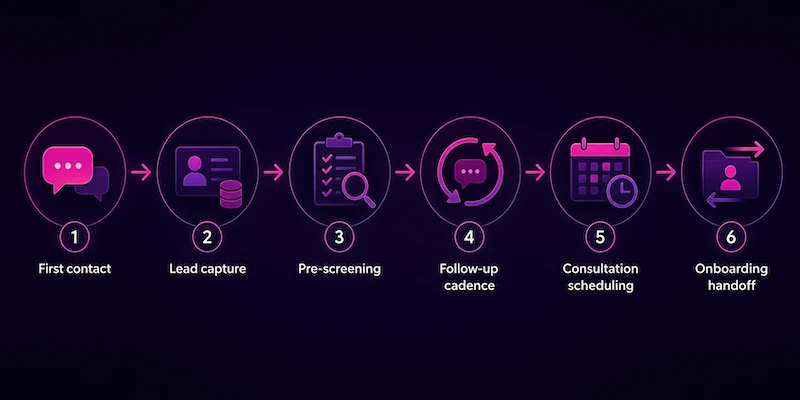
Intake and follow-up support is not a single task. It is an end-to-end workflow that carries a prospect from stranger to signed client, and each stage matters.
Here is what the full workflow includes:
- First contact: answering calls, web forms, and referral emails promptly and warmly, so no lead sits unattended
- Lead capture: logging every inquiry with accurate contact details, matter type, and source into your CRM
- Pre-screening: gathering basic facts, running conflict checks, and confirming the matter fits your practice before it reaches your desk
- Follow-up cadence: reaching back out on a set schedule until the prospect responds, books, or declines
- Consultation scheduling: booking the consult, sending confirmations, and reducing no-shows with reminders
- Onboarding handoff: preparing the engagement letter, collecting documents, and transitioning a signed client cleanly into your case workflow
The pattern here is important. Software can capture and store, but it cannot reassure a nervous prospect, chase a slow responder, or notice that a detail does not add up. That is why intake is a people problem first.
The most effective law firms combine technology with dedicated administrative support, creating workflows that improve responsiveness without sacrificing the human experience.
A simple follow-up cadence you can hand off
The reason follow-up breaks down is that it depends on memory and free time, and you have neither to spare. A written cadence fixes that by turning follow-up into a repeatable routine anyone you trust can run.
Here is a straightforward version to start with:
- Day 0: respond within one business hour by phone, then email if there is no answer
- Day 1: a second touch by the prospect’s preferred channel, offering two concrete consultation times
- Day 3: a brief check-in that answers a likely question and restates how you can help
- Day 7: a final touch that leaves the door open and confirms you will close the file if you do not hear back
Once this lives on paper, it stops being your burden and becomes a process.
The Real Cost of a Broken Follow-Up Process
It is tempting to treat a missed follow-up as a minor slip, but the math is unforgiving. Start with your billable capacity. If attorneys bill only 2.9 hours per day on average, then every hour you spend chasing leads or re-entering intake notes is revenue you did not earn.
Now add the leads. With most of your working hours already going to non-billable work, the follow-up that would have signed a client is usually what gets dropped first.
A prospect who waits more than a day often signs elsewhere, so the loss is not one hour. It is the lifetime value of a case, multiplied by however many leads slip through in a busy month.
There is a quieter cost too. An inconsistent process is where deadline and calendar mistakes take root, and those rank among the most common malpractice claims.
A broken follow-up process is not saving you money. It is costing you in lost clients, unbilled hours, and avoidable risk.
A structured virtual legal assistant cost model helps quantify those hidden costs, compare them against the investment in additional support, and identify the point where delegation becomes more profitable than doing everything yourself.
Your Options for Intake and Follow-Up Support (and Where Each One Breaks)
When you decide to fix intake, you have five realistic options. Each solves part of the problem, and most break at the same point: the human follow-up.
- Do it yourself: you keep full control, but you are back to being the intake desk, and leads go cold every time you step into court
- Answering service: it catches calls after hours, yet operators do not know your practice, cannot pre-screen well, and rarely nurture a lead past the first message
- Intake software and CRMs: forms and automated sequences capture and organize leads efficiently, but a template email cannot read hesitation or answer a specific worry, so warm leads still stall
- In-house hire: a dedicated staff member gives you real ownership, though the cost and the commitment are steep for a firm of one to five people
- Virtual legal assistant: a trained person handles the calls, the pre-screening, and the human follow-up on your cadence, at a lower cost than a local hire
The honest takeaway is that automation is necessary but not sufficient. Tools remove busywork, but signing clients still comes down to a person who follows up.
Technology delivers the greatest value when it supports well-designed workflows rather than replacing human judgment. Law firm automation helps streamline repetitive processes, but consistent client communication, follow-up, and operational coordination still depend on trained professionals.
The strongest setup pairs good software with a dependable person, which points naturally to the next option.
Why a Virtual Legal Assistant Is the Right Fit for Solo Firms

A Virtual Legal Assistant is the piece that connects “we captured the lead” to “we signed the client,” because the missing link was never a form. It was a person who responds. Here is why this fits a solo or small firm so well.
Consistent, human communication is what turns inquiries into clients. A trained assistant responds promptly, qualifies prospects thoughtfully, and keeps your intake process moving so no opportunity falls through the cracks. Because Virtual Latinos’ Virtual Professionals work in U.S. time zones and provide bilingual support, they help firms deliver a responsive, seamless experience from the very first conversation.
Confidentiality is often the first concern, and it is a fair one. Delegating intake to a nonlawyer is permitted and expected when you supervise the work, exactly as ABA Model Rule 5.3 describes. You set the process, you stay accountable, and a professional handles the execution.
The cost case is just as clear. A pre-vetted virtual legal assistant runs about USD 1,800 to USD 3,500 per month, well below the roughly USD 4,200 or more per month that a fully loaded in-house paralegal costs, with a median salary of USD 61,010 (BLS).
This is where Virtual Latinos fits as a long-term hiring partner rather than a task vendor. Every professional is drawn from the top 1% of pre-vetted bilingual talent, matched to your firm through a human-guided process, and backed by a Replacement Guarantee.
A Virtual Legal Assistant for solo lawyers provides the operational support needed to protect billable time, improve client responsiveness, and create room for sustainable growth.
How to Delegate Intake and Follow-Up Without Losing Control
Handing off intake feels risky only when the process lives in your head. Once you document it, delegation becomes safe, because you are transferring a system, not just hoping someone guesses right. Here is how to do it in a way that keeps you in command.
- Document the process: write down how a lead moves from first contact to signed client, including your conflict-check steps and what disqualifies a matter
- Set the cadence: give your assistant the exact day-0, day-1, day-3, and day-7 follow-up schedule so there is no ambiguity
- Choose the tools: standardize on one CRM, one calendar, and one intake form, then grant access with clear permissions
- Protect confidentiality: define what stays privileged, require secure handling, and supervise the work as ABA Model Rule 5.3 directs
- Review and refine: check intake logs weekly at first, give feedback, and loosen oversight as trust builds
Start with lower-risk pieces like scheduling and first-response, then expand to pre-screening as your assistant proves reliable. Control does not come from doing the work yourself. It comes from owning a clear process someone else can run.
Key Takeaways
- Speed to lead is your single biggest lever on conversion, so the firm that answers first usually wins the client
- Intake and follow-up are a people problem, not a software problem, because forms and CRMs capture leads but do not nurture them
- A dependable virtual legal assistant costs meaningfully less than an in-house hire while giving you consistent, human follow-up
- Delegating intake is ethical and expected when you supervise it properly, so handing it off does not put your license at risk
- Bilingual intake widens your addressable market if you serve Spanish-speaking communities
- Offloading intake reclaims hours you can reinvest in business development, which is how you finally break the feast-or-famine cycle
Frequently Asked Questions
What does client intake and follow-up support include for a law firm?
Client intake and follow-up support is the end-to-end process of turning a prospective client into a signed one. It covers answering inquiries, capturing lead details, running conflict checks, pre-screening matters, following up on a set cadence, scheduling consultations, and handing off a signed client into onboarding. The goal is a fast, warm, consistent response every time, without you touching each step.
How fast should a law firm respond to a new client lead?
As fast as you can, ideally within the first business hour. Prospects usually retain whoever responds first and makes them feel understood, so speed is your strongest advantage.
What is the difference between an intake specialist and a virtual legal assistant?
An intake specialist focuses narrowly on capturing and qualifying new leads. A Virtual Legal Assistant does that and more, supporting scheduling, follow-up cadence, document collection, and onboarding, while integrating into your firm as a long-term team member. Think of the assistant as the broader role that includes intake.
Can a virtual legal assistant support Spanish-speaking clients during intake?
Yes. Virtual Latinos connects you with bilingual Virtual Professionals who conduct intake fluently in English and Spanish. That lets you respond to Spanish-speaking prospects in their preferred language from the first call, expanding the community your firm can serve and reducing the friction that causes those leads to go elsewhere.
Take Intake Off Your Plate and Start Signing More Clients
You did not go to law school to be the intake desk. Yet as long as follow-up depends on your free time between hearings, qualified leads will keep going cold, admin will keep eating your evenings, and your billable hours will keep leaking away. The fix is not another form or a faster CRM. It is a dependable person who responds the way you would, on a cadence you define, in your time zone.
That is what a Virtual Legal Assistant from Virtual Latinos gives you: fast, warm, consistent intake and follow-up, handled ethically under your supervision, at a cost that pays for itself in recovered billable hours. You stop chasing leads, reclaim time for business development, and never let a qualified prospect slip to the firm that simply called back sooner.
Ready to stop being the intake desk and start signing more clients? Hire a virtual assistant to grow your business.