
The legal industry is experiencing its most significant staffing transformation in decades, driven by three converging forces: chronic talent shortages in major markets, unsustainable overhead costs for traditional hiring, and the proven success of remote work arrangements that started during the pandemic.
What began as a temporary solution has become a competitive advantage. Law firms adopting virtual assistants are cutting costs by up to 60% while maintaining or improving service quality.
Remote legal assistants now handle everything from client intake and document preparation to e-filing and discovery support. They work inside the same secure systems as in-house staff. This article breaks down why the shift is happening, how to implement it successfully, and what you need to know about costs, security, technology, and long-term strategy.
The Shift Toward Remote Legal Staffing
Law firms across the United States are moving toward remote staffing as a core business decision, not a temporary fix. According to recent industry analysis, firms are adopting virtual assistants to cut costs and streamline operations while maintaining service quality.
“Remote legal assistant roles are rapidly becoming the norm and offer unmatched benefits,” said a spokesperson for a leading bar association. “A virtual legal support model is integral to the law firm of tomorrow.”
The shift comes from three converging forces: finding qualified local candidates has gotten harder and more expensive, both attorneys and support staff now expect work flexibility, and the cost savings from remote arrangements are too significant to ignore.
Post-pandemic talent shortages
Traditional legal markets don’t have enough experienced legal assistants to meet demand. Many metro areas face shortages as baby boomers retire and younger professionals choose different career paths.
Remote hiring expands your talent pool from one city to an entire hemisphere. Geography stops being a limitation when you can access skilled professionals anywhere with reliable internet and proper credentials.
Demand for flexible work
Today’s workforce expects flexibility, and legal support staff are no exception. Research from the American Bar Association shows that remote work arrangements now influence top talent when choosing between opportunities.
Attorneys benefit too. They maintain focus on client work while delegating administrative tasks to remote team members who work during overlapping business hours, creating better work-life balance without sacrificing responsiveness.
Core Challenges Traditional Law Firms Face Today
Traditional staffing models create specific barriers to growth and profitability. Accounting for the full cost of an employee extends well beyond base salary.
Industry data shows firms can reduce expenses by up to 60% when hiring remote talent from regions with lower cost-of-living, without compromising skill or professionalism.
Inconsistent workload spikes
Case volumes fluctuate dramatically in most practice areas. You might have three major cases settle in one month, then face discovery-heavy trial work the next. Traditional staffing forces you to either maintain excess capacity during slow periods or scramble to find help when workload increases.
Remote legal assistants offer scalability matching your actual needs. You can adjust hours, bring on project-based support, or scale up permanently without lengthy hiring processes and commitments that in-house staff require.
Turnover and training costs
The U.S. Bureau of Labor Statistics reports that paralegal and legal assistant turnover rates remain high, particularly in competitive urban markets. Every departure means lost institutional knowledge, recruiting costs, and weeks of training before a replacement reaches full productivity.
Remote professionals working with established platforms often show higher retention rates. They value flexibility and opportunity, which translates into longer tenures and more consistent support for your practice.
Key Tasks A Remote Legal Assistant Can Own
Remote legal assistants handle a surprisingly broad range of responsibilities. Modern legal work is already digital, court filings happen electronically, client communications flow through email and video calls, and case management lives in the cloud.
Here’s what you can delegate:
- Client intake and screening: Initial consultations, case evaluation, and prospect qualification
- Document preparation: Drafting standard legal documents, pleadings, and correspondence
- Court filings: E-filing submissions and docket management
- Discovery support: Document review, organization, and response preparation
- Billing tasks: Invoice generation and payment follow-up
Client intake and screening
A skilled remote legal assistant manages initial client contact with professionalism and efficiency. They conduct preliminary consultations, gather essential case information, and assess whether prospects align with your practice areas.
You only speak with qualified leads who’ve already been screened and prepared. Your time goes toward evaluation and legal strategy, not administrative questioning.
Drafting pleadings and motions
Experienced remote legal assistants prepare discovery requests, draft routine motions, and handle standard correspondence under attorney supervision. They work from your templates and past filings, adapting language to fit current cases while maintaining your firm’s style and standards.
You review and refine rather than starting from scratch. That time savings compounds across dozens of documents each month.
E-filing and docket management
Electronic court filing systems are accessible from anywhere with proper credentials and training. Remote assistants manage deadlines, prepare filing packages, submit documents through e-filing portals, and track confirmation receipts.
They also maintain your docket calendar, setting reminders for critical dates. This detailed work is perfect for delegation because it’s essential but doesn’t require your legal judgment.
Cost And ROI Comparison In-House Vs Remote Support
The financial case for remote legal staffing is compelling once you understand how to reduce legal assistant costs without sacrificing quality. Here’s what the cost structure typically looks like:
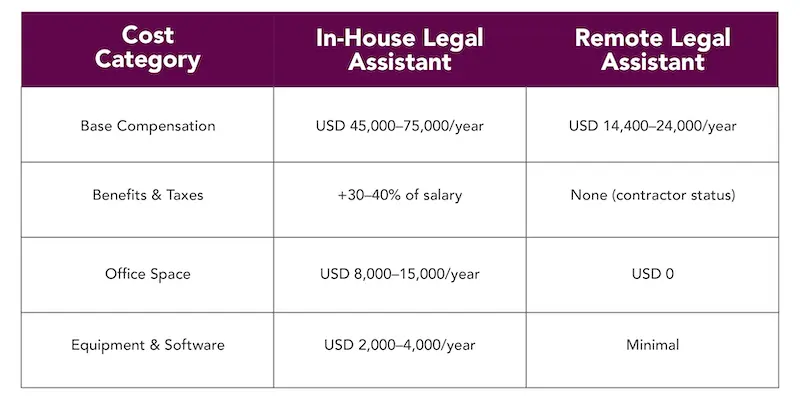
| Cost Category | In-House Legal Assistant | Remote Legal Assistant |
| Base Compensation | USD 45,000–75,000/year | USD 14,400–24,000/year |
| Benefits & Taxes | +30–40% of salary | None (contractor status) |
| Office Space | USD 8,000–15,000/year | USD 0 |
| Equipment & Software | USD 2,000–4,000/year | Minimal |
Opportunity cost of attorney billable hours
Here’s the calculation that matters most: if your billable rate is USD 300 per hour and you spend 10 hours weekly on tasks a remote assistant could handle at USD 25 per hour, you’re losing USD 2,750 in potential revenue each week.
That’s USD 143,000 annually in opportunity cost. Even accounting for the time you invest in delegation and oversight, the math overwhelmingly favors remote support.
Sample monthly budget
A part-time remote legal assistant working 20 hours weekly might cost USD 1,200–2,000 monthly. For that investment, you reclaim 80 hours of your time, time you can redirect toward client development, complex legal work, or better work-life balance.
Security And Ethics When Working With Remote Paralegals
Client confidentiality and ethical obligations are legitimate concerns when working with remote staff. The key is treating remote staff the same way you’d treat in-house employees when it comes to security, supervision, and ethical compliance.
ABA compliance checkpoints
The American Bar Association provides clear guidance on working with non-lawyer assistants. You must supervise their work, protect confidentiality, and ensure competence.This applies whether your assistant sits in your office or across the hemisphere and works remotely. You remain responsible for supervising their work, protecting client confidentiality, and ensuring competence.
Secure document sharing practices
Modern encryption makes remote document sharing as secure as physical file cabinets. Use encrypted cloud storage with two-factor authentication, secure password management, and role-based access controls.
Your remote assistant accesses only the files and systems necessary for their responsibilities. Tools like Clio, MyCase, and other legal practice management platforms offer built-in security features designed specifically for this purpose.
Technology Stack For Seamless Collaboration
Effective remote collaboration depends on having the right tools in place. The goal is creating workflows that feel natural despite physical distance.
Case management software integrations
Platforms like Clio, PracticePanther, a legal practice management platform, or MyCase, a cloud-based legal management solution, serve as your central hub, giving remote legal assistants access to case files, calendars, contacts, and billing information. They log in just like an in-house employee would, working within the same system and following the same procedures.
Most legal practice management software offers role-based permissions, so you control exactly what each team member can view and edit.
Time tracking and KPI dashboards
Time tracking software such as Toggl, a simple time-tracking app, Harvest, an online time and expense tracker, or built-in features in your practice management system provide visibility into how hours are spent. You can also establish key performance indicators, documents drafted per week, filing deadlines met, client communications handled, that give you objective measures of productivity and quality.
Hiring Models Compared Freelancer Agency Curated Platform
You have three main options for sourcing remote legal talent, each with distinct advantages and trade-offs:
| Factor | Freelancer | Agency | Curated Platform |
| Vetting Process | Self-managed | Agency-managed | Platform-managed |
| Quality Control | Your responsibility | Shared responsibility | Platform guarantees |
| Management Overhead | Highest | Low | Low to moderate |
| Replacement Support | None | Usually included | Usually included |
Quality control and vetting
Hiring freelancers directly means you handle all screening, reference checking, and skills assessment. That gives you complete control but requires significant time investment upfront.
Agencies and platforms like Virtual Latinos pre-vet candidates, testing for language proficiency, technical skills, and cultural fit. You still interview and make the final decision, but you’re choosing from pre-qualified candidates.
Long-term retention
Direct freelancer relationships can be incredibly stable when they work well. You build rapport and institutional knowledge over time, though if a freelancer leaves, you start from zero with no backup.
Platforms maintain talent pools and can provide replacements quickly if your assistant moves on. That continuity protection is valuable for firms that depend heavily on remote support.
Step By Step Guide To Onboard A Virtual Legal Assistant
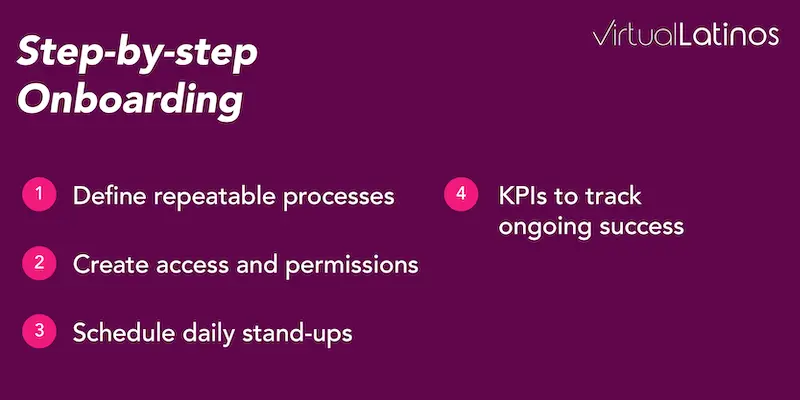
Successful onboarding sets the foundation for a productive long-term relationship. Here’s how to do it right.
1. Define repeatable processes
Before your assistant starts, document the tasks you’re delegating. Create simple process guides, record screen shares showing how you complete routine tasks, or share templates and examples.
You don’t need elaborate manuals, just enough clarity that someone unfamiliar with your specific procedures can replicate them.
2. Create access and permissions
Set up accounts, grant appropriate system access, and configure permissions before day one. Your assistant can hit the ground running when systems are ready.
Use role-based permissions to ensure they can access what they need while maintaining security.
3. Schedule daily stand-ups
Brief daily check-ins keep everyone aligned, especially during the first few weeks. A 15-minute video call each morning lets you prioritize tasks, answer questions, and address any confusion before it becomes a problem.
As your assistant gains confidence and autonomy, you can reduce check-in frequency.
KPIs To Track Ongoing Success
Once your remote legal assistant is up and running, you need ways to measure whether the arrangement delivers value:
- Turnaround time: How quickly tasks get completed from assignment to delivery
- Billable hour recovery: Additional billable hours you capture because you’re not doing administrative work. Track your billable hours before and after delegating to remote support. Most attorneys see 15-30% increases in billable time within three months of effective delegation.
- Client satisfaction: Whether clients notice improved responsiveness and organization
Future Trends Shaping Flexible Legal Staffing
Remote legal staffing is evolving rapidly as technology advances and firms discover new ways to leverage distributed teams.
Legal process automation and AI
Legal process outsourcing is evolving as artificial intelligence and automation tools augment remote legal assistants, not replace them. AI handles truly repetitive tasks like initial document review or data extraction, freeing your assistant to focus on work requiring judgment and client interaction.
The most effective approach combines AI efficiency with human oversight.
Cross-border bilingual support
As U.S. demographics shift, bilingual legal services are increasingly valuable. Remote legal assistants from Latin America offer native Spanish fluency alongside English proficiency, positioning your firm to serve diverse client populations more effectively.
This isn’t just about translation, it’s about cultural competence and the ability to build rapport with Spanish-speaking clients who might otherwise feel uncomfortable in English-only legal environments.
Scale Smarter With Time Zone Aligned Talent From Latin America
If you’re ready to embrace remote legal staffing, the quality of your talent source matters enormously. Virtual Latinos, a curated talent platform specializing in connecting U.S. law firms with the top 1% of bilingual legal professionals from Latin America, stands out for its rigorous vetting process and cultural alignment.
Every candidate goes through rigorous vetting for English fluency, legal knowledge, technical proficiency, and cultural alignment with U.S. business practices. Here’s what sets Virtual Latinos apart for legal practices:
- Pre-vetted legal experience: Candidates have proven backgrounds in legal support roles
- Time zone alignment: Latin American professionals work during U.S. business hours
- Bilingual capabilities: Native Spanish speakers with professional English proficiency
- Cultural compatibility: Understanding of U.S. legal procedures and professional communication standards
You’re not just hiring help, you’re building a strategic partnership with professionals who understand legal work and are committed to your firm’s success.
Ready to transform how your firm operates? Start hiring a virtual assistant to grow your business and discover how Virtual Latinos can match you with the perfect legal support professional.
FAQs About Remote Legal Assistants
How quickly can law firms see ROI from remote legal assistants?
Most firms experience immediate cost savings from day one due to lower compensation costs. Productivity gains typically become apparent within the first month as attorneys redirect reclaimed time toward billable work and business development.
Do state bar rules limit remote legal staffing arrangements?
State bar associations generally permit remote legal support under the same supervision and confidentiality requirements that apply to in-house staff. Check your specific jurisdiction’s rules, but the framework is typically accommodating rather than restrictive.
Can a remote legal assistant attend client calls and meetings?
Yes, remote legal assistants regularly participate in video conferences and client communications when properly introduced and supervised. Many clients appreciate the additional support and don’t distinguish between remote and in-office team members.
How many weekly hours do law firms typically start with when hiring remotely?
Starting with 20-30 hours weekly allows you to test workflows and build mutual confidence before committing to full-time arrangements. Many firms begin part-time and expand as they identify additional delegation opportunities.
Conclusion
Embracing remote legal assistants is no longer a trend, it’s a strategic move that helps you cut costs, improve productivity, and gain access to top-tier bilingual talent. By leveraging professionals from Latin America with Virtual Latinos, you ensure time zone alignment, cultural compatibility, and seamless integration into your daily workflow.
Whether you’re looking to scale your firm, recover more billable hours, or build a long-term partnership, remote support empowers you to focus on what matters most: growing your business and delivering exceptional legal service. Start hiring a virtual assistant today and discover how Virtual Latinos can help transform your operations for the future.