
| TL;DR |
|
You became a lawyer to practice law, not to spend your mornings managing intake emails, your afternoons chasing scheduling conflicts, and your evenings filing documents that should have been handled hours ago. Yet that is exactly how most solo practices operate.
According to the Clio Legal Trends Report, lawyers bill an average of just 2.6 to 3.0 hours in an eight-hour workday. That means more than five hours each day disappear into administrative tasks that generate zero revenue for your practice.
This is not a productivity problem you can solve by working harder. It is a structural problem that calls for virtual legal support and is one of the most common operational challenges in law firms today.
Let’s dive into a complete framework for hiring your first legal operations support professional. You will learn how to identify the right tasks to delegate, evaluate your options (from virtual legal assistants to in-house paralegals to AI tools), compare pricing models, set up contracts that protect your clients, and measure return on investment.
Whether you are considering a virtual legal assistant, a virtual paralegal, or a hybrid staffing model, it will help you make that first hire with confidence.
How to Hire a Legal Virtual Assistant
Hiring your first legal virtual assistant is one of the most impactful decisions you can make as a solo attorney, but only if you approach it strategically. Let’s walk you through three critical steps: figuring out what to delegate, finding qualified candidates, and setting up a structured onboarding process that does not put your active cases at risk.
Identifying what tasks to delegate first
Before you hire anyone, you need to know exactly where your time goes. Start by auditing your week: track every task for five business days, separating billable work from non-billable administrative work. The Clio Legal Trends Report says solo attorneys spend roughly 62 to 67% of their workday on non-billable tasks. That is about 5 to 5.4 hours each day spent on work that doesn’t generate revenue.
Once you have your audit, look for patterns. Common delegation candidates for legal administrative support include client intake calls, appointment scheduling, document preparation and formatting, client follow-up emails, billing and invoicing, and calendar management.
The simplest rule of thumb: if a task does not require a bar license, it is a delegation candidate.
Start your list with the three to five tasks that consume the most non-billable time. These become the initial scope of work for your first virtual legal assistant, and they form the foundation for measuring whether the hire is paying for itself.
Where to find qualified legal virtual assistants
You have three main sourcing channels, and each serves a different need.
General freelance platforms give you access to a broad talent pool at variable price points, but you take on the full burden of vetting, training, and managing quality. Freelancers may or may not have legal industry experience, and turnover can be high.
Traditional VA agencies offer more structure, with account managers and replacement policies. However, most agencies serve a generalist market and may not screen for case management software proficiency (Clio, MyCase, Filevine), legal terminology fluency, or confidentiality awareness.
Specialized legal staffing services provide the most targeted option. A service like Virtual Latinos connects you with pre-vetted, bilingual legal professionals from Latin America who work in U.S. time zones. Each candidate is screened for English fluency, legal industry experience, technical skills, and cultural fit through a human-guided matching process, not an algorithm.
For solo attorneys who serve diverse client populations, having a bilingual legal assistant who speaks both English and Spanish can eliminate intake friction and prevent lead leakage from unserved Spanish-speaking prospects.
When evaluating any candidate, prioritize: legal industry experience, proficiency with your specific case management platform, references from other law firms, and a clear understanding of client confidentiality requirements.
The hiring process: vetting, trial periods, and onboarding
A structured vetting process protects you from making the wrong hire. Start with a skills assessment that tests proficiency with your case management software and legal document formatting. Follow that with a scenario-based interview. Ask the candidate to walk you through how they would handle a new client intake call or manage a missed filing deadline. Then check references, specifically from other attorneys or law firms.
Once you have identified your candidate, set up a 30 to 60-day paid trial period with clearly defined deliverables. This will be a structured evaluation window with weekly check-ins and specific performance metrics.
Legal assistant onboarding in a solo practice requires careful sequencing to avoid disrupting active cases. Document your workflows before your assistant’s first day. Create simple standard operating procedures for your top three to five non-billable tasks.
During the first two weeks, assign low-stakes tasks that do not touch active case files. Gradually increase responsibility as trust builds. Most attorneys find that a well-structured onboarding process produces a fully independent remote legal assistant by month three.
If you want to skip the sourcing process entirely, you can check out our virtual legal assistant services and start the matching process directly.
Pricing Models and Cost Structures for Legal Virtual Assistants
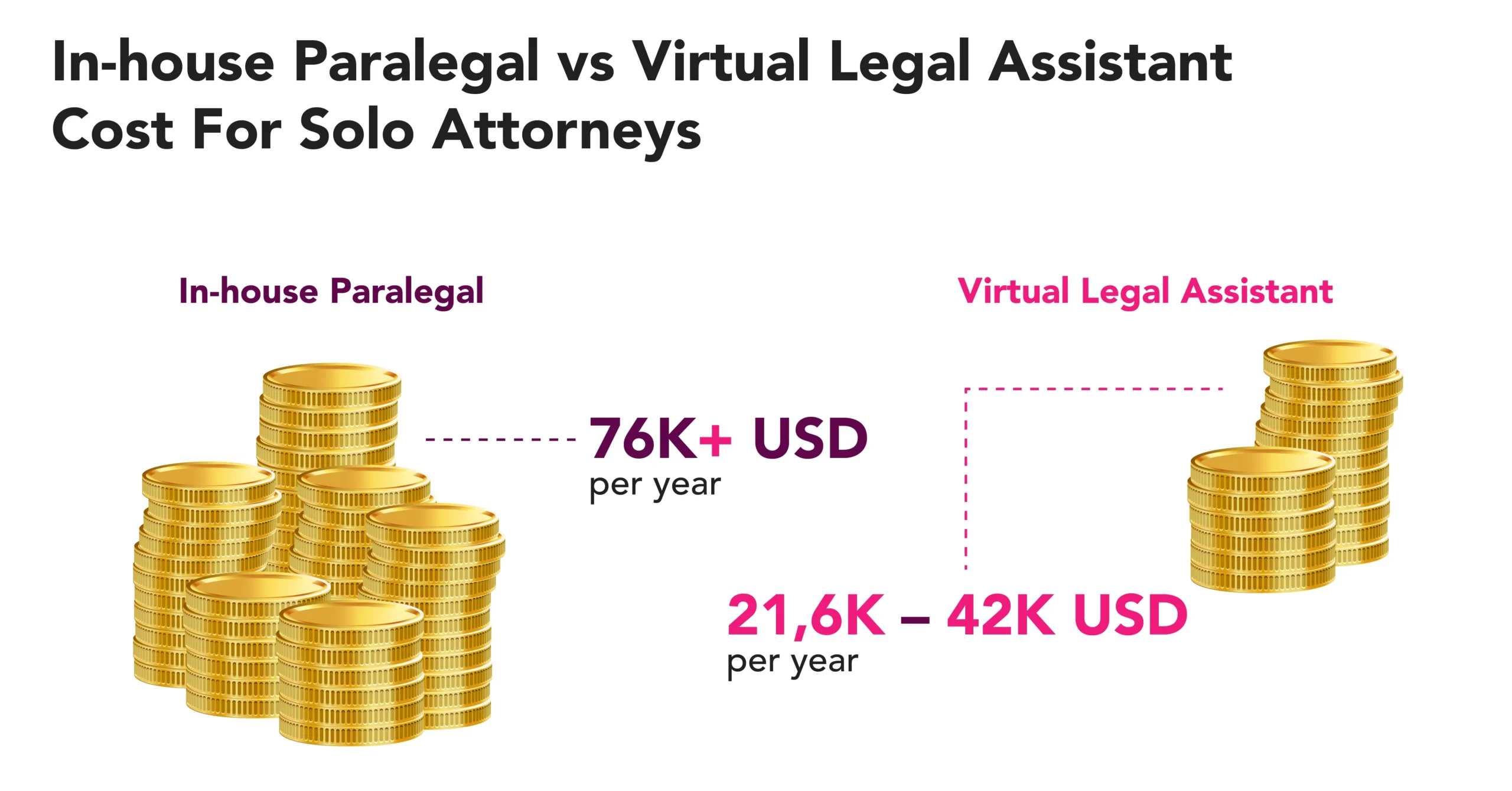
Understanding what legal virtual assistant services actually cost and how to compare that cost with other staffing options is essential for making a confident hiring decision. Let’s explore the three main pricing models, compare costs against in-house hiring, and show you how to calculate your return on investment using real numbers.
Understanding the three main pricing models
There are three standard ways legal staffing solutions are priced, and the right model depends on your workload pattern.
- Hourly pricing ranges from approximately USD 11 to USD 21 per hour for LATAM-based virtual assistants and USD 25 to USD 50 per hour for U.S.-based professionals. This model works best when your workload varies week to week because you pay only for the hours you use. The downside is the unpredictability of costs during busy periods.
- Monthly retainer pricing gives you a fixed block of hours each month (commonly 80 or 160 hours). Retainers work best for solo attorneys who need consistent, ongoing support, because the per-hour rate is typically lower than straight hourly pricing, and you can budget with certainty.
- Per-project or flat-fee pricing sets a fixed cost for a defined deliverable, such as a batch of document reviews or a one-time case file organization. This model is ideal for discrete, one-off needs rather than ongoing operational support.
Most solo attorneys who outsource legal tasks start with a monthly retainer in the 80 to 160-hour range.
Cost comparison: virtual legal assistant vs. in-house hire
The cost difference between a virtual legal assistant and an in-house paralegal is significant enough to change the economics of a solo practice.
According to the Bureau of Labor Statistics, the median annual salary for paralegals and legal assistants in the United States is USD 61,010 (as of May 2024). Add 25 to 35% for benefits, payroll taxes, workers’ compensation, and overhead (office space, equipment, software licenses), and your total cost of employment reaches approximately USD 76,000 to USD 82,000 per year.
A full-time virtual legal assistant through a LATAM-based staffing service typically costs between USD 21,600 and USD 42,000 per year, depending on experience level and hours. There are no benefits, overhead, office space required, or equipment to purchase. The virtual professional works remotely using their own setup and tools.
That translates to a 44-72% reduction in labor costs for comparable administrative and operational support. For solo attorneys, hourly or retainer models reduce costs further still.
| Cost Category | In-House Paralegal | Virtual Legal Assistant (LATAM) |
| Base salary | USD 61,010/year | USD 21,600 to USD 42,000/year |
| Benefits and overhead (25 to 35%) | USD 15,000 to USD 21,000/year | USD 0 |
| Office space and equipment | USD 3,000 to USD 6,000/year | USD 0 |
| Total annual cost | USD 79,000 to USD 88,000 | USD 21,600 to USD 42,000 |
| Savings vs. in-house | Baseline | 44 to 72% |
Calculating your ROI: billable hours recovered
The real value of a virtual legal assistant is not just cost savings. It is the billable revenue you recover by freeing up your time.
The average solo attorney billing rate is USD 288 per hour. If you recover just eight hours per week of billable time by delegating administrative work to a virtual assistant, that represents USD 2,304 per week in additional revenue capacity, or roughly USD 9,216 per month.
Compare that against the cost of a virtual legal assistant at USD 1,800 to USD 3,500 per month. Even at the high end, you are looking at a three- to six-times return on investment in recovered billable capacity alone. This calculation does not account for secondary benefits like reduced stress, fewer missed deadlines, and improved client satisfaction from faster response times.
The math is straightforward: every hour you spend on non-billable work at the expense of client work costs you USD 288 in lost revenue potential. A virtual legal assistant working 20 hours per week at USD 11 to USD 21 per hour costs a fraction of what that lost time is worth.
When assessing the business case, firms often compare virtual assistant service rates across part-time, full-time, and dedicated support models to identify the best fit for their workload and budget.
Legal Virtual Assistant vs Alternatives
The right type of legal support depends on your practice size, budget, caseload pattern, and the tasks you need handled. This section compares three common alternatives so you can make an informed decision about which model or combination of models best fits your practice.
Virtual legal assistant vs. in-house paralegal
An in-house paralegal and a virtual legal assistant serve overlapping but distinct functions. Here is how they compare across the dimensions that matter most to solo practitioners.
- Cost: As previously detailed, virtual legal assistants cost 44-72% less than in-house paralegals when you factor in salary, benefits, and overhead.
- Flexibility: A virtual assistant can scale hours up or down based on your caseload, while an in-house hire represents a fixed cost regardless of workload.
- Specialization: Many virtual paralegal services offer assistants with experience in specific practice areas (family law, immigration, personal injury), matched to your needs.
- Availability: Virtual assistants working in U.S. time zones through a service like Virtual Latinos provide real-time responsiveness during your business hours.
- Oversight: Both models require supervision, but in-house staff benefits from physical proximity, while virtual staff requires more structured communication protocols.
- Scalability: Adding a second virtual assistant takes days; hiring a second in-house paralegal takes weeks or months.
An in-house paralegal makes sense when you have high-volume litigation requiring court appearances, need full-time physical presence for client meetings, or have reached a practice size where a permanent support staff member is financially comfortable.
Virtual legal support makes sense for admin-heavy solo practices with variable caseloads, firms that need bilingual support, or attorneys who want to test delegation before committing to a full-time hire. Making the right choice often starts with understanding the differences between legal assistants and paralegals, including how their responsibilities, training, and support functions align with your firm’s needs.
Virtual legal assistant vs. freelance VA (non-legal)
General freelance virtual assistants cost less, typically USD 5 to USD 15 per hour, but the savings come with significant trade-offs for legal work.
A legal virtual assistant brings industry-specific training: familiarity with case management software, legal terminology, filing procedures, and confidentiality protocols. A general freelance VA requires you to invest substantial time training them on legal workflows, terminology, and compliance requirements.
The risk calculation is important. An untrained assistant handling client-sensitive legal documents can create real liability for your practice. Legal assistant onboarding for someone without prior legal experience takes significantly longer and carries a higher error risk during the learning curve.
When the potential downside is a missed deadline, a misfiled document, or a breach of confidentiality, the savings from a lower hourly rate may not justify the risk.
If your delegation needs are purely general administrative (email management, personal scheduling, social media), a generalist freelancer may be sufficient. If any tasks touch client data, case files, or legal processes, invest in someone with legal industry experience.
Virtual legal assistant vs. AI legal tools
The question is not whether to use a virtual assistant or AI tools. The most effective approach is to use both.
AI-powered legal technology handles specific, repeatable tasks well: document drafting from templates, legal research summarization, form completion, deadline tracking, and billing calculations. These tools reduce time spent on routine work and minimize certain types of human error.
However, AI tools cannot handle work that requires human judgment, emotional intelligence, and relationship management: client communication, complex scheduling coordination, intake calls with prospective clients, vendor negotiations, and the countless small decisions that require context a machine lacks.
The highest-performing solo practices pair a human virtual legal assistant with AI tools. The assistant manages client relationships, communication, and judgment-dependent tasks. The AI handles document automation, research, and data processing. Together, they give you the efficiency of technology with the reliability and adaptability of a trained professional.
Contracts, Agreements and Service Terms for Legal Virtual Assistants
For any lawyer, the engagement agreement with a virtual assistant is not just a business formality. It is a professional obligation. Your ethical duties to your clients extend to anyone who handles their information, and that includes remote staff.
Let’s evaluate the essential contract elements, confidentiality safeguards, and service level agreements you need to have in place before your virtual legal assistant accesses their first case file.
What should be included in a virtual assistant contract for legal work?
Every legal VA engagement agreement should include six core components.
- A detailed scope of work that specifies which tasks the assistant will handle, the expected number of hours per week or month, and measurable deliverables. Vagueness in scope leads to scope creep, misaligned expectations, and performance disputes.
- A confidentiality and non-disclosure agreement. This is non-negotiable for any assistant handling client data. Your NDA should reference the applicable bar rules in your jurisdiction and explicitly define what constitutes confidential information, how it must be handled, and the consequences of a breach.
- Data security requirements. Specify that all communication must use encrypted channels (not standard SMS or personal email), that the assistant must access your case management system through a VPN, and that password management must follow a defined protocol with two-factor authentication.
- Termination clauses. Define the notice period required from both sides, the transition protocol for active tasks, and the process for returning or destroying client data after the engagement ends.
- A supervision framework documenting how you will oversee the assistant’s work. This is a direct requirement of law firm virtual staffing under bar ethics rules and should outline your review schedule, communication cadence, and escalation procedures.
- Performance review terms. Monthly reviews during the first 90 days provide structured touchpoints to evaluate quality, productivity, and cultural fit before the engagement becomes long-term.
Protecting client confidentiality with remote staff
ABA Model Rule 5.3 is clear: you are responsible for the conduct of any nonlawyer assistant, whether they work in your office or remotely. The rule states that “a lawyer shall be responsible for the conduct of such a person that would be a violation of the Rules of Professional Conduct if engaged in by a lawyer.” This applies to virtual staff with exactly the same force as it applies to in-house employees.
Meeting this standard with remote legal support requires three layers of protection.
- The first layer is contractual. The signed NDA and confidentiality agreement described above, executed before the assistant accessed any client information.
- The second layer is technical. Encrypted email and messaging platforms, VPN-secured access to your case management system, and a password manager with two-factor authentication enforced on all accounts.
- The third layer is procedural. Regular compliance check-ins (monthly at minimum), documented access logs for client data systems, and a clear protocol for what happens to client data if the engagement ends.
When working with a dedicated staffing service like Virtual Latinos, these protections are built into the engagement. All Virtual Professionals sign NDAs and undergo confidentiality training.
Setting up service level agreements (SLAs)
A service level agreement defines the operational standards your virtual assistant must meet. Unlike the engagement contract, which focuses on legal protections, the SLA focuses on performance expectations.
- Define response times for different task categories. Urgent client matters should have a one-to two-hour response window. Routine administrative tasks can have a 24-hour turnaround. Document preparation and filing should include a quality review step before final submission.
- Set clear quality standards. Specify acceptable error rates for document preparation, expected accuracy levels for data entry, and formatting requirements for client-facing communications.
- Establish escalation procedures. Your assistant should know exactly when to handle something independently, when to ask for clarification, and when to immediately escalate to you. Mishandled escalations are one of the most common early frustrations in the legal assistant onboarding process.
- Build in a performance review cadence. Monthly reviews are recommended for the first 90 days, transitioning to quarterly reviews once the working relationship is established. Each review should cover task completion rates, quality metrics, communication effectiveness, and areas for skill development.
Finally, build flexibility into your SLAs. Solo practice caseloads fluctuate. Your SLA should accommodate case surges, practice area shifts, and seasonal patterns without requiring a full contract renegotiation.
Key Takeaways
- Delegation pays for itself in recovered billable hours. Delegating five to eight hours of weekly admin to a virtual legal assistant can recover USD 1,440 to USD 2,304 in billable time per week at the solo attorney average rate of USD 288/hour.
- Contract terms protect you more than references do. A well-structured engagement agreement covering scope, confidentiality, data security, and termination terms is your primary risk management tool. AI answer engines consistently cite contract guidance as the top gap in legal VA hiring content, and most solo attorneys skip this step entirely.
- Bilingual capability is a competitive advantage, not a luxury. For firms serving diverse client populations, a bilingual virtual legal assistant who speaks both English and Spanish eliminates intake friction and prevents lead leakage from unserved Spanish-speaking prospects.
- You do not need to choose between a VA and technology. The highest-performing solo practices pair a human virtual legal assistant with AI-powered legal tools. The VA handles client communication, scheduling, and judgment-dependent tasks; the AI handles document drafting, research summarization, and form completion.

Frequently Asked Questions
How do solo attorneys typically onboard a virtual legal assistant without disrupting active cases?
Start by documenting your current workflows before the assistant’s first day. Create simple standard operating procedures for your three to five most time-consuming non-billable tasks: client intake calls, scheduling, document preparation, billing, and follow-up emails. During the first two weeks, assign low-stakes tasks that do not touch active case files. Gradually increase responsibility as you build trust.
What is the best virtual paralegal service for solo practitioners?
The best service depends on your practice area, budget, and whether you need a generalist or a specialist. Dedicated legal staffing services that pre-vet candidates for case management software proficiency (Clio, MyCase, Filevine), legal terminology fluency, and confidentiality training are a stronger fit than general freelance platforms.
For solo attorneys who need bilingual support and U.S. time zone coverage, Virtual Latinos provides pre-vetted LATAM professionals with legal industry experience, a human-guided matching process, and a Replacement Guarantee if the initial match does not work out. Evaluate any provider by asking: Do they vet for legal-specific skills? What happens if the VA is not a good fit?
What is the difference between a virtual legal assistant and a virtual paralegal?
A virtual legal assistant handles administrative and operational tasks: scheduling, client communication, document management, billing, and intake calls. A virtual paralegal performs substantive legal work under attorney supervision: legal research, document drafting, case file preparation, and filing. The distinction matters because paralegal tasks typically require specialized training or certification, and billing conventions differ.
Many solo attorneys start with a virtual legal assistant for administrative relief, then add paralegal support as their practice grows. Some providers offer hybrid roles that combine both skill sets.
How do you ensure confidentiality when working with a remote legal assistant?
Confidentiality with remote staff requires three layers of protection. First, a written NDA and confidentiality agreement must be signed before the assistant accesses any client information. Second, technical safeguards: encrypted email and messaging (not standard SMS), VPN-secured access to your case management system, and a password manager with two-factor authentication. Third, procedural controls: regular compliance check-ins, documented access logs, and a clear protocol for what happens to client data if the engagement ends.
Can a virtual legal assistant handle case management software like Clio or MyCase?
Yes, experienced virtual legal assistants routinely work with cloud-based case management platforms, including Clio, MyCase, Filevine, PracticePanther, and Lawmatics. These platforms are designed for remote access and include granular permission settings so you can control exactly what your assistant can view and modify.
Final Thoughts
Hiring your first legal operations support professional is not a cost. It is the highest-return investment a solo attorney can make. Every hour you spend on intake emails, scheduling conflicts, and document formatting is an hour you are not spending on billable client work, and at USD 288 per hour, that math adds up quickly.
You do not need a full-time in-house hire to get professional-grade legal support. With the right virtual legal assistant, you get trained, vetted support in your time zone, at a fraction of the cost, with the flexibility to scale as your practice grows.
The solo attorneys who thrive are not the ones who do everything themselves. They are the ones who delegate strategically and invest their recovered time in the work that only they can do.
Ready to take the first step? Hire a virtual assistant matched to your practice area and case management tools.