Industry experts are calling 2025 “the year of AI,” and AI agents are no longer just a sci-fi concept—they’re actively reshaping the way we work.
As remote work becomes the standard, businesses are relying more than ever on intelligent automation to stay competitive, boost efficiency, and streamline operations.
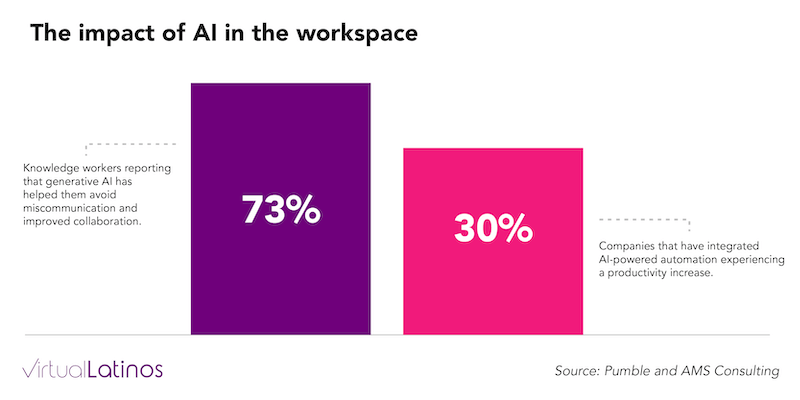
Recent data highlights the tangible impact of AI on modern workplaces. 73% of knowledge workers report that generative AI tools have helped them avoid miscommunication, improving collaboration across distributed teams.
Additionally, companies that integrate AI-powered automation into their remote work environments experience a 30% increase in productivity, as AI helps reduce administrative workloads and streamline task management.
Beyond boosting efficiency, AI agents are revolutionizing decision-making. More companies are leveraging generative AI agents that can analyze trusted customer data in real time, providing valuable insights without the manual effort that traditionally consumes both time and resources.
Their ability to learn, adapt, and provide intelligent support is making them an indispensable asset for remote teams.
So how exactly do AI Agents work, and why are they becoming essential for businesses embracing the future of work? Let’s explore the evolution of AI-driven automation and its far-reaching impact.
What Are AI Agents?
AI agents are intelligent software programs designed to understand their environment, analyze information, and take autonomous actions to achieve specific goals.
Unlike traditional automation tools that follow strict, pre-programmed rules, AI agents leverage Agentic AI, a new paradigm that enables them to think, adapt, and make decisions dynamically.
While traditional automation executes repetitive tasks based on predefined workflows, Agentic AI allows AI agents to operate independently, learning from real-time data and adjusting their actions accordingly.
This makes them far more flexible, intelligent, and capable of handling complex scenarios without constant human intervention.
How do AI agents work?
AI agents function through four key steps:
- Perception – They collect and interpret data from various sources, such as emails, chat conversations, customer interactions, and databases.
- Processing – Using AI models and pre-trained knowledge bases, they analyze information to identify patterns, extract insights, and predict outcomes.
- Decision-making – Unlike traditional automation, which follows fixed instructions, Agentic AI enables AI agents to make independent decisions based on real-time data, past experiences, and specific goals.
- Action execution – They perform tasks such as answering customer questions, scheduling meetings, generating reports, or even making strategic recommendations—continuously improving their efficiency over time.
How is agentic AI different from traditional automation?
Traditional automation follows static, rule-based processes that require manual updates to adapt to changes. Agentic AI development, on the other hand, enables AI agents to:
- Think and act autonomously, rather than just executing pre-programmed steps.
- Learn and adapt based on new data, making them more effective over time.
- Respond dynamically to conversations, context, and unexpected situations.
- Optimize processes in real time, without human intervention.
These capabilities allow AI agents to provide smarter, more efficient interactions in customer service, business operations, and beyond.

Types of AI Agents and Their Applications in Remote Work
In remote work environments, AI agents help streamline workflows, enhance productivity, and improve decision-making.
To better understand their functionality, this section explores the five main types of AI agents, ranked from the simplest to the most advanced.
Simple reflex agents
Simple reflex agents operate based on predefined rules and react to specific inputs without considering past experiences. They follow an “if-then” logic, meaning they respond to triggers but cannot adapt or learn.
Example in remote work:
- Basic Chatbots: Automated chat assistants that provide instant responses based on keywords. For example, if a user asks, “What are your business hours?” the chatbot retrieves and displays a predefined response.
- Email Auto-Responders: Automatic replies, such as “Out of Office” messages, function as simple reflex agents.
Early expert systems, such as MYCIN, followed strict rule-based logic for medical diagnosis.
Model-based agents
Unlike simple reflex agents, model-based agents create an internal representation of their environment. They remember past interactions, allowing them to adjust responses and make better decisions over time.
Example in remote work:
- AI Scheduling Assistants (e.g., Google Calendar’s AI assistant)
- Remembers preferred meeting times and avoids scheduling conflicts.
- Suggests optimized time slots based on prior bookings.
- Smart Email Filters (e.g., Gmail’s spam detection)
- Analyzes past interactions with emails to improve spam recognition.
Model-based reasoning is widely used in robotics and autonomous driving, where AI must maintain an understanding of the world to navigate effectively.
Goal-based agents
Goal-based agents assess different possible actions and select the one that aligns best with a predefined goal. Unlike model-based agents, they do not just remember—they evaluate alternative choices before making a decision.
Example in remote work:
- AI-Powered Recommendation Engines (e.g., Netflix, Amazon)
- Suggests personalized content based on past behavior and user preferences.
- Example: If a remote worker frequently buys office supplies, Amazon’s AI will recommend related products.
- Virtual Business Coaches (e.g., AI-driven goal-setting software)
- Helps remote workers set and achieve productivity goals by providing recommendations tailored to their work habits.
Goal-based agents are commonly used in autonomous robots, where they must plan actions to complete complex tasks efficiently.
Utility-based agents
Utility-based agents go beyond achieving goals—they prioritize efficiency by weighing multiple factors such as speed, cost, accuracy, and user preferences to determine the best possible outcome.
Example in remote work:
- AI-Powered dynamic pricing systems (e.g., Uber’s surge pricing, Amazon’s price adjustments)
- Monitors demand and competitor pricing to suggest optimal product or service prices.
- Helps freelancers and businesses set competitive rates based on market conditions.
- AI in project management tools (e.g., Asana, Trello AI)
- Suggests deadlines based on task complexity and historical project timelines.
- Prioritizes urgent assignments dynamically.
This approach is used in automated financial trading systems, where AI evaluates potential investments by analyzing risks and rewards dynamically.
Learning agents
Learning agents are the most advanced type of AI. They continuously improve by analyzing new data, adapting to user behavior, and optimizing their decision-making over time. These agents rely on machine learning and deep learning techniques.
Vertical AI agents take this a step further by specializing in specific industries or tasks, allowing for even more precise and effective performance.
Example in remote work:
- AI Writing Assistants (e.g., Grammarly, ChatGPT, AI Humanizer)
- Learns from a user’s writing style to suggest personalized corrections and tone adjustments.
- AI-Powered Virtual Assistants (e.g., Siri, Alexa, Google Assistant)
- Understands user preferences and refines responses with experience.
- Example: If a user frequently schedules meetings at 10 AM, the assistant starts suggesting that time automatically.
DeepMind’s AlphaGo, an AI system that learned to play and defeat human champions in Go, is an example of a learning agent continuously improving through experience.
Table 1. Types of AI agents and their business applications
| AI agent type | Business application example |
| Simple Reflex Agents | Rule-based chatbots for FAQs |
| Model-Based Agents | AI-powered CRM tools that remember past interactions |
| Goal-Based Agents | AI-driven recommendation engines (e.g., personalized marketing) |
| Utility-Based Agents | AI systems that optimize pricing and cost-efficiency |
| Learning Agents | AI assistants that improve based on user behavior and feedback |
AI Agents and Virtual Assistants: How Can They Work Together
The rise of AI agents and virtual assistants is transforming industries by automating tasks, improving efficiency, and enhancing user experiences.
While both technologies leverage human expertise and artificial intelligence (AI), they serve different yet complementary roles.
Table 2. Differences between AI Agents and virtual assistants
| Feature | AI agents (intelligent agents) | Virtual assistants (human or AI-powered) |
| Definition | Software programs designed to perceive their environment, make decisions, and take actions autonomously. | Professionals (humans) or AI-powered tools that assist with administrative, operational, or customer service tasks. |
| Main function | Automate complex processes, analyze data, and make autonomous decisions. | Assist users with tasks such as scheduling, customer support, research, and workflow management. |
| Autonomy level | High – Operates independently based on predefined rules, AI models, or hierarchical decision-making. | Varies – AI-powered assistants depend on programmed responses, while human virtual assistants use critical thinking and adaptability. |
| Technology used | AI algorithms, machine learning, hierarchical agents, automation software. | AI-powered assistants use NLP and chatbot frameworks; human virtual assistants use communication and productivity tools. |
| User interaction | Works in the background, often without direct interaction. | Direct communication with users (human assistants via calls, emails, chats; AI assistants via voice or text). |
| Examples | AI agents for predictive analytics, fraud detection, automated workflow management. | AI-based assistants like Siri, Alexa, or ChatGPT; human virtual assistants handling executive support, customer service, or content creation. |
| Best use cases | Process automation, business intelligence, workflow optimization, decision-making support. | Customer service, administrative support, personal productivity, creative tasks. |
| Flexibility | Operates within predefined parameters and may require updates for new scenarios. | Human assistants adapt to changing needs and complex situations; AI-powered assistants improve with machine learning. |
AI Agents and Virtual Assistant Collaboration
By integrating AI agents with virtual assistants, businesses can create smarter, more autonomous solutions. Here are some ways they can collaborate:
Enhancing customer service
The top AI agents for customer service work behind the scenes, analyzing customer inquiries, predicting responses, and automating issue resolution. Meanwhile, virtual assistants act as the primary communication channel, providing a human-like interaction experience.
Automating workflow management
AI agents can manage complex tasks by breaking them into smaller steps handled by different hierarchical agents. Virtual assistants then interact with users, guiding them through processes while AI agents execute tasks in the background.
Improving decision-making with data insights
AI agents analyze vast amounts of data, providing valuable insights that virtual assistants can communicate in an accessible way. This combination is particularly useful in industries like healthcare, finance, and marketing.
Personalizing user experience
AI agents can track user preferences, learn behaviors, and adapt responses accordingly. Virtual assistants then use this data to offer tailored recommendations and a more engaging experience.
Streamlining operations in virtual assistant agencies
For businesses that manage virtual assistants, integrating AI agents can optimize operations by handling scheduling, tracking performance metrics, and automating repetitive tasks.

How Implementing AI Agents
AI agents, particularly utility-based and other intelligent agents, are designed to optimize workflows, analyze data, and make informed decisions based on specific objectives.
Below is a step-by-step guide to implementing AI agents in a business setting, helping entrepreneurs and business owners maximize their potential while avoiding common pitfalls.
Step 1: Identify business needs and goals
Before deploying AI agents, businesses must define their specific challenges and objectives. AI should be used as a tool to solve real business problems, not just as a trend to follow.
Key questions to ask:
- What repetitive or data-driven tasks could benefit from automation?
- Where can AI improve decision-making or optimize resources?
- What outcomes are you expecting—cost reduction, improved customer experience, or increased productivity?
Addressing these challenges requires a strategic approach to AI adoption, focusing on ethical AI use, transparency, and workforce development.
Step 2: Choose the right type of AI agent
Different AI agents serve different purposes, and selecting the right one is critical to implementation success (see Table 1).
If the business prioritizes efficiency, utility-based agents are a strong choice since they consider multiple factors (speed, cost, accuracy) to determine the best course of action.
Step 3: Prepare your data for AI training
AI agents rely on high-quality data to function effectively. Poor, outdated, or biased data can lead to inaccurate or unfair AI-driven decisions.
Data preparation checklist:
- Ensure data is clean, structured, and relevant to the AI’s intended purpose.
- Remove duplicate, outdated, or incorrect records.
- Use diverse and unbiased datasets to prevent AI from developing decision-making biases.
- Establish data security protocols to protect sensitive information and comply with regulations (e.g., GDPR, CCPA).
If your AI agent will be handling large-scale decision-making, such as automated pricing or customer segmentation, consider using utility-based agents that weigh multiple variables in real time.
Step 4: Select the right AI tools and vendors
Businesses must decide whether to develop AI in-house or use third-party AI solutions.
Considerations for choosing AI solutions:
- Ease of integration: Ensure AI can seamlessly connect with existing software (CRM, ERP, HR systems).
- Customization options: AI should be adaptable to your specific business needs.
- Scalability: Choose AI tools that grow with your business.
- Security and compliance: Confirm AI vendors comply with relevant data protection laws.
Examples of AI Tools for business:
- Customer service: Zendesk AI, Drift AI, ChatGPT-powered chatbots
- Efficiency & automation: Asana AI, Trello AI-powered task management, Noem.ai
By selecting the right AI agent and platform, businesses can minimize integration complexity and maximize efficiency.
Step 5: Ensuring successful AI adoption by employees
To ensure successful AI adoption, businesses must address employee resistance by positioning AI as a productivity-enhancing tool rather than a job replacement.
Providing an ai agents course online, emphasizing AI’s supportive role in decision-making, and implementing human-in-the-loop systems can help employees adapt and maximize AI’s benefits in daily operations.
Step 6: Continuously monitor and improve AI performance
AI agents require ongoing evaluation to ensure they continue delivering value.
Key areas for AI monitoring:
- Decision accuracy: Are AI predictions and recommendations correct?
- Efficiency gains: Has AI reduced workload or increased productivity?
- Security & compliance: Is AI following data protection regulations?
By setting up a regular AI auditing process, businesses can ensure their AI agents remain reliable, fair, and effective.
Utility-based agents and other intelligent AI solutions can drive significant efficiency gains when properly integrated into business workflows.
The Benefits of AI Agents for Remote Work
The rapid adoption of AI tools in businesses is transforming remote work, driving productivity and efficiency across industries.
Companies are increasingly leveraging AI agents to streamline operations, enhance human performance, and improve decision-making—but the real advantage comes from hiring virtual assistants (VAs) who know how to use these tools effectively.
Here’s how AI agents, combined with skilled VAs, create a strategic edge:
- Improving customer service: AI agents with internal models and NLP provide 24/7 automated support, reducing response times by 40% and cutting operational costs.
- Automating repetitive tasks: AI-powered assistants handle emails, schedules, and document management, boosting productivity and minimizing human errors. A VA trained in AI can oversee and optimize these processes, ensuring smooth operations.
- Enhancing business strategy: AI analyzes data to optimize production processes, predict trends, and improve resource allocation. A VA skilled in AI-driven analytics can help businesses make smarter, data-backed decisions.
For recurring strategy presentations, a PowerPoint AI agent can turn existing templates and slide libraries into editable decks while keeping the work inside PowerPoint. - Reducing costs: Companies that expect AI agents to automate workflows report a 30% decrease in operational expenses.
By integrating AI tools and hiring VAs who know how to leverage them effectively, remote teams can maximize efficiency, reduce costs, and maintain a competitive edge in today’s digital-first world.
Optimize Your Workflow with Noem.ai
The rise of AI agents is transforming remote work by automating repetitive tasks, optimizing decision-making, and enhancing overall efficiency.
One of the most powerful AI automation solutions available today is Noem.ai. Unlike traditional AI tools that simply generate text, Noem.ai enables fully autonomous workflows, handling multi-step tasks such as:
- Automating email generation and scheduling – Drafting personalized emails, scheduling follow-ups, and managing inbox organization without manual input.
- Conducting market research and data analysis – Gathering insights from multiple sources, identifying trends, and summarizing key findings to inform decision-making.
- Managing and optimizing ad campaigns – Adjusting budgets, A/B testing creatives, and analyzing performance metrics to maximize ROI.
- Creating dynamic presentations and reports – Generating data-driven reports, designing presentations, and tailoring content based on audience insights.
By leveraging Noem.ai, businesses can streamline operations, empower remote teams, and maximize efficiency without increasing their workload.
At Virtual Latinos, we are committed to helping businesses thrive by connecting them with skilled Virtual Assistants who stay ahead of industry trends—especially as AI continues to transform the way we work.
That’s why we provide exclusive opportunities for our VL Community members, including the Introduction to Noem.ai and other AI-focused courses through the Virtual Latinos Academy, equipping Virtual Assistants with the skills to effectively integrate AI into their workflows.
Ready to optimize your workforce with AI-powered Virtual Assistants? Contact us today for a consultation.