
Wondering How Much Does It Cost to Hire a Remote Real Estate professional, and whether the math really works? You’re not alone.
The good news is that remote hiring isn’t a fad anymore; in the U.S., about 29% of paid workdays were from home in March 2025, which means building a distributed team is now a mainstream way to run your brokerage or investing operation.
When you run the numbers, make a true apples-to-apples comparison. for civilian workers averaged $48.05 per hour worked in June 2025, so many teams benchmark contractor rates against W-2 total cost of ownership to see the real savings.
Most importantly, remote support lines up with where deals actually start.
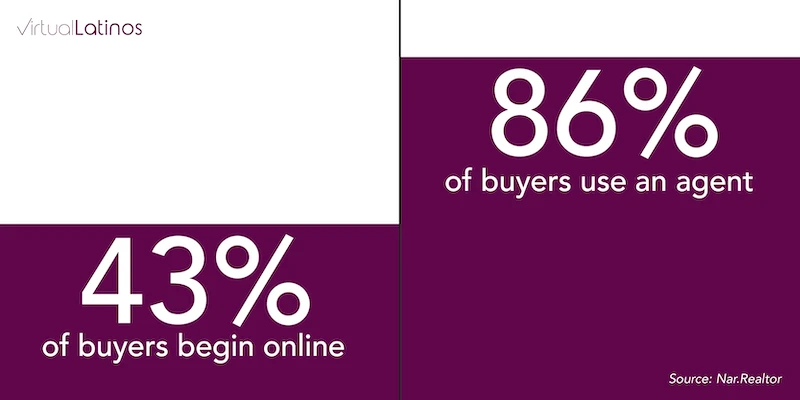
43% of buyers begin online and 86% use an agent, so consistent listing polish, social content, and fast follow-ups from a capable VA translate directly into pipeline and closings.
This blog is presented by Virtual Latinos, a platform that helps brokerages and investors hire vetted, bilingual real estate VAs and operational support, complete with cost calculators, SOP templates, and onboarding playbooks to make remote hiring work end-to-end.
Why remote hiring for real estate makes business sense in 2025?
Because remote and hybrid work are now a durable feature of business operations, not an experiment.
Multiple large-scale U.S. datasets show that roughly a quarter of all paid workdays are from home in 2025, which cements remote hiring as a mainstream operating model for teams that live in the cloud (CRMs, e-sign, listing portals).
Small businesses, the heart of real estate (brokerages, investor groups, local property teams), are also leaning in.
U.S. small companies (<250 employees) increased their share of remote hires by ~5.7% year over year through July 2024, according to LinkedIn’s Economic Graph.
That’s a strong demand signal for remote real estate professionals who can handle listing polish, lead nurturing, and transaction support from anywhere.
There’s also a clear cost lever. In the U.S., benefits account for ~29.8% of total compensation in private industry, per the Bureau of Labor Statistics.
That’s why many firms blend W-2 staff with specialized contractors/virtual assistants, benchmarking against total cost of ownership (TCO) rather than hourly wage alone, to keep margins healthy while maintaining coverage across time zones and weekends.
With remote/hybrid now “normal,” small firms expanding remote hiring, and TCO math favoring flexible staffing, hiring a remote real estate professional is no longer a fringe perk, it’s a competitive system for speed, consistency, and cost control.
How Much Does It Cost to Hire a Remote Real Estate (VA/professional)?
Here’s the quick math on remote real estate VA costs, what hourly rates look like by skill level and how that translates into monthly budget.
Hourly rates vary widely by scope, experience, and hiring channel.
- On a major marketplace, Virtual Assistants typically cost $10–$20/hour (median ≈ $13).
- Specifically for real estate virtual assistant roles, published ranges show $5/hour (beginner), ~$19/hour (intermediate), up to $90/hour (advanced specialists).
Most real estate VA work (CRM cleanups, listing coordination, lead nurture, social media management) falls in the beginner-to-intermediate bracket.
What does that mean per month?
For a full time (40 hrs/week) remote hire:
- $10/hr → ~$1,733/month (based on 173.3 hrs/month)
- $15/hr → ~$2,600/month
- $20/hr → ~$3,467/month
Those figures are contractor costs (no U.S. payroll taxes/benefits).
A U.S. W-2 equivalent typically adds benefits, taxes, and overhead; using official employer-cost data, benefits alone average ~30% of total compensation in private industry, so a $20/hr wage can translate closer to $28–$30/hr in TCO once benefits are included.
Use hourly × 173.3 to model monthly contractor spend, then compare against a W-2 total cost of ownership (benefits add ~30%, per BLS).
For most brokerages, a remote pro delivers flexible capacity and real savings without adding fixed overhead.

What drives the price up (or down) for a real estate virtual assistant?
Rates track scope, specialization, and fluency. Use this section to align responsibilities with the right skill tier, general ops vs. specialist tasks that move ROI.
Scope & specialization
- Transaction coordination: timelines, disclosures, contingencies, escrow communications.
- Lead generation & nurture: CRM hygiene, smart follow-ups, appointment setting.
- Real estate marketing: listing descriptions, flyers, social media management, email campaigns, website updates, ad ops.
- Ops & admin: inbox/calendar, document prep, vendor coordination.
More specialized tasks (e.g., ad platform management, IDX site updates, MLS data workflows, high-end copywriting for luxury listings) increase rates, but can improve efficiency and ROI when handled by experienced talent.
Tools & data fluency
Familiarity with CRMs (Follow Up Boss, kvCORE, BoomTown), e-sign (DocuSign), MLS data exports, Canva/Adobe, Meta/Google ads, and transaction platforms often commands higher compensation because it compresses your ramp-up time (fewer mistakes, faster delivery).
English level & client-facing work
Bilingual VAs who can handle client calls or draft persuasive marketing often sit at the mid-range or higher.
Match the scope to the talent (and pay for specialization when the ROI is clear). If you need vetted, bilingual real-estate VAs who already know the tools, Virtual Latinos can source and screen the right fit fast.
Okay, but how do I build a realistic budget for a remote real estate VA?
Turn fuzzy “headcount vs. contractor” debates into math.
Use this TCO worksheet to scope work, price it, and prove ROI before you scale hours.
Use a TCO worksheet you can iterate on each quarter:
- Define the mission (30/60/90 days):
- Example goals: reduce days on market content gaps, keep all deal timelines green, respond to new leads in <10 minutes during business hours, publish 3 high-quality local posts/week.
- Scope the tasks by frequency:
- Daily: inbox triage, CRM follow-ups, appointment setting, social replies.
- Weekly: listing updates, social media management calendar, pipeline report.
- Per-deal: disclosures packet, offer tracking, contingency calendar.
- Estimate hours:
- Start at 10–15 hrs/week for a pilot; move to part-time (20 hrs) or full time (40 hrs) after 30–45 days if ROI is clear.
- Apply a rate band:
- Pilot at $12–$18/hr for core admin/marketing; expand to $20–$30/hr for ad ops / advanced copy / data tasks (based on published marketplace ranges).
- Model the savings:
- Compare with an in-house admin by adding benefits (~30% of comp) to any U.S. wage assumption to understand your true cost savings from contracting.
Review the model quarterly: keep what pays back, upgrade rates for proven specialists, and sunset low-impact tasks.
Make a simple rule, expand if ROI ≥ 2×, pause if < 1×, so staffing stays data-driven, not opinion-driven.
How do I protect quality when I hire remotely (and still improve efficiency)?
Turn expectations into evidence. Use this scorecard + SOPs + access rules to make remote performance visible, repeatable, and secure.
Scorecard > job description
Track weekly:
- Lead response time
- On-time tasks (% by due date)
- Listing accuracy (0-1 errors)
- Showings booked / appts kept
- Content cadence (posts/newsletters sent)
Document the “how”
- One-page SOPs for MLS updates, listing launches, open house workflow, inspection/contingency calendars, and CRM follow-ups.
Tool access & security
- Use role-based permissions for CRM, cloud drive, and ad platforms; rotate credentials; keep all files in shared folders.
Cadence and overlap
- A 15-minute daily stand-up (async bullets are fine) and a 2-hour overlap window for live questions keep momentum high in remote settings, consistent with the broader trend that remote/hybrid success depends on clear practices more than policy alone.
Keep it simple: track the few metrics that move revenue, document the “how” on one page, lock down tools, and protect a daily overlap window.
That rhythm, not policy, makes remote/hybrid teams win.

FAQ
Q1) What tasks does a real estate VA handle most often?
Answer: CRM cleanups, lead nurture, appointment setting, listing updates, marketing assets, open-house logistics, vendor coordination, and transaction timelines.
These are high-leverage because buyers start online and expect rapid follow-ups.
Q2) How many hours should I start with, part-time or full time?
Answer: Pilot 10–15 hrs/week for 30–45 days with clear KPIs (lead response time, on-time tasks, content cadence). If ROI is clear, scale to 20–25 hrs/week or full time.
Q3) Do remote arrangements hurt quality?
Answer: Not when you run them with SOPs + metrics. Studies indicate small positive productivity effects in some knowledge tasks and lower turnover, which reduces re-hiring costs.
Q4) Where can I find remote real estate VA talent and rate benchmarks?
Answer: Marketplaces publish transparent price bands for VAs and real estate VAs, which help you calibrate offers and scopes before you commit.
Final Take: Make the Math Work for You
When you price remote help the right way, scoping tasks, using rate bands, and comparing against W-2, total cost of ownership, you turn capacity into a controllable lever.
Real estate workflows are digital by default (CRM, listings, e-sign), so a remote specialist can lift speed-to-lead, keep timelines green, and polish marketing without adding fixed overhead.
Ready to answer How Much Does It Cost to Hire a Remote Real Estate pro for your team?
- U.S. teams: scope tasks, pick a rate band, and launch a 30-day pilot.
- LATAM pros: apply to vetted roles and build a results-first portfolio (listing pack, CRM cleanup, pipeline report)—contact Virtual Latinos.
Prefer DIY? Download the cost & ROI worksheet to plug in hours, rates, and conversion metrics—then hire with confidence.