
Traditional real estate is under pressure in states like Florida, Texas, and California—where climate disasters have caused over $1.12 trillion in damages since 1980. Yet, rental properties are showing surprising strength. Cities like Sarasota, FL, and Austin, TX, continue to generate strong income despite climate risks, and in 2024, the U.S. accounted for 63% of global rental revenue. With nearly 800,000 real estate jobs tied to a shifting market, short-term rentals are emerging as a serious alternative for investors and the industry’s future.
In a country where real estate has long been synonymous with stability and prosperity, the rules are starting to change—fast.
Florida, Texas, and California, three pillars of the U.S. housing market, face the most brutal consequences of the climate crisis. Once magnets for new residents and investors, these states have become the country’s natural disaster cost epicenter. Since 1980, they’ve accounted for over $1.12 trillion in climate-related damages 40% of the national total.
But even in the face of hurricanes, wildfires, and surging insurance rates, one market segment is not only holding its ground—it’s growing: rental properties, particularly in the short term.
So what’s going on here? Could short-term rentals become the new formula for weathering the storm?
The hard numbers hiding a bigger shift
To fully grasp the scale of the crisis, we can start with a look at the financial reality.
When you add up the damages from events like Hurricane Harvey ($155 billion), Hurricane Maria ($111 billion), and Hurricane Irma ($62 billion)—all of which hit Florida or Texas—you get a picture of how fast climate change is destabilizing the real estate market.
These four events alone—three hurricanes and a wave of California wildfires—have caused over $500 billion in damages. The financial scale of climate disasters underscores why real estate investors are rethinking long-term property strategies in high-risk states.
But those are just the headline events. The actual erosion is happening slowly through things like skyrocketing insurance premiums, delayed property repairs, and shrinking buyer interest in high-risk areas. And California isn’t immune. With 1.3 million homes facing wildfire threats and another 233 thousand in Texas, the psychological impact on homeowners is already shifting how people invest, buy, and sell.
The takeaway: Climate risk is no longer hypothetical—it’s priced in. Many traditional property owners are left questioning whether long-term ownership still makes sense.
Why rentals are doing surprisingly well
Here’s where it gets interesting.
Despite all the risks, the short-term rental market is booming. Places that have faced repeated disasters are still generating consistent, even impressive, rental income.
In Sarasota, FL, for example, rental occupancy is at 83%, with average annual revenues of $65,481. That’s not a fringe exception—it’s part of a larger trend. In Austin, TX, rental occupancy averages 72%, bringing in over $50,000 annually, while Santa Barbara, CA, despite being in a wildfire-prone region, sees earnings upwards of $91,000 per property. You can use Amigo Energy to shop electricity rates for your rentals in Texas, reducing monthly expenses and protecting profit even in high-risk regions.
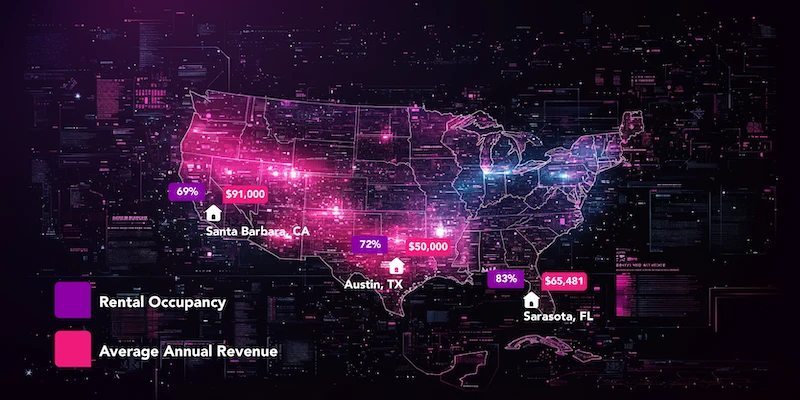
The message here isn’t that climate risk doesn’t matter—it’s that the rental market is more resilient than many expected. Why? Short-term rentals respond faster to market shifts, benefit from ongoing tourism, and don’t depend on long-term property appreciation. In a volatile climate landscape, flexibility is valuable.
Real estate investors are noticing the same trend on the ground. According to Seth Williams, a real estate expert and investor who tracks property performance in climate-vulnerable markets through his website REtipster.com:
“I’m seeing more investors target short-term rentals in high-risk areas like Florida, Texas, and California — even with rising insurance costs and climate risks. It seems counterintuitive, but short-term rental investors are focused on strong monthly income rather than long-term appreciation. If a property generates $5,000 to $10,000 monthly, higher insurance premiums become another line item in the budget.”
Seth explained that this trend is the strong cash flow potential in tourist-heavy markets, limited inventory in some areas that gives short-term rentals a competitive edge, and a short-term mindset: “Investors aim to get in, generate cash flow, and exit before risks fully materialize. There’s also a sense of FOMO, with many chasing the big returns they see others posting. While the risks are real, many believe the income justifies the gamble — as long as they enter with a clear exit strategy.”
Remote work changed the rules—and boosted rentals
Remote work changed the rules—and boosted rentals
One of the most significant shifts bolstering the rental market has nothing to do with climate—it’s how Americans work.
Since 2020, remote work has redefined mobility. People are no longer tied to one city or office, and that’s helped fuel a surge in demand for short-term rentals as the share of remote workers grew from 20% to 28% between 2020 and 2023. The U.S. is leading that boom: North America generated $5 billion in short-term rental properties revenue in 2024, representing 63% of its global earnings.
With 63% of global short-term rental revenue coming from the U.S., it’s clear that America is leading the shift toward flexible housing models. This dominance highlights the growing role of rentals as a financial buffer in climate-vulnerable regions.
This isn’t just a tech trend—it’s become a structural shift in housing demand. Florida, Texas, and California, despite their risks, remain desirable for digital nomads, remote professionals, and families looking for seasonal flexibility. That’s why they now account for over 30% of all short-term rental property listings in the U.S., with Los Angeles alone hosting more than 46,000 active listings.
These numbers tell us something simple but powerful: even as permanent residents leave or hesitate to buy, renters are still coming—and spending.
Behind the Numbers: A Job Market Trying to Adapt
This shift in housing dynamics is affecting more than just owners and investors—it’s reshaping the real estate job market.
As of 2024, the sector supports around 790,000 jobs across the country. Traditionally, these roles have revolved around buying, selling, and managing long-term property. However, with that model under stress, workers are looking to adapt.
The growth of the rental economy is opening up new roles: property managers, marketing specialists for short-term rentals, maintenance services tailored to higher turnover rates, and remote customer service agents for platforms in the rental properties market.
This transformation is especially important in climate-impacted states where full-time homeownership is increasingly risky. It offers real estate professionals a way to stay in the industry without being tied to a declining model. It’s not just about properties—it’s about people’s livelihoods.
The Questions No One’s Answering Yet
Despite the positive signals, the future of rental real estate in climate-risk areas is still uncertain—and complex.
What happens when local governments tighten short-term rental regulations in response to housing shortages? What will insurance coverage for high-turnover properties look like in disaster-prone areas? How long will infrastructure—roads, water systems, electricity—hold up in regions under constant environmental strain?
None of these questions have clear answers yet. But they matter because they’ll define whether this rental boom is a bridge to something sustainable—or just a temporary workaround in a crumbling system.
Renting as resilience
There’s no denying it: climate change is shaking the foundation of real estate in America’s most desirable—and most vulnerable—states. But in that shake-up, something else is emerging: a new model that prizes adaptability, mobility, and short-term value over long-term permanence.
Rental properties, particularly in Florida, Texas, and California, are showing us what that model might look like. They’re not invincible but proving surprisingly agile, even as the old norms collapse.
In a way, the rental market isn’t just reacting to climate risk—it’s evolving because of it. That evolution may be key to keeping people and their incomes afloat in the years ahead.
In today’s climate-driven economy, owning might be a gamble, but renting is starting to look like the safe bet.
Sources and Methodology
This report is based on publicly available data and market research to evaluate how rental properties are performing in climate-risk areas, particularly in Florida, Texas, and California.
The primary source on climate-related real estate devaluation is the 12th National Risk Assessment by First Street Foundation (read the full report here). This study provided the estimate of $1.47 trillion in projected property value loss by 2055 due to climate impacts and insurance market pressures. It also identified the concentration of losses across 70,026 census tracts nationwide and the disproportionate exposure of Sun Belt states.
Supporting cost data on individual climate disasters was drawn from Statista, including economic losses from Hurricane Harvey ($155B), Hurricane Maria ($111B), Hurricane Irma ($62B), and California wildfires ($150B+) (source). Additionally, wildfire risk exposure was taken from a Statista report on states with the highest number of homes at extreme wildfire risk (view chart).
Rental property performance data—including occupancy rates and annual revenue—was sourced from Airbtics, which provides city-level market insights for short-term rentals. All city data cited in this report reflects performance in 2024 and includes top-performing locations such as Sarasota, FL, Austin, TX, Los Angeles, CA, and Santa Barbara, CA.
Remote work–driven demand growth was obtained from a 2024 report by Research Nester, which reported an increase in remote work from 20% in 2020 to 28% in 2023 (source). The report links this trend to greater demand for flexible housing and predicts sustained market expansion through 2037.
Employment figures were taken from the U.S. Bureau of Labor Statistics, using 2024 data on real estate and property industry jobs (source). The report highlights the potential transition of approximately 790,000 U.S. real estate workers toward roles in short-term rental operations, digital property management, and guest services.
All estimates, percentages, and figures in this report reflect the most recent available data as of Q1 2025, and are presented to inform—not predict—trends in property value resilience and investor behavior.